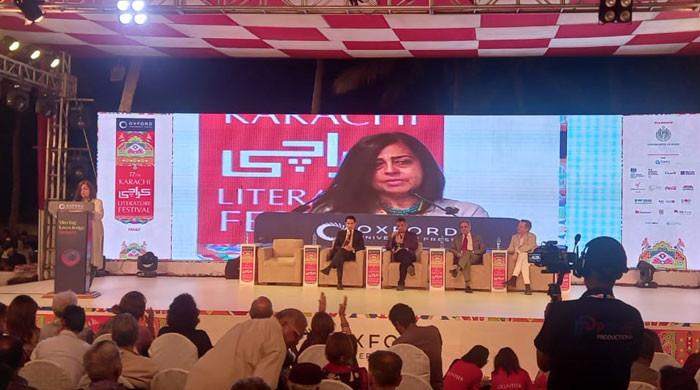
The 17th Karachi Literature Festival (KLF) concluded in style on its third and final day, celebrating literature, culture, education and public discourse.
From morning debates to an evening qawwali, the festival reaffirmed the KLF’s role as Pakistan’s most inclusive and dynamic intellectual platform.
The day opened with an inter-school debate on the theme “Literature today: elitist or essential? ”, setting the tone for discussions about access, relevance and the future of ideas.
Participating schools were KGS, Lyceum and Cedar College. KGS was the winner. The dramatic readings of Yousuf Bashir Qureshi, Ali Mazhar and Usman Qureshi created a literary buzz.
Literature sessions celebrated classic and emerging writers. Sessions on Jane Austen, global and local issues including women’s and children’s health amid climate change, changing power dynamics in South Asia, policing and civic responsibility in Karachi, and the future of higher education.
“Academic freedom is essential for universities. Universities in Pakistan do not enrich young minds to make them free but rather control the mind,” said Pervez Hoodbhoy.
Throughout the three-day event, literature remained at the heart of the festival, with book launches and author talks generating keen interest.
Highlights included Mohammed Hanif’s Rebel English Academy, Kishwar Naheed’s Umar Mujhay Likhti Hai, Pakistan Cricket Chronicles 1948-2024, as well as new translations and poetry collections showcasing Pakistan’s linguistic and cultural diversity.
Sessions such as “Future Shock: Dystopia in a Dystopian World” and “Karachi Between the Lines” explored global and local literary traditions through new perspectives.
The Youth Pavilion was full of activities, hosting storytelling, writing and calligraphy workshops, drama, dance, music and dialogue aimed at nurturing creativity and serious thinking.
School performances, interactive theater sessions and discussions on skills for the future highlighted KLF’s commitment to engaging the next generation of readers, writers and thinkers.
Cultural and public interest sessions added further depth, covering Pakistani television series, media in a changing world, artificial intelligence and the role of museums and conservation.
Film screenings, dramatic readings and musical performances enriched the festival atmosphere, while “The Great KLF Debate: Will AI Take Over?” » elicited enthusiastic participation from the public.
Salma Alam, CEO of Durbeen, said, “We are planning to upskill teachers. A good teacher is a good educator. We are working on a public-private partnership to set up a graduate program to train teacher trainers.”
The session on “Hope, Faith and the Miracle of Survival” attracted crowds. Zafar Masud said, “My life experience can make people understand how it feels to be so close to death and somehow escape it. Everyone has to face death, but my book can help you set priorities in life.”
Amin Gulgee spoke about his Gulgee Museum manual during the session with Nicolas Engel. Film screenings included Screen Locked and 2025-26 Banff World Tour. A Pakistani television series was discussed in the session ‘Adakari, Hidayatkari ya Kahani?’
The festival ended with a memorable closing ceremony in the main garden. Acclaimed writer Mohammed Hanif delivered a speech on the enduring power of literature to question, resist and imagine. Daniel Arsenault, Advisor to the Canadian High Commission, Sibtain Naqvi, Head of Institutional Branding and Storytelling, Getz Pharma, and Arshad Saeed Husain, Managing Director, Oxford University Press Pakistan, delivered their acceptance speech, followed by a stirring qawwali performance by Hamza Akram Qawwal & Brothers, bringing the 17th Karachi Literature Festival to a resounding close and edifying.