
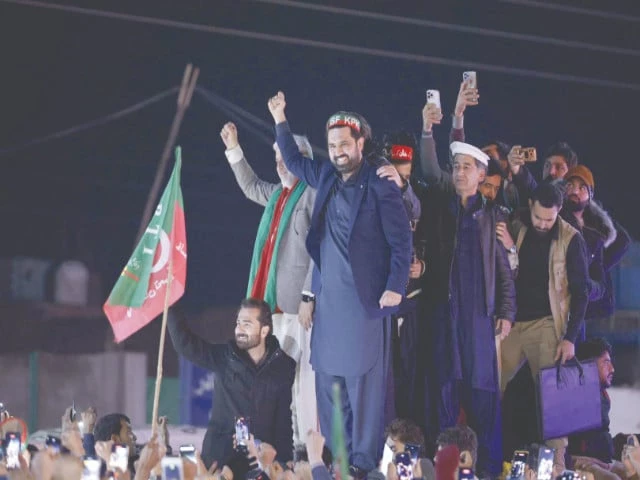
PTI rally. Photo: Express
ISLAMABAD:
The Pakistan Tehreek-e-Insaf (PTI) envisioned February 8 as a watershed moment to translate street power into political momentum, but despite intensive promotion as a major show of strength and public resistance, the uneven response on the ground has raised new questions about the party’s mobilization capacity and policy direction.
Although groups of supporters have come forward, the overall impact has not lived up to expectations. Even more striking, a large part of the party’s senior leaders remained absent from the scene. The protest, it appears, went ahead without delivering the promised political blow, according to political analysts watching the developments.
However, the Tehreek Tahaffuz-e-Aain Pakistan (TTAP), in which the PTI plays a key role, welcomed the success of the strike. PTI general secretary Sheikh Waqas Akram thanked people for their “massive participation in the shutdown strike”.
Khyber-Pakhtunkhwa Chief Minister Sohail Afridi echoed this assessment in an article on X, congratulating all political parties in TTAP for “a successful strike” and calling for continued peaceful resistance.
However, the government deemed the protest ineffective. The information minister said the public had rejected the confrontational politics, while Punjab Chief Minister Maryam Nawaz told X that the protest had “no impact”.
However, for many observers, the real test of February 8 was not the turnout figures or the television images. The question was whether the protest would create enough pressure to force the government and powers that be to soften their hardline stance against the PTI and its incarcerated leader, Imran Khan.
After all, one of the stated goals of the protest was to secure his release.
“An emboldened government”
Many analysts believe the protest produced no tangible results. Rather, they argue that the absence of senior PTI leaders and the relatively dull spectacle may have further emboldened the government.
Journalist and political analyst Ehtisham Ul Haq said the protest had been largely unsuccessful. Speaking to The Express PK Press Club, he said the call for closure “did not have much success”.
“Yes, it was said that everything would come to a halt, wheel locks, shutdowns and the government forced to its knees. This did not happen, so I would not call this call a success. The PTI did not gain anything concrete politically,” he added.
Observers were also surprised by the way the PTI and the broader opposition handled the protest, even in their traditional stronghold, Khyber Pakhtunkhwa. Reports indicate that Peshawar remained largely open on Sunday despite the strike call.
Although a PTI rally took place, the absence of KP Chief Minister Sohail Afridi raised eyebrows.
The party justified his absence by arguing that as a sitting chief minister, he was not supposed to attend such rallies. However, critics pointed out that his predecessor, Ali Amin Gandapur, had already led thousands of PTI supporters to Islamabad while he was chief minister.
Political analyst Hassan Askari weighed in, calling the February 8 date “a very discreet affair, much smaller than what was anticipated or planned.”
“Lahore was busy with Basant celebrations, and the rest of Pakistan did not fully respond. I do not expect nationwide protests, given the number of factors that limit such mobilization,” he added.
Responding to the question whether the PTI had gained anything politically from the protests, Ehtisham Ul Haq said the exercise mainly served as a signal to the government that protests could continue if dialogue failed.
“The most important point is that in Pakistan and around the world, change does not happen without institutional support. History shows that when the establishment is aligned, change is possible; without it, it is not. Pressure tactics alone do not work. Internationally, this government is recognized and the economy has shown some stabilization. The narrative that strikes would paralyze the system and force concessions has not materialized.”
“Overall, the PTI is heading towards a dead end unless a constructive dialogue emerges. Talks with the Prime Minister could pave the way. The Prime Minister has said he wants to resolve the issues through Parliament, and if that happens, there could be some relief for the PTI. Otherwise, continued agitation alone is unlikely to lead to success,” he said.
On the broader political outlook, Askari noted that Pakistan’s trajectory remains difficult to predict due to multiple moving variables.
“The government claims to want dialogue, but its actions suggest otherwise, focusing instead on maintaining control of the PTI,” he said.
He added that the PTI itself is grappling with serious organizational and leadership problems, with leaders and close aides either imprisoned or in hiding.
“This has created a crisis that prevents the party from making clear strategic decisions. As a result, it remains uncertain whether meaningful dialogue will take place and whether the government is truly serious in its commitment.”
Haq and Askari warned that the PTI needs to recalibrate its messages. Persistent hostility and abuse on social media are counterproductive, they say.
They observed that politics is about opening doors, not repeatedly banging your head against the wall. A change in approach could still create space for limited relief.


