
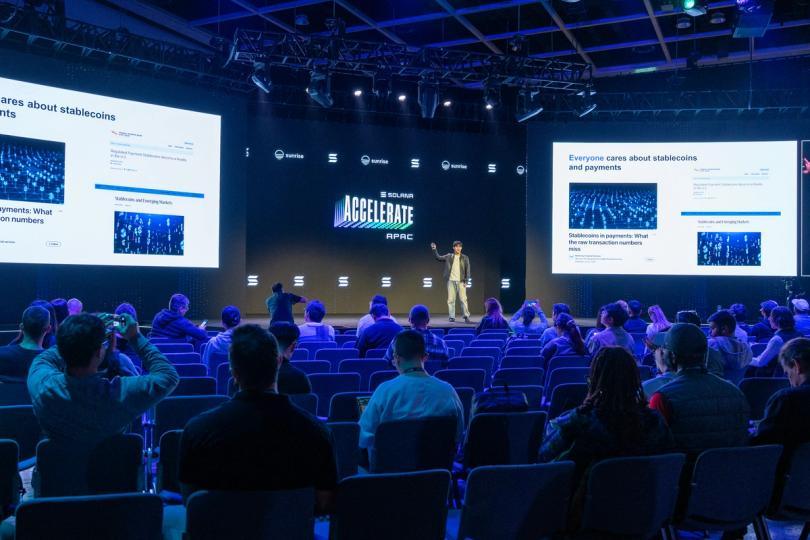
Solana aims to position itself as the execution layer of “internet capital markets” in Asia, or a place where users can issue, trade, borrow, lend and settle assets online, 24/7, without the need for a traditional exchange, bank or clearing house.
At least, that was the stance of attendees and panelists at Solana’s Accelerate APAC event in Hong Kong on Wednesday. Speakers struck a distinctly institutional tone, with panels and keynotes focused less on hype cycles and more on payments, tokenization and the plumbing needed to integrate traditional finance at the conference, held alongside CoinDesk’s Hong Kong Consensus.
The day’s agenda reflected this change. Discussions ranged from SOL staking exchange-traded funds (ETFs) and digital asset trusts to stablecoins, tokenized securities, and regulated exchange-traded products.
Asset managers including Mirae Asset and ChinaAMC shared the stage with infrastructure players such as CME Group, Fireblocks and Cumberland, showing how the ecosystem is courting traditional financial firms.
Payments have also been very present. Several sessions focused on payment rails, compliant stablecoin infrastructure, and cross-border use cases, with a clear focus on real-world adoption rather than speculative trading.
Infrastructure and AI was another pillar. Discussions from Alibaba Cloud and several crypto-native builders highlighted the growing overlap between blockchain settlement layers and AI-powered applications, reinforcing Solana’s long-standing pitch for speed and scalability.
The general mood in Hong Kong was simple and almost stubbornly consistent. Build.
Not the “buidl” that appears in bull markets to check the mood, but the kind that appears when prices are down 70% year-over-year, attention is limited, and no one pretends the last few months have been fun. But that was not the setting in which the event took place.
The panels kept coming back to the same practical questions: how do stablecoins work at scale, how to onboard institutions without violating compliance, and what metrics actually matter when you’re selling on-chain rails to asset managers and banks. How to make wallets look less like science projects and how to build tokenization infrastructure that survives a regulator’s first serious audit also took center stage.
If anything, the economic downturn has seemed to sharpen the message, with less discussion about narratives and more about settlement, custody, payments, identity, and the boring operational details that decide whether “real adoption” is real or just a meme.
One of the key takeaways is not that Solana is immune to market cycles, but that the people who model themselves on it try to act as if the cycle doesn’t decide what matters.


