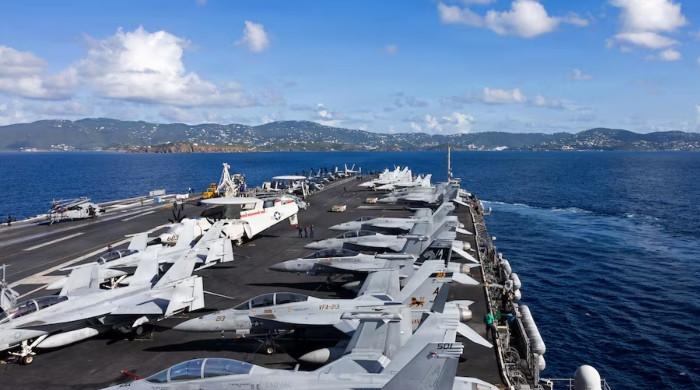
- USS Gerald R Ford, escort ships to be sent to the Middle East.
- The development comes after last week’s US-Iran talks in Oman.
- The United States has already sent the aircraft carrier Abraham Lincoln to the Middle East.
The United States was preparing to deploy a second aircraft carrier to the Middle East on Friday after President Donald Trump warned of “traumatic” consequences if Tehran fails to reach an agreement on its nuclear program.
Tensions have escalated between Tehran and its traditional enemy Washington following protests last month that rights groups say left thousands dead.
Trump has conditioned abstaining from any military action on an agreement to curb Iran’s nuclear program, which the West fears could aim to build a bomb.
“We have to make a deal, otherwise it’s going to be very traumatic, very traumatic. I don’t want that to happen, but we have to make a deal,” Trump told reporters Thursday.
Trump had already sent an aircraft carrier, the USS Abraham Lincoln, to the Middle East to warn Tehran, and several US media outlets said a second aircraft carrier, the USS Gerald R Ford, and its escort ships would also be sent to the region.
The Ford-led ships, currently deployed in the Caribbean, are not expected to return to their home ports until late April or early May, the statement said. New York Times said.
Representatives of Iran and the United States, who have not maintained diplomatic relations since shortly after the revolution, held talks on the nuclear program last week in Oman.
Although no date has been set for new negotiations, there are signs that Trump is optimistic about the prospects of a deal.
Israeli Benjamin Netanyahu said after meeting with Trump in Washington that the US leader believed he could strike a “good deal”, although the Israeli prime minister himself expressed skepticism that any deal would be good if it did not also cover Iranian ballistic missiles.
The United States joined Israel’s 12-day war against Iran in June, carrying out strikes against Iranian nuclear facilities.
But there is no consensus on Washington’s targets for new strikes or whether it would seek to loosen Supreme Leader Ayatollah Ali Khamenei’s grip on power.