
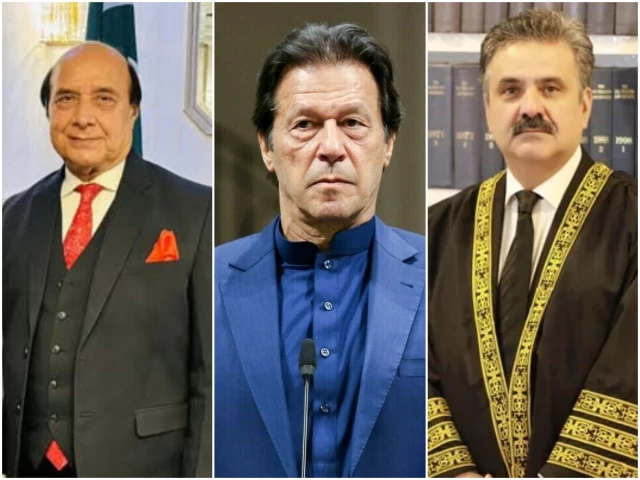
Urges SC to ensure Khan’s family members are duly informed and given reasonable access regarding his health condition
Lawyer Latif Khosa (left), PTI founder Imran Khan, CJP Yahya Afridi. Photo: Files
Lawyer and Pakistan Tehreek-e-Insaf (PTI) leader Latif Khosa on Monday expressed serious concerns over the health of party founder Imran Khan and the secrecy surrounding his medical examination in a letter addressed to Chief Justice of Pakistan (CJP) Yahya Afridi.
He urged the CJP to grant immediate access to Imran’s personal doctors and direct authorities to shift him to Islamabad’s Shifa Hospital.
“The petitioner has repeatedly requested access to his personal doctors for independent examination and treatment of his deteriorating eye condition. In view of the findings recorded in the report submitted before this honorable court, the conduct of medical examination in secret, without prior notice to the family or independent doctors, has given rise to serious apprehensions,” Khosa said in a letter available at The Express PK Press Club.
Imran has been imprisoned since August 2023 and is currently serving a sentence in Adiala Prison in a £190 million corruption case. Additionally, he faces ongoing trials under the anti-terrorism law related to the May 9, 2023 protests. The party has in recent days expressed concern over Imran’s health and demanded treatment by its own team of doctors.
The medical board that examined him the day before reported an improvement in his eyesight and did not recommend transferring him to hospital. According to the whistled medical report, obtained by The Express PK Press Clubhis vision in his right eye has improved from 6/36 to 6/9, while his left eye maintains 6/6 vision through the use of glasses. The assessment was conducted by Dr Nadeem Qureshi and Dr Arif, following a detailed examination at Adiala Prison.
Learn more: Medical board reports improvement in Imran Khan’s eye condition
In the letter to the CJP, Khosa further said that the continued exclusion of Imran’s family and personal doctors from information regarding his health had created unavoidable doubts.
“Such secrecy not only undermines trust in the medical process, but also causes unrest and distress among family members, friends and supporters,” he added.
Khosa also wrote that Imran, who was taken into custody in May 2023, faced prolonged incarceration, during which his fundamental and statutory rights had been consistently violated. While previously his family members and relatives were allowed to meet him in accordance with prison rules, it has now been more than four to five months since any meetings have been allowed. His family had effectively been denied access to him, the letter said.
He went on to state that over the past few months, reports have emerged across Pakistan raising serious concerns about Imran’s deteriorating eyesight and general health. This information, compounded by the continued denial of access to his family members, had created deep uncertainty.
Khosa further noted that the report submitted by friend-of-the-court lawyer Salman Safdar confirmed that Imran’s right eye now had only 15 per cent vision. He also pointed out that a lack of timely medical care contributed to the permanent damage.
“In the backdrop of these alarming findings, it has come to light that a medical examination of the petitioner was conducted inside the Rawalpindi Central Prison on February 15, 2026. It is shocking to note that the examination was conducted in the complete absence of his family,” Khosa wrote.
He added that claims that Imran’s family and party members had been informed but voluntarily chose not to attend were “totally incorrect and unrealistic”.
“At no time were the petitioner’s family members, personal doctors or lawyer informed. In fact, when the petitioner’s sisters approached the authorities, they were denied access,” he said. “Instead, a select group of doctors was assembled to conduct the examination. The petitioner’s personal doctors, his family members and his legal team were denied access, contrary to the recommendations noted by lawyer Salman Safdar.”
Khosa stressed that the concerns raised before the court had always been reasonable: the applicant should receive transparent medical care; his personal doctors should be allowed to examine him; and his family should be informed and allowed to know his state of health.
Read also: PTI revives KP House protest after reviewing Imran’s health report
In conclusion, Khosa prayed the Supreme Court (SC) to direct the authorities concerned to provide a certified copy of the medical report of the examination conducted on February 15, to allow immediate access to Imran’s personal doctors, including Dr Faisal Sultan and Dr Asim Yousaf, for independent medical examination and treatment, and to direct the authorities to transfer Imran to Shifa Hospital, Islamabad for immediate treatment.
He further prayed that the SC ensures that Imran’s family members are duly informed and given reasonable access regarding his health condition and any future medical procedures.
According to Imran’s medical report, the anterior segment of both eyes was normal and the cornea was clear. He noted a slight intragel hemorrhage at the edge of the right eye and a moderate retinal hemorrhage in all four quadrants.
Swelling of the macula in the right eye subsided, with macular thickness reduced from 550 to 350 microns. The board outlined the ongoing medications and treatment and recommended OCT angiography and fundus fluorescein angiography after completion of anti-VEGF treatment, the report added, while no recommendation was made for Imran’s transfer to a hospital.
Meanwhile, Law Minister Azam Nazeer Tarar said Imran had normal vision of 6/6 in one eye, while the other eye achieved around 70% vision with glasses. Speaking at an event of lawyers in Ferozewala, he said the specialized medical team expressed satisfaction over the treatment provided and also informed opposition leaders and Imran’s personal doctors.
On the other hand, opposition protests continue until emergency medical treatment is provided for Imran’s eye condition. The demonstration by opposition MPs began on Friday and continued despite government assurances. Monday marked the fourth day of sit-in by leaders in front of Parliament and KP House.
Lawmakers vowed that the sit-in would not end until Imran was transferred to specialized care. Protesters cited reports claiming that his vision in his right eye had deteriorated significantly and demanded treatment in the presence of his family and personal doctors.


