
DNA experts say extreme heat hampered identification; chemical materials intensified the fire
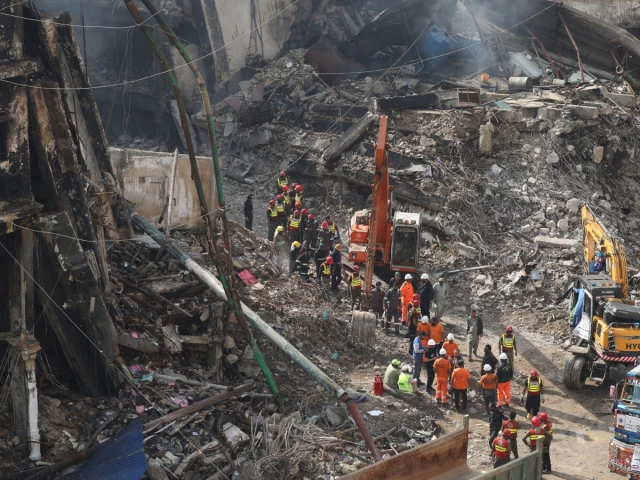
Members of rescue and emergency teams gather near heavy machinery before beginning their search for survivors, following a massive fire that broke out at the Gul Plaza shopping mall in Karachi on January 22. Photo: Reuters
KARACHI:
Scientists who carried out DNA examinations of victims of the Gul Plaza inferno revealed that the intensity of the fire reached up to 1,200 degrees Celsius, causing such burns that in several cases only bones – and in some cases powdered remains – were found.
The surprising revelations were made during an exclusive interview with The Express PK Press Club by Prof. Raza Shah, Director, International Center for Chemical and Biological Sciences (ICCBS), University of Karachi, and Prof. Ishtiaq Ahmed, Head of Sindh Forensic and Serological Laboratory.
Professor Ahmed, who led the process of DNA identification of the victims, said the forensic laboratory had received 48 post-mortem samples for DNA analysis. Of these, 24 victims were fully identified while eight were partially identified. He added that 56 reference samples were obtained from relatives for matching purposes.
He revealed that in some cases, remains were received as bone fragments or even ashes and powder, making DNA extraction extremely difficult. “Due to the very high level of combustion, DNA analysis of some samples was not possible,” he explained.
Professor Shah, who has conducted extensive research into fire dynamics and written a book on the subject, said examination of the bone structure indicated the temperature of the fire was between 800 and 1,200°C. “In some samples, even the calcium content of the bones had been reduced, indicating extremely high temperatures,” he explained.
He added that Gul Plaza was considered a “mini Karachi” due to the wide variety of products sold there, attracting customers from across the metropolis.
Many items on the market, he explained, were made from plastics and chemically treated materials. When these materials burn, they change into chemical compounds or turn into petroleum-like substances that further intensify and sustain the fire.
Dr Shah said fires involving such materials cannot be controlled effectively with water alone.
“In some cases, water can even make the situation worse. Foam is more suitable for extinguishing chemical-based fires,” he said.
He suggested that if foam had been used instead of water during the Gul Plaza tragedy, the fire could have been brought under control earlier and the scale of human losses could have been reduced.
The scientists further announced that ICCBS plans to make the Gul Plaza tragedy a case study and organize a research workshop and symposium to examine the scientific and security aspects of the disaster.


