
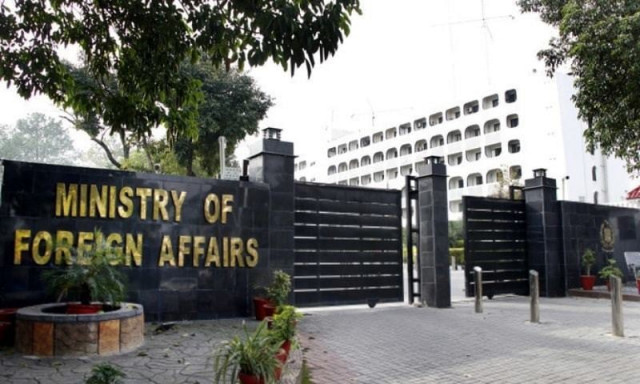
Ministry of Foreign Affairs. Photo: File
ISLAMABAD:
The Foreign Ministry said on Thursday it had summoned Afghanistan’s deputy head of mission and launched a strong approach following the deadly Bajaur terrorist attack on February 16, warning Kabul to take “immediate, concrete and verifiable measures” against terrorist groups operating from its soil.
According to an official statement, the action was conveyed to the representative of the Afghan Taliban regime following a suicide attack using a vehicle bomb and subsequent firing on a post of the Pakistani army and law enforcement agencies in Bajaur. Eleven Pakistani soldiers were martyred during the assault.
Pakistan condemned “in the strongest possible terms” the attack, which it said was carried out by Fitna al Khwarij, also known as Tehreek-e-Taliban Pakistan (TTP), a banned group. The Ministry of Foreign Affairs expressed serious concern that the entire FAK/TTP leadership was based in Afghanistan and continued to operate with impunity from Afghan territory.
Islamabad reiterated that it had repeatedly received assurances from the Afghan Taliban authorities that Afghan soil would not be used for terrorist purposes against Pakistan. However, the statement noted with regret that there has been no “visible or concrete action” to address Pakistan’s concerns.
The Afghan side was categorically informed that Pakistan reserved the right to respond and eliminate any Khwarij belonging to the FAK as well as their affiliates “wherever they may be” in order to safeguard its soldiers, civilians and territorial integrity.
The move came amid heightened tensions along the Pak-Afghan border and followed what officials described as a worrying escalation in cross-border attacks.
During his weekly press briefing on Thursday, Foreign Ministry spokesperson Tahir Andrabi detailed the context of the move, calling the Bajaur attack a “cowardly” act.
Andrabi stressed that while Pakistan remained committed to dialogue and diplomacy in the broader context of its historical, cultural and ethnic ties with Afghanistan, patience had its limits when it came to attacks on Pakistani civilians and security personnel.
He said Pakistan’s right to self-defense under Article 51 of the United Nations Charter remained intact and any action taken against terrorist elements would be aimed at protecting innocent lives.
The spokesperson also highlighted Prime Minister Shehbaz Sharif’s visit to Washington at the invitation of US President Donald J. Trump to attend the inaugural session of the Peace Council (BoP) on February 19.
Summarizing multiple issues on the agenda of the BoP meeting, Andrabi said a decision was still awaited on the contours of the mandate of the proposed International Stabilization Force (ISF).
“We understand that a decision is awaited on the contours of the mandate of the International Stabilization Force and, until then, we are not in a position to make a decision on this issue,” he said.
He reiterated that Pakistan had clearly identified its “red lines”.
“Pakistan can be part of any peacekeeping mandate, but we will not be part of any disarmament/demilitarization mandate,” he said, adding that discussions on the issue could take place at the BoP meeting in Washington.
On concerns over some countries’ participation in the Council, Andrabi said Pakistan had joined the forum with a particular objective. “We joined the Peace Council with a particular objective, namely the reconstruction of Gaza and the long-term settlement of Palestinian issues. We will therefore continue to follow this approach and will not be hampered by the participation of one country or another.”
He described the BoP as offering a “ray of hope” and expressed hope that it would help alleviate the plight of the Palestinian people, particularly in Gaza, and contribute to peace, prosperity and a path to a lasting resolution of the Palestinian issue.
Referring to recent developments in the occupied West Bank, the spokesperson said the topic could also be discussed at the BoP meeting, particularly in light of concerns expressed by eight Arab and Islamic countries regarding Israel’s actions.
While diplomatic engagements continued abroad, Islamabad’s message to Kabul remained firm: Afghan soil must not be used for terrorist purposes against Pakistan, and assurances must be translated into tangible actions.


