
Reversal of power for the American president’s economic program; Trump imposes 10% additional customs duties on his partners
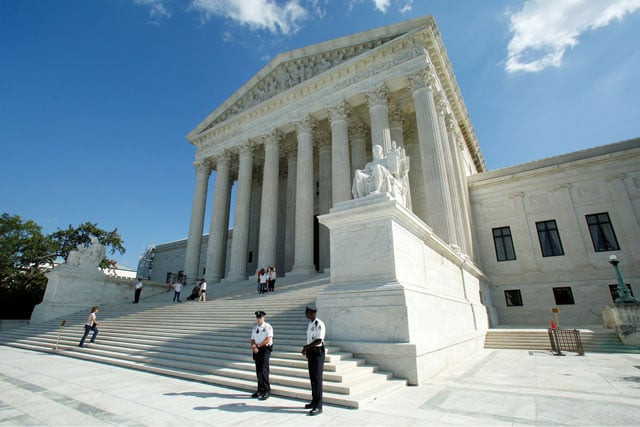
The United States Supreme Court is located in Washington, United States. REUTERS/FILE
WASHINGTON:
The U.S. Supreme Court on Friday declared sweeping global tariffs imposed by Donald Trump illegal – a resounding rebuke of the president’s signature economic policy that has upended international trade.
Reacting to the decision, the US president said the Supreme Court’s decision declaring his sweeping global tariffs illegal was “deeply disappointing”.
Trump also told reporters that he was “absolutely ashamed” of “certain members” of the conservative-dominated court who ruled against him.
He announced that he was imposing an additional 10 percent global tariff on the United States’ trading partners. Speaking to reporters after the Supreme Court ruled his global tariffs illegal, Trump said he would impose tariffs by appealing to other authorities.
“Today’s decision by the Supreme Court made the president’s ability to regulate trade and impose tariffs more powerful and clearer, rather than diminishing it,” he said.
The conservative-majority high court ruled 6-3, saying a 1977 law known as the International Emergency Economic Powers Act (IEEPA) that Trump relied on “does not authorize the president to impose tariffs.”
The decision does not impact sector-specific duties that Trump separately imposed on imports of steel, aluminum and various other products. Several government investigations that could lead to more sector-specific tariffs are still underway.
Still, it was Trump’s biggest defeat at the Supreme Court since he returned to the White House last year.
While Trump has long relied on tariffs as a lever for diplomatic pressure and negotiations, he made unprecedented use of emergency economic powers during his second term to impose new tariffs on virtually all of the United States’ trading partners.
These included “reciprocal” tariffs on trade practices that Washington deemed unfair, as well as separate sets of duties targeting key partners Mexico, Canada and China on illicit drug flows and immigration.
The court noted Friday that “if Congress had intended to confer the distinct and extraordinary power to impose tariffs” with IEEPA, “it would have done so expressly, as it has consistently done in other tariff laws.”
The Supreme Court’s three liberal justices joined three conservative justices in Friday’s ruling, which upheld lower court rulings that Trump’s tariffs under IEEPA were illegal.
Conservative Justices Brett Kavanaugh, Clarence Thomas and Samuel Alito dissented.
Chief Justice John Roberts, in issuing his opinion, said that “the IEEPA contains no reference to tariffs or tariffs.”
A lower trade court ruled in May that Trump exceeded his authority by imposing widespread levies and blocked most of them, but that ruling was put on hold as the government appealed.
With the White House already bracing for a negative outcome, KPMG chief economist Diane Swonk warned that “tariffs deemed illegal can be quickly reinstated via other levers.”
“The financial markets have recovered following this news, but it is premature,” she added.
Still, business groups welcomed the move, with the National Retail Federation saying it “provides much-needed certainty” to U.S. businesses and manufacturers.
“We urge the lower court to ensure a transparent process for refunding tariffs to U.S. importers,” the federation said.
But the justices did not address the extent to which importers can receive refunds. This will likely be the subject of litigation.
Kavanaugh warned that this process — as he acknowledged during oral arguments — could be a “mess.”
Gregory Daco, chief economist at EY-Parthenon, told AFP that the loss of IEEPA customs revenue to the US government could amount to around $140 billion.
Delighted Democratic leaders pounced on the move, with Senate Minority Leader Chuck Schumer praising the outcome as a “win for the wallet” for American consumers.
But the top Democrat on the Senate Banking Committee, Elizabeth Warren, warned that there remained “no legal mechanism for consumers and many small businesses to get back the money they have already paid.”
The Yale University Budget Lab estimates that consumers face an average effective tariff rate of 9.1 percent with Friday’s decision, up from 16.9 percent.
But this figure “remains the highest since 1946”, excluding 2025.
The European Union said it was studying the court’s decision and would remain in close contact with the Trump administration.
Britain plans to work with the United States on how it will affect a trade deal between the two countries, while Canada said the decision affirmed Trump’s tariffs were “unjustified.”
Removing the emergency tariffs “would limit the president’s ambitions to impose across-the-board tariffs on a whim,” said Erica York of the Tax Foundation, a tax policy nonprofit.
But that leaves him with other laws to use for tariffs, even if they tend to be more limited in scope – or require specific processes such as investigations – York told AFP.
“The ruling dismantles the legal scaffolding, not the building itself,” ING analysts Carsten Brzeski and Julian Geib said of Trump’s trade restrictions.


