
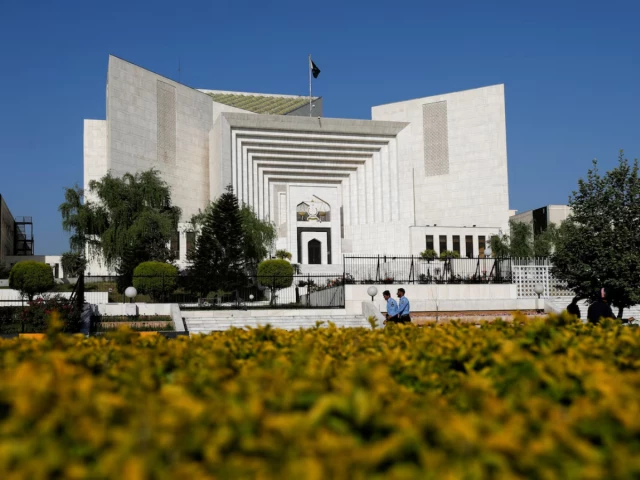
Police officers walk past the Supreme Court of Pakistan building, in Islamabad, Pakistan April 6, 2022. REUTERS
ISLAMABAD:
The Supreme Court has declared the blocking of a citizen’s Computerized National Identity Card (CNIC) to execute a financial decree illegal, ruling that such action exceeds the powers granted to the executing courts under the Code of Civil Procedure (CPC).
The decision was announced by a two-member bench comprising Justice Munib Akhtar and Justice Irfan Saadat Khan in a civil application for leave to appeal. Justice Akhtar authored the detailed order.
The case arises out of execution proceedings initiated after the passing of a money decree in a summary trial in favor of respondent Idrees Ahmed against petitioner Agha Abid Majeed Khan.
During the execution process, the trial court ordered the blocking of the petitioner’s CNIC until he vouched for the decree amount. The Sindh High Court (SHC) later upheld this order, observing that blocking the CNIC was a step towards implementing lawful court orders and noting that the order had remained unexecuted since March 2016.
Challenging the SHC’s decision, the petitioner contended that there is no provision of law authorizing an executing court to block a CNIC in execution of a decree. The petitioner’s lawyer, Ahmer Bilal Soofi, argued that such an order was beyond the jurisdiction of the executing court.
During the hearing, Sindh Additional Advocate General and Additional Attorney General supported the petitioner’s stand, saying that the SHC order was not legally viable. The court appreciated the assistance provided by the magistrates.
In its decision, the SC considered Article 51 of the CPC, which describes the permissible modes of execution of a decree. It observed that although clauses (a) to (d) specify particular methods of enforcement, clause (e) permits enforcement “in any other manner as the nature of the relief granted may require”.
However, the judiciary ruled that this general provision cannot be interpreted so broadly as to authorize measures which lose all link with the legislative framework. Justice Akhtar pointed out that the decree in question was a mere monetary decree and did not justify blocking the judgment debtor’s CNIC.
The Court cautioned that while a robust approach is necessary to ensure the execution of decrees, it must not become excessive to the point of depriving a citizen of essential aspects of daily life.
The judgment highlights that the CNIC is not just a statutory formality or a luxury but has become essential for the conduct of day-to-day business in modern society.
According to the SC, depriving a person of access to his or her CNIC amounts to curtailment of a basic necessity of life and cannot be considered an appropriate exercise of judicial discretion under general enforcement powers.
The bench also took note of an amendment made in 2018 by the Peshawar High Court (PHC) to the Khyber-Pakhtunkhwa (KP) CPC, introducing Rule 117 in Order XXI, which expressly authorizes blocking of a CNIC as a mode of compelling attendance or termination of execution proceedings.
However, the SC clarified that this provision applies only within KP and has no application in Sindh. The court further observed that the very inclusion of an express provision in the KP indicates that in the absence of such specific authorization, no such power can be implied under the general enforcement clauses.
Reserving its opinion on the constitutional or legal validity of the KP amendment for an appropriate case, the SC concluded that the SHC erred in upholding the order of the executing court. The court converted the application for leave into an appeal and allowed it, thereby setting aside the contested order.


