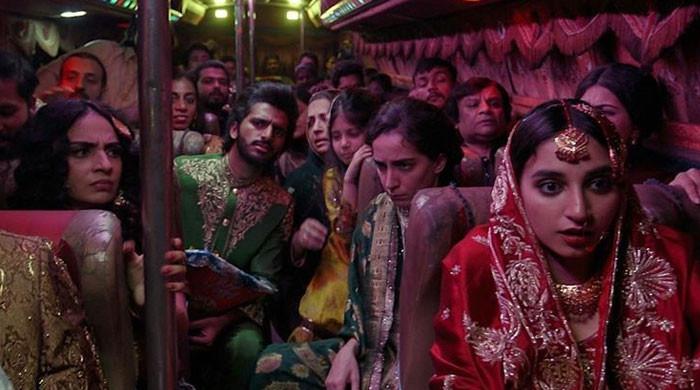
BERLIN: The Berlin Film Festival, which ends on Saturday, made cinema history earlier this week by screening its first feature film produced entirely in Pakistan.
Director Sarmad Sultan Khoosat’s “Lali” had its world premiere on Thursday to a packed house where it was warmly received by members of Berlin’s Pakistani community, including the country’s ambassador to Germany.
The Punjabi-language dark comedy tells the story of Sajawal (Channan Hanif) and his new wife Zeba (Mamya Shajaffar).
Residents of their working-class neighborhood in the town of Sahiwal whisper that Zeba lives under a curse after her previous suitors died in mysterious circumstances.
Khoosat said AFP that making Pakistan’s debut at the festival came with “a good sense of accomplishment, but also a sense of responsibility.”
He said it was a “sign of validation” to be recognized with a story “deeply rooted in one’s own language.”
Part of that idiom is the boisterous humor for which the Punjab region is famous, represented in part by Sajawal’s mother, the imposing matriarch Sohni Ammi.
The film opens with her encouraging the neighborhood men to shoot guns to celebrate Sajawal’s wedding – only for her to be shot in the leg.
“New generation” of filmmakers
Biting humor alternates with more serious themes like desire, sexuality and unhealed trauma and occasional suggestions of magic and the supernatural.
Although Khoosat emphasized that nothing that happens on screen is physically impossible.
This film tells the story of a man who falls in love with the trans director of a dance troupe and also received critical praise from the Jury Prize and the “Queer Palm” at Cannes.
Khoosat was a producer of this film and Sadiq in turn worked as an editor on ‘Lali’.
Does Khoosat hope that such films can raise the profile of Pakistani cinema?
He said the industry in Pakistan was struggling, suffering a “kind of semi-gradual demise” over the past 20 years.
“Before that, we had a big theater…that produced, you know, over 100 films a year.”
But Khoosat said Pakistani cinema was struggling to differentiate itself from other media and was not “speaking to a new audience”.
Could films like “Lali” bring new recognition to Pakistani cinema?
“This opportunity for visibility on such platforms – I just wish that, you know, it would translate into a more thriving domestic film industry,” Khoosat said.
“There’s definitely a whole new generation of filmmakers, and we need to help them produce more work.”