
Pakistan says offensive is led by “robust intelligence”; More than 80 terrorists eliminated thanks to precision strikes
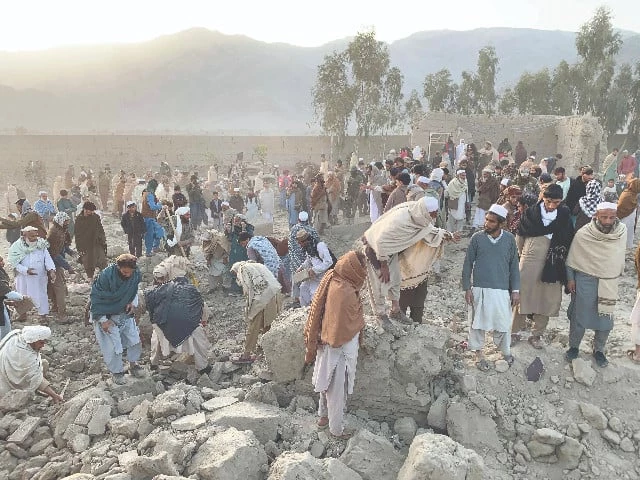
Afghan men gather at the site of an overnight airstrike in Girdi Kas village, Bihsud district, Nangarhar province. Photo: AFP
ISLAMABAD:
Pakistan carried out intelligence-based strikes on terror camps in Afghanistan on Saturday night, in response to a series of deadly suicide attacks, including an attack on an Imambargah in Islamabad and multiple blasts in Bajaur and Bannu during the holy month of Ramazan.
This development marks a sharp escalation in tensions between Islamabad and Kabul, with the Afghan authorities having summoned the Pakistani ambassador and condemned what they described as a violation of their territorial integrity.
Unlike in the past, this time Pakistan was quick to confirm airstrikes in Afghanistan after reports of multiple explosions in several districts of the neighboring country emerged.
According to an official press release issued late in the evening, Pakistan said it has “conclusive evidence” that the recent attacks were orchestrated by terrorists at the behest of their leaders and handlers based in Afghanistan.
The statement said suicide attacks targeted an Imambargah in Islamabad, followed by one attack each in Bajaur and Bannu districts of Khyber-Pakhtunkhwa (KP), and another incident in Bannu on Saturday.
The attacks were claimed by the Afghanistan-based Pakistani Taliban, Fitna al Khwarij (FAK) and their affiliates, as well as the Islamic State of Khorasan Province (ISKP). Islamabad has increasingly used the term “Khwarij” to describe factions of the Tehreek-e-Taliban Pakistan (TTP), which it says operate from sanctuaries across the border.
“Despite Pakistan’s repeated efforts to urge the Afghan Taliban regime to take verifiable measures to prohibit the use of Afghan territory by terrorist groups and foreign proxies to carry out terrorist activities in Pakistan, the Afghan Taliban regime has not taken any substantive action against them,” the statement said.
He added that while Pakistan has always strived to maintain peace and stability in the region, “the safety and security of our citizens remains our top priority.”
“In this context, Pakistan, in a punitive response, carried out with precision and accuracy, based on intelligence, selective targeting of seven terrorist camps and hideouts belonging to Pakistani Taliban FAK and its affiliates and ISKP on the Pakistan-Afghan border,” the press release said.
Officials said the strikes were “selective” and based on actionable intelligence linking targeted sites to the planners and facilitators of recent attacks in Pakistan. They argued that the operation was limited in scope and aimed at dismantling infrastructure used to launch cross-border terrorism.
The statement did not give any figures, but Express News, citing its military sources, reported that all seven TTP hideouts in Nangarhar, Paktika and Khost were destroyed and more than 80 Khawarij terrorists were killed.
The report identified the destroyed terrorist hideouts as New Center No 1 Nangarhar, New Center No 2 Nangarhar, Khawarij Maulvi Abbas Centre, Khost, Islam Khawarij Centre, Nangarhar, Khawarij Ibrahim Centre, Nangarhar, Khawarij Mullah Rehbar Paktika Center and Khawarij Mukhlis Yar Paktika Centre.
The official statement reiterated Pakistan’s hope that the interim Afghan government will fulfill its obligations and deny the use of its soil by militants targeting Pakistan. “The safety and security of the people of Pakistan comes first,” the statement said.
He called on the international community to play a “positive and constructive role” in urging the Taliban regime to respect its commitments under the Doha agreement to prevent Afghan territory from being used against other countries.
The reference was to the 2020 agreement between the United States and the Afghan Taliban, under which the latter committed that Afghan soil would not be used by groups or individuals to threaten the security of other states.
However, Kabul strongly rejected the Pakistani version of events. In a statement on Sunday, the Islamic Emirate of Afghanistan’s foreign ministry said it had summoned Pakistan’s ambassador to Kabul in response to what it described as “attacks by Pakistani forces on the Afghan provinces of Nangarhar and Paktika.”
The Afghan Foreign Ministry said it “strongly condemns the violation of Afghan airspace and bombing of civilians by the Pakistani army, and considers it a blatant violation of the territorial integrity of Afghanistan and a provocative act.”
“It was made clear to the Pakistani side that the protection of Afghan territory is the legal responsibility of the Islamic Emirate of Afghanistan and the responsibility for the negative consequences of such attacks lies with the other side,” the statement added.
Pakistani officials, however, rejected claims that civilians had been targeted, insisting that the strikes were carried out against militant hideouts in border areas used to plan and execute attacks inside Pakistan.
Security sources said the targeted camps were located along the porous border and had long been reported as hubs for cross-border infiltration. They said individuals linked to recent suicide attacks received logistical and operational support from these sites.
This latest escalation comes amid a new wave of terrorism in Pakistan’s western regions. Attacks claimed by the TTP and ISKP have increased over the past year, straining relations between Islamabad and Kabul and complicating efforts to stabilize the border.
Islamabad has repeatedly demanded that Afghan authorities take “visible and verifiable” measures against TTP elements, arguing that their continued presence in Afghanistan undermines bilateral relations and regional security.
Kabul, in turn, has denied allowing any group to use its territory against other countries and has often called for dialogue to resolve disputes.
Diplomatic observers say the current crisis could further complicate already fragile relations between the two neighbors, who share a long and contentious border. Although both sides have made their positions forcefully known, the immediate challenge will be to prevent further deterioration.
For now, Islamabad appears determined to send a clear message that cross-border terrorist attacks will require a response, even as it calls on Kabul and the international community at large to ensure that Afghan territory is not used to destabilize Pakistan.


