
ISLAMABAD:
Walking a political tightrope while keeping the door ajar, opposition alliance Tehreek Tahaffuz Ayeen Pakistan (TTAP) on Thursday agreed to respond positively, with clear conditions, to the government’s offer of dialogue, while pushing for the immediate release of jailed former Prime Minister Imran Khan and the formulation of a comprehensive national counter-terrorism strategy.
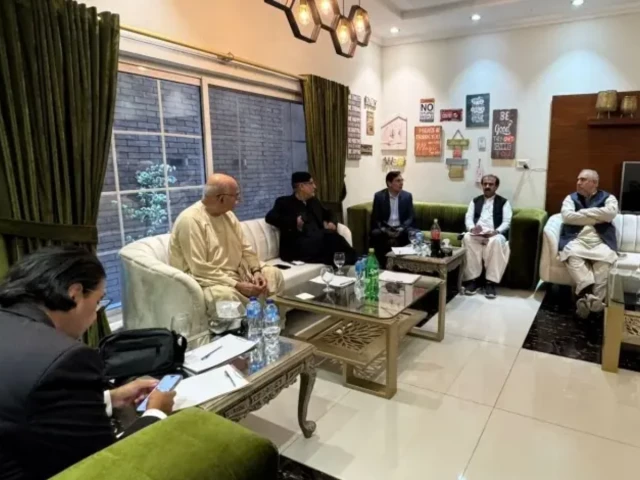
The decision was taken at a key consultative meeting held on Wednesday evening in Islamabad, where top leaders of the alliance reviewed the current political situation, recent government statements and the possible framework for the negotiations.
Among the participants were alliance leader Mahmood Khan Achakzai, Leader of Opposition in Senate Allama Raja Nasir Abbas, former Prime Minister Shahid Khaqan Abbasi, Mustafa Nawaz Khokhar, Asad Qaiser, Akhunzada Hussain Yousafzai, Khalid Yousaf Chaudhry and other high-ranking personalities.
Sources said the meeting undertook a detailed assessment of the government’s offer of talks, with particular focus on Rana Sanaullah’s recent remarks and whether the political environment was conducive for meaningful engagement. It was agreed that any dialogue must remain anchored in constitutional supremacy and democratic principles.
On the suggestion of PTI general secretary Salman Akram Raja, Shahid Khaqan Abbasi and other central PTI leaders, the alliance authorized its designated leaders to formally contact the government.
Following the consensus, Mahmood Khan Achakzai and Allama Nasir Abbas were given full powers to advance the negotiation process.
According to sources, contacts with key government figures are expected during Ramazan to discuss the agenda, procedure and possible schedule of the talks. TTAP spokesperson Akhunzada Hussain Yousafzai confirmed that the alliance would respond positively if officially contacted.
Freedom for Imran
At a separate central committee meeting held at Mustafa Nawaz Khokhar’s residence, the TTAP reiterated its demand for Imran Khan’s immediate release, saying he had been “unjustly imprisoned”.
The alliance also insisted that the PTI founder be examined at Shifa International Hospital by his personal doctors and given unrestricted access to lawyers and family members.
Leaders condemned government secrecy over Imran Khan’s health, warning that hiding medical information from his family only heightened concerns and could deepen the political crisis.
They also raised concerns over the health of Sunni Ittehad Council Chairman Sahibzada Hamid Raza and demanded the release of all political prisoners, including senior leaders of the PTI and its allies.
The call for dialogue comes amid visible internal divisions within the PTI. While Achakzai and other senior leaders have said they are ready to engage, government officials have publicly suggested that obstacles to the talks come from members of Imran Khan’s family, particularly his sister Aleema Khanum, who they accuse of influencing party decisions and delaying consensus.
Fight against terrorism, Afghanistan
TTAP leaders also urged a national consensus against terrorism and called on the federal government to formulate a comprehensive counter-terrorism strategy in consultation with provinces, political stakeholders and the public.
Expressing concern over deteriorating relations with Afghanistan, the alliance urged both governments to avoid further confrontations and pursue meaningful negotiations to address security challenges. They also called for engagement with neighboring and friendly countries to prevent further destabilization in the region.
Additionally, TTAP warned of possible US military action against Iran and urged Pakistan to play a proactive diplomatic role to prevent escalation.
The alliance criticized Pakistan’s participation in Donald Trump’s “Peace Council,” arguing that the lack of Palestinian representation raised serious questions about the initiative’s intent and warning that involving Muslim countries without clarity could exacerbate regional tensions.
On the economy, the opposition expressed concern about deteriorating indicators, citing recently released data showing that poverty stands at 29 percent and unemployment is at its highest level in 21 years. TTAP leaders claimed that despite the government’s claims of major economic deals, foreign and domestic investment had declined sharply.
They argued that the announced withdrawal of hundreds of multinational companies from Pakistan reflected a deterioration in the risk profile and criticized the government’s failure to present a concrete recovery plan.
The alliance also took aim at public spending decisions, including the purchase of a multi-billion rupee Gulfstream jet, calling it an example of misplaced priorities amid growing economic woes.
TTAP announced its intention to present in the coming months an alternative budget and policy proposals, prepared with the help of experts, aimed at responding to the country’s economic and legal crises.


