
Both said that the State of Pakistan would not compromise on its peace, stability and territorial integrity.
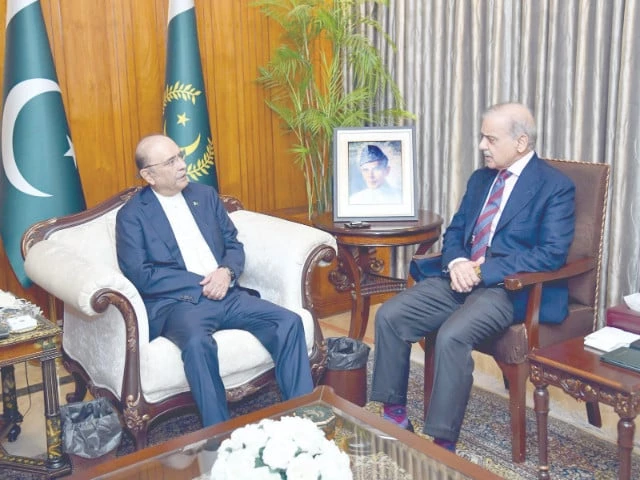
President Asif Zardari and Prime Minister Shehbaz Sharif discuss the political, security and economic situation during a meeting in Aiwan-e-Sadr. Photo: Express
President Asif Ali Zardari and Prime Minister Shehbaz Sharif said on Friday that there would be no compromise on the country’s defense and that any aggression would be met with an appropriate response, according to state broadcaster. Radio Pakistan.
In separate statements, they said the State of Pakistan will not compromise on its peace, stability and territorial integrity.
The President said no one should have the wrong idea that Pakistan would be coerced by pressure or intimidation. He said the nation and the armed forces stood “like a rock wall” to protect the integrity of the homeland and its borders.
He said the armed forces’ response capability was comprehensive, timely and decisive, and they had the ability to uproot the enemy’s evil intentions.
Asif Ali Zardari said Pakistan did not want confrontation, but warned that if anyone saw peace in Pakistan as weakness, they would face a tough response.
He said that over the past five years, the “ungrateful Taliban regime” had been engaging in terrorist acts against Pakistan through TTP terrorists.
Read: Afghan Taliban suffer ‘heavy losses’ as Pakistan Army launches ‘Operation Ghazab Lil Haq’
He said diplomatic efforts and the involvement of brotherly countries had failed to bring the “criminal gang” onto what he described as the right path.
The president said the group had crossed the international border and undermined the integrity of Pakistan.
He said Pakistan, as a responsible state, had adopted the diplomatic route and made serious efforts to bring the group on the path of moderation with the help of brotherly countries, but no positive progress had been made.
The Prime Minister said the people and the armed forces were always ready to protect the security, sovereignty and territorial integrity of the country. He said the armed forces were determined not to allow any threat to the peace and security of the country and were fully capable of defeating aggressive designs.
Shehbaz Sharif said that under the leadership of Chief of Defense Forces and Chief of Army Staff Field Marshal Syed Asim Munir, the armed forces were performing their duties with national spirit. He said the armed forces were equipped with professional capabilities, quality training and an effective defensive strategy, and were fully capable of facing any internal or external challenge.
The prime minister said Pakistan had always favored peace, but made it clear that the integrity of the country would not be compromised and the armed forces would resolutely oppose any aggression. He said the entire nation stood with the armed forces.
Pakistani security forces launched “Operation Ghazab Lil Haq,” carrying out air and ground strikes against Afghan Taliban positions in Kabul, Kandahar, Paktia and Nangarhar after what officials described as an unprovoked cross-border assault. According to security sources and Prime Minister’s spokesperson Mosharraf Zaidi, at least 133 Taliban fighters were killed and more than 200 injured, while 27 posts were destroyed and nine captured.
The operation targeted important militant infrastructure, including two corps headquarters, three brigade headquarters, ammunition depots and a logistics base, with officials saying more than 80 tanks, artillery pieces and armored vehicles were also destroyed. Pakistani troops also took control of five Afghan posts in the Paktia region, facing South Waziristan.
The strikes were a response to Taliban firing and drone attempts along several sectors of the Pakistan-Afghanistan border, including Torkham, Bajaur, Mohmand and Kurram. Two Pakistani soldiers were martyred and three injured in the clashes. The government described the military action as a “strong and decisive response”, while Information Minister Attaullah Tarar and Defense Minister Khawaja Asif warned that Pakistan would continue to thwart any aggression and safeguard its territorial integrity.


