
Analysts warn Taliban could boost support for TTP and BLA, risking wider conflict in Pakistan
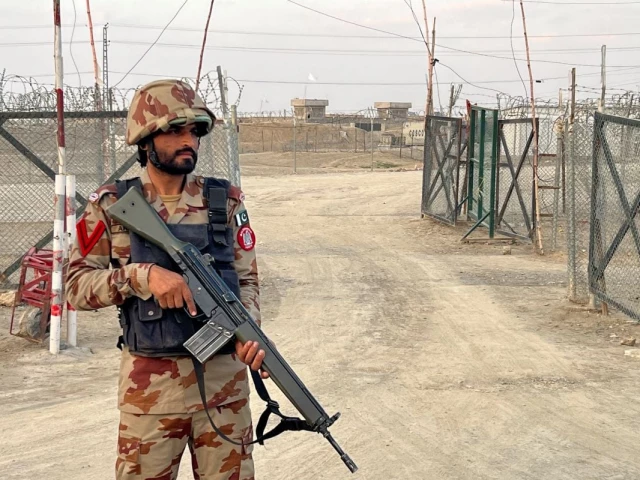
An army soldier guards a deserted entry point at the Friendship Gate, following the exchange of fire between Pakistani and Afghan forces, at the border post between the two countries, in Chaman, Pakistan, February 27, 2026. Photo taken with a cellphone. REUTERS/Abdul Khaliq Achakzai
Weeks after the Taliban’s lightning takeover of Afghanistan in 2021 from a U.S.-led coalition, Pakistan’s then-intelligence chief visited Kabul and told a reporter: “Don’t worry, everything will be fine.”
Five years later, Islamabad – once seen as a patron of the Taliban – is engaged in its most violent battles against the extremist group, which Defense Minister Khawaja Muhammad Asif has described as “open war”.
The unrest is putting a large part of Asia – from the Gulf to the Himalayas – in flux, with the United States strengthening its forces near Iran even as tensions between Pakistan and India, its arch-rival, remain high after last May’s clashes.
At the heart of the conflict with Afghanistan is Pakistan’s accusation that the Afghan Taliban supports militant groups, including the Tehreek-e-Taliban Pakistan (TTP), which have wreaked havoc across the country.
The Afghan Taliban, which had previously fought alongside the TTP, deny the accusation, insisting that Pakistan’s security situation is its internal problem.
The disagreement reflects the blatantly incompatible positions taken by the two sides, with Pakistan expected to comply after decades of supporting the Taliban, who do not consider themselves beholden to Islamabad, analysts say.
“Neither side had an honest conversation about what the relationship would actually look like. This structural misunderstanding is at the root of everything that followed,” said Jennifer Brick Murtazashvili, a political scientist at the University of Pittsburgh and an expert on Afghanistan.
Although tensions have been simmering for months along their rugged 2,600-kilometer border, following last October’s clashes, Friday’s fighting is notable because of Pakistan’s use of warplanes to strike Taliban military installations instead of limiting attacks to militants it allegedly harbors.
Learn more: Pakistan Army will continue ‘Operation Ghazab Lil Haq’ until ‘desired results’ are achieved: DG ISPR
These include targets deep in the country, in Kabul, as well as in the southern city of Kandahar, home of Taliban supreme leader Hibatullah Akhundzada, according to military spokesman Lt. Gen. Ahmed Sharif Chaudhry.
The clashes are unlikely to end there.
“We are in uncharted territory,” said Abdul Basit, an expert on militancy and violent extremism at the S. Rajaratnam School of International Studies in Singapore.
“What we are seeing is a recipe for instability, which will lead to more violence and tension. And terrorist groups will gain strength by exploiting the chaos.”
“A nightmare scenario” for Pakistan
Pakistan has a formidable army of 660,000 active troops, supported by a fleet of 465 combat aircraft, several thousand armored fighting vehicles and artillery pieces.
Across the border, the Afghan Taliban have only about 172,000 active troops, a handful of armored vehicles and no real air force.
But the battle-hardened group, which took on and outlasted a phalanx of Western military powers in 2001, has the ability to rely on insurgents such as the TTP and the Baloch Liberation Army (BLA), to move beyond border skirmishes.
“So either the Taliban can step back from the brink, or they can move forward and continue the fighting on the border, but also increase their support for the TTP, the BLA and all the other groups that operate inside Pakistan,” said Avinash Paliwal, reader in international relations at SOAS University of London.
The BLA is at the center of a decades-long insurgency that has staged large, coordinated attacks in recent years.
Pakistan has long accused India of supporting insurgents, a charge repeatedly denied by New Delhi, which has maintained a robust military deployment along the border since last May.
“A two-front situation has long been a nightmare scenario for Pakistan,” said former Pakistani diplomat Maleeha Lodhi.
“For Pakistan, a prolonged break in relations [with Afghanistan] worsens the security challenge, given the unstable situation on the eastern border with India. »
Although a number of influential countries, including China, Russia, Turkey and Qatar, have been willing to help mediate the conflict, all such efforts have so far met with limited success.
“The challenge right now is that there is a huge gap between the expectations of the two sides,” said Ibraheem Bahiss, a senior analyst at the International Crisis Group specializing in Afghanistan.
“We need to somehow find a compromise to achieve a more realistic compromise that is both achievable and digestible for both sides.”


