
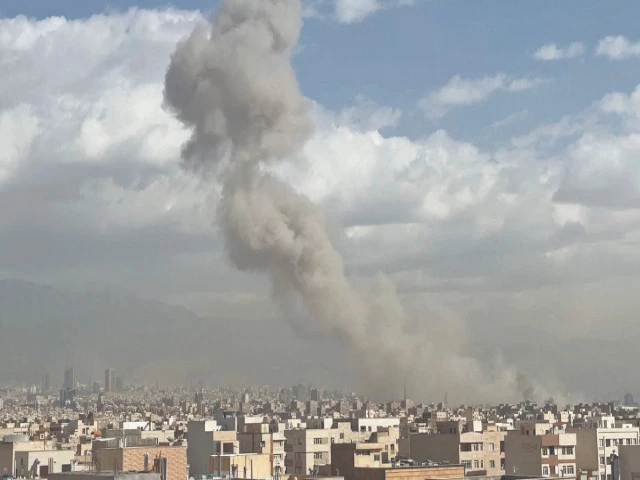
The United States and Israel attacked Iran on Saturday, targeting its top leaders and calling for the overthrow of its government, while Iran responded by firing missiles at Israel and neighboring Gulf countries. Iran’s Al-Alam television said Supreme Leader Ayatollah Ali Khamenei – who has not yet been heard from on Saturday evening – was expected to deliver a speech soon. The statement comes as Israeli Prime Minister Benjamin Netanyahu said there were "many signs" Khamenei was dead. The United States believes Iran’s Supreme Leader Ayatollah Ali Khamenei and five to 10 senior Iranian leaders were killed in an initial Israeli strike, a Fox News reporter said Saturday, citing a U.S. official. Iranian authorities urged residents to evacuate the capital, a city of 10 million, while the country’s Red Crescent said at least 201 people were killed in the strikes and more than 700 injured. Iran’s Revolutionary Guards said a first wave of retaliatory missile and drone attacks had been launched against Israel and US facilities in the region. President Donald Trump, who in the biggest foreign policy gamble of his presidency launched war against a foe Washington has fought with for generations, said the strikes were aimed at ending a security threat and ensuring Iran could not develop a nuclear weapon. He called on Iranian security forces to lay down their arms and called on Iranians to overthrow their government once the bombing ends. Tehran called the strikes unprovoked and illegal and said it considered all US and Israeli bases, installations and assets in the region to be "legitimate military objectives". Iranian Foreign Minister Abbas Araqchi told the UN Security Council and UN Secretary-General Antonio Guterres in a letter calling on the 15 Council members to "take immediate action in response to this violation of international peace and security". Meanwhile, the United Arab Emirates reported one civilian killed and missile damage in Dubai and Abu Dhabi, as blasts from Tehran’s retaliatory salvo and the air defenses that intercepted it also echoed across Israel, Saudi Arabia, Bahrain, Qatar, Jordan and Kuwait.
"This morning, in a powerful surprise strike, the residence of tyrant Ali Khamenei was destroyed in the heart of Tehran… and there are many signs that this tyrant is no longer alive," ” Netanyahu said in a televised statement. Cheers could be heard in the streets of Tehran after the death was announced, according to witnesses. Plumes of black smoke were seen above Tehran’s Pasteur neighborhood, where Khamenei usually resides, with Israel’s Channel 12 reporting that 30 bombs were dropped on the compound. Foreign Minister Abbas Araghchi earlier told NBC News that Khamenei was alive. "As far as I know"adding that "all senior officials are alive". Also asked about Khamenei’s state of health, Foreign Ministry spokesperson Esmail Baqaei told the BBC that he "not able to confirm anything"but "the whole system, the whole nation is focused on defending (our) national integrity". In a sign that the fighting was far from over, Netanyahu said "thousands" Targets would be hit in the coming days, while Iran’s top security official promised fierce retaliation. US Central Command (CENTCOM) said it began striking targets at 1:15 a.m. ET (0615 GMT). "dismantle the Iranian regime’s security apparatus"he said in an article on
"After the first wave of US and partner strikes, CENTCOM forces successfully defended against hundreds of Iranian missile and drone attacks," » said CENTCOM. The Israeli military said its pilots hit hundreds of targets across Iran, including strategic defense systems already damaged in last year’s strikes. He said three sites where leaders were meeting were struck simultaneously and several senior officials were killed. Following the U.S. and Israeli strikes, Iran retaliated with attacks across the Middle East, targeting Dubai, Doha, Bahrain and Kuwait — places home to U.S. or U.S.-allied military bases — and other regions. Explosions were reported in Kuwait, the United Arab Emirates, Bahrain and Qatar. Bahrain said the US Fifth Fleet service center was subjected to a missile attack. Video footage from witnesses in Bahrain showed a thick plume of gray smoke rising near the coast of the small island state as sirens wailed. At least half a dozen witnesses, including Reuters correspondents, heard loud bangs in various parts of the United Arab Emirates capital, Abu Dhabi, a major oil producer and close U.S. ally. Qatar said it had shot down all missiles targeting the country, according to the official news agency. A Qatari official told AFP that defense systems intercepted an Iranian missile as warning sirens sounded across the Gulf state. The official, speaking on condition of anonymity, said Qatar’s U.S.-made Patriot interceptors shot down the missile. Qatar is home to the Al-Udeid military base, the largest US military installation in the region. Meanwhile, the United Arab Emirates said one person was killed by shrapnel following the Iranian missile attack. The United Arab Emirates said it was targeted on Saturday by what it described as a "blatant attack" involving Iranian ballistic missiles, adding that its air defense systems had intercepted a number of them. The Defense Ministry said debris fell in a residential area of Abu Dhabi, causing property damage and killing a person of Asian nationality. Authorities said the security situation was under control and all relevant agencies were monitoring developments 24 hours a day. The ministry strongly condemned the attack, calling it "dangerous climbing" and a "cowardly act" which threatens the security of civilians and regional stability. He said the strike was a blatant violation of UAE sovereignty and international law. The United Arab Emirates reserved "It’s absolutely his right to respond." and to take all necessary measures to protect its territory, its population and its national interests. He added that he was fully prepared to face any threat and that the safety of citizens, residents and visitors remained a top priority. The ministry urged the public to rely on official sources for information and avoid spreading rumors. In Israel, a series of explosions were heard and air raid sirens sounded over Jerusalem after Israel and the United States launched a joint attack on Iran earlier in the day. The Israeli military said it had identified a barrage of missiles launched from Iran. Explosions were also heard near the Iranian island of Kharg. Iran exports about 90% of its crude oil through Kharg, passing through the narrow Strait of Hormuz. Iranian media reported explosions in Isfahan, Qom, Karaj and Kermanshah. Explosions were also heard in the northwestern city of Tabriz, according to the Fars news agency. Iranian Defense Minister Amir Nasirzadeh and Revolutionary Guard commander Mohammed Pakpour were reportedly killed in Israeli attacks, two sources close to Israeli military operations and a regional source said. A source told Reuters that Iranian officials were the main target of the first wave of US-Israeli strikes. Senior Iranian officials are "in perfect health"including President Masoud Pezeshkian, Parliament Speaker Mohammad Bagher Ghalibaf and security chief Ali Larijani, Fars News Agency reported on Saturday.
"While Israeli sources claim to have targeted and succeeded in attacking the president and senior Iranian leaders, official sources in the country report that senior regime officials, including the heads of the armed forces, are in perfect health," the report said. These attacks come as negotiations between Washington and Tehran on Iran’s nuclear program continue under the mediation of Oman. A new round of negotiations ended Thursday in Geneva. The joint strikes pushed the Middle East into new military conflict and further dimmed hopes for a diplomatic solution to the West’s long-standing efforts to denuclearize Iran, despite Tehran’s repeated assertions that it would not seek nuclear weapons. Israeli defense officials say the operation was planned months ago and the launch date was decided a few weeks before. They added that this attack had been coordinated with the United States and that the United States had planned "several days of attacks" against Iran.


