
FO informs that the evacuation of citizens is facilitated via Azerbaijan to ensure their safe return
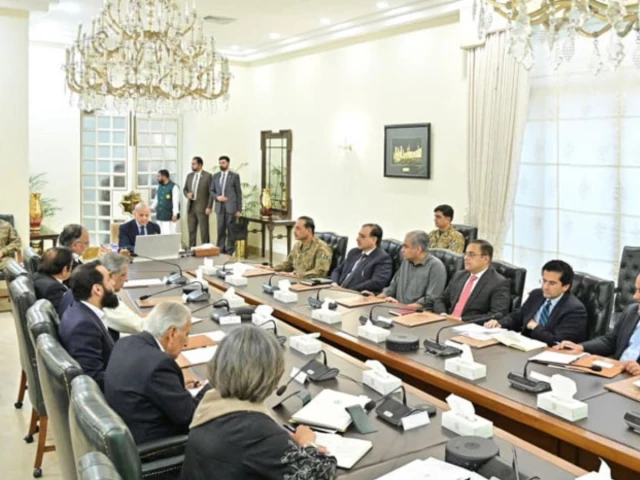
Prime Minister Shehbaz Sharif on Sunday chaired a high-level meeting to review regional and national security issues, including the evacuation of Pakistani citizens from Iran amid escalating tensions following the US and Israel attack on Iran.
The meeting was called in the wake of the current situation along the Afghan border and the wider crisis in the Middle East, following the assassination of Iranian Supreme Leader Ayatollah Ali Khamenei.
At least 10 people were killed in Karachi in clashes that broke out as protesters marched towards the US consulate, while Section 144 was enforced in Punjab and Islamabad amid protests following Khamenei’s assassination.
Meanwhile, the deteriorating law and order situation in Skardu prompted the deployment of the Pakistan Army under Article 245 of the Constitution.
Earlier in the day, the Prime Minister also held a separate meeting with Interior Minister Mohsin Naqvi to discuss the overall situation in the country.
وزیرِ اعظم محمد شہباز کی زیرِ صدارت علاقائی اور پاکستان کی سیکیورٹی صورتحال پر جائزے کیلئے اعلی سطح اجلاس
اجلاس میں علاقائی و خطے کی صورتحال کا تفصیلی جائزہ لیا گیا.
اجلاس میں پاکستان کے خطے میں امن کے قیام کیلئے کرادر اور مختلف اقدامات زیر غور آئے
اجلاس میں افغانستان… pic.twitter.com/0BtGKoHnUW
– PTV News (@PTVNewsOfficial) March 1, 2026
According to a statement issued by the Prime Minister’s Office, the meeting reviewed in detail the regional situation, including measures to ensure peace and stability in the country and the wider region. “The security situation in Afghanistan was also closely examined,” the statement said.
“The officials were briefed on the country’s internal security arrangements and ongoing measures to protect Pakistani citizens abroad,” the statement added.
On the instructions of the Prime Minister, the Ministry of Foreign Affairs (FO) provided a detailed briefing on efforts to safely evacuate Pakistani nationals from Iran. “Evacuation is being facilitated across Azerbaijan to ensure the safe return of citizens,” FO informed the meeting.
The meeting was attended by Chief of Army Staff and Chief of Defense Force Field Marshal Asim Munir, Federal Ministers Ahsan Iqbal, Mohsin Naqvi, Azam Nazeer Tarar, Ahad Khan Cheema, Attaullah Tarar, Ali Pervaiz Malik, Special Assistant Tariq Fatemi and senior civil and military officials.
Prime Minister Chehbaz also postponed his planned visit to Russia due to the current domestic and regional situation.
The federal government said that the Prime Minister’s visit to Russia holds significant importance for the advancement of bilateral relations between the two countries. However, given the current situation, the visit has been postponed. “The new date of the visit will be announced later after mutual consultation,” the press release added.
Pakistan launched ‘Operation Ghazab-Lil-Haq’ following renewed clashes along the Pakistan-Afghan border.
According to Information Minister Attaullah Tarar, security forces killed 415 Afghan Taliban in a major military operation launched in response to “unprovoked cross-border attacks” from Afghanistan.
Learn more: Number of Afghan Taliban killed in ‘Operation Ghazab Lil Haq’ reaches 415
Security sources said the operation was ongoing and would continue until all objectives were achieved. “The Pakistani armed forces remain fully committed to defending national security and responding decisively to any unprovoked aggression,” the statement added.
On the other hand, the United States and Israel jointly launched strikes against Iran that pushed the Middle East into new military confrontation and further dimmed hopes for a diplomatic solution to the West’s long-standing efforts to denuclearize Iran, despite Tehran’s repeated assertions that it would not seek nuclear weapons.
In response, Iran targeted Israel and US bases in the Middle East. Explosions were reported in Kuwait, the United Arab Emirates, Bahrain and Qatar.
Iranian state media later confirmed that Supreme Leader Ayatollah Ali Khamenei had been killed in Israeli and US strikes, and announced 40 days of public mourning in the Islamic Republic.
Hours after the United States and Israel said an airstrike killed Ayatollah Ali Khamenei in the most ambitious series of attacks on Iran in decades, Iranian state media on Saturday confirmed the death of the 86-year-old leader.
U.S. President Donald Trump said airstrikes launched Saturday against Iranian targets were aimed at ending a decades-long Iranian threat and ensuring that Iran cannot develop a nuclear weapon, seeking to justify a risky gamble that appears to run counter to his stated opposition to U.S. involvement in complex conflicts abroad.


