
Law minister says politics must be put aside as Pakistan has ties with Iran, defense pact with Saudi Arabia
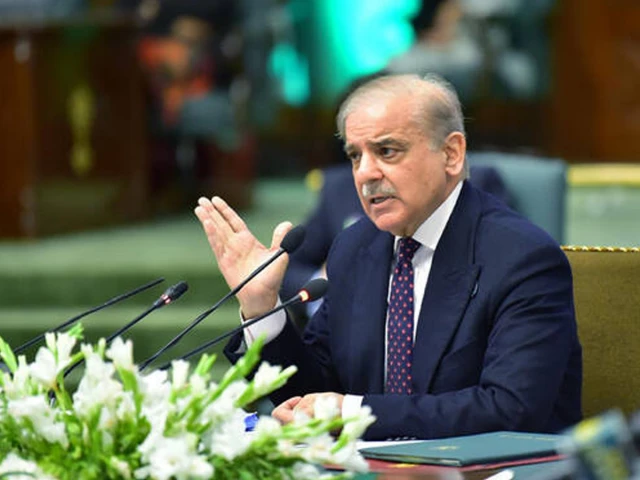
Prime Minister Shehbaz Sharif addresses the special federal cabinet meeting in Islamabad, Pakistan on March 4, 2025. Photo: PID
Prime Minister Shehbaz Sharif has invited parliamentary leaders and party leaders to a closed-door briefing tomorrow to discuss escalating regional tensions, particularly following the martyrdom of Iran’s Supreme Leader Ayatollah Khamenei, it was reported on Tuesday.
Last week, the United States and Israel jointly launched strikes against Iran that pushed the Middle East into a new military confrontation as its supreme leader, Ayatollah Ali Khamenei, was assassinated in the strikes. In response, Iran targeted Israel and US bases in the Middle East.
Speaking to media today, Law Minister Azam Nazeer Tarar said leaders of all political parties have been invited for a briefing on national and regional security.
“We have relations with Iran and, on the other hand, we also have a defense agreement with Saudi Arabia. In this matter, politics must be put aside. Tomorrow the prime minister will give a closed-door briefing to all political leaders,” Tarar said.
Read more: PM Shehbaz calls for de-escalation and dialogue on Middle East crisis
He added that Prime Minister’s Advisor on Political Affairs Rana Sanaullah would extend the invitations to the political leaders and the meeting would take place tomorrow at 11 am.
According to the public channel Radio Pakistan, Tarar said the same during today’s National Assembly session, adding that the current global situation would also be discussed.
The report said the House began with a discussion of the regional situation, focusing on the attack on Iran and the loss of its revered leader. He added that lawmakers from various parties condemned the assault and paid tribute to Khamenei.
They also expressed their solidarity with the Iranian people.
Several parliamentarians, including Aniqa Mehdi, Abdul Qadir Patel, Hameed Hussain, Aasia Ishaque Siddiqui, Sehar Kamran, Maulana Fazlur Rehman and Syeda Shehla Raza, spoke in favor of the unity of Muslim countries to face common challenges.
“We must forge unity within the Ummah to confront growing threats,” Fazl said.
Crisis in the Middle East
Khamenei’s assassination opened a new chapter of escalation and instability in the Middle East. Following the recent crisis, Pakistan has repeatedly called for de-escalation. A day earlier, Deputy Prime Minister and Foreign Minister Ishaq Dar had said Pakistan was closely monitoring the regional situation and working to reduce tensions through diplomatic efforts.
Addressing ambassadors of several countries, FM Dar said Pakistan was engaging with regional partners in what he described as a “fragile and sensitive situation”.
He added that Pakistan was closely monitoring the developments in Iran, and all its efforts were focused on easing tensions, describing the situation as “extremely delicate.”
Separately, an attack by two drones earlier in the day on the US embassy in Riyadh sparked a small fire, a Saudi Defense Ministry spokesperson said in a statement, as Iran continued its retaliatory strikes across the Gulf.
The Saudi Defense Ministry said it had intercepted more than half a dozen drones near the capital Riyadh and the city of Al-Kharj.
“Eight drones were intercepted and destroyed near the cities of Riyadh and Al-Kharj,” Defense Ministry spokesperson General Turki al-Malki said on X.
Read also: US, Israel must end military action, says Iranian Foreign Ministry spokesperson
US CENTCOM said in an article on X that US forces destroyed Islamic Revolutionary Guard Corps installations, air defenses, missile and drone launch sites and military airfields.


