
US-Israeli strikes hit Qom office linked to committee tasked with selecting new supreme leader
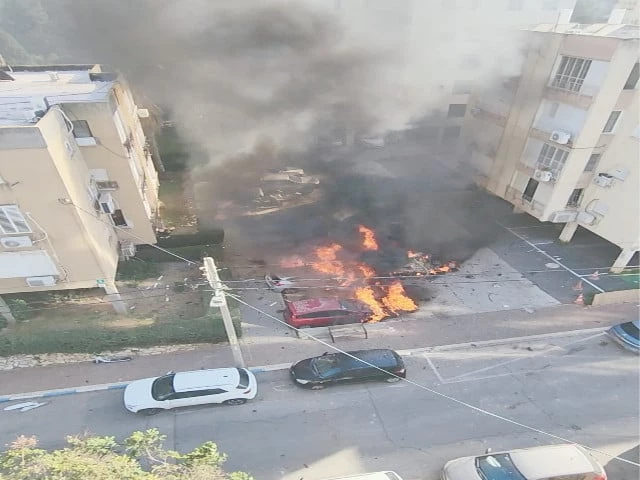
Smoke and flames rise from vehicles after shrapnel from an Iranian missile strike fell on a parking lot in Ramat Gan, Israel, in this screenshot from a video obtained from social media. Photo: Reuters
WASHINGTON/TEHRAN:
The fourth day of the US-Israeli military campaign against Iran was marked by intensified bombing on several Iranian cities and in the Gulf maritime zones, where drones and missiles targeted energy installations, diplomatic installations and urban infrastructure, stoking global concern over the scale of the conflict.
US and Israeli forces struck a building in Qom linked to the committee tasked with selecting a new supreme leader following the assassination of Ali Khamenei. This strike followed attacks the day before against the organization’s main headquarters in Tehran.
Israeli officials described the attacks as a “wave of large-scale operations” centered on Tehran, while Donald Trump said the bombing caused massive destruction. He claimed that Iran’s future leadership networks, air defense units and naval capabilities had been largely disabled.
Iranian media reported retaliatory drone and missile attacks on U.S. oil installations and diplomatic missions in the Gulf. Strikes were launched against US and Israeli positions as tensions escalated into a wider regional confrontation involving multiple maritime and urban targets.
Thick columns of smoke rise above central Tehran, where several government offices are located. Local reports said the strikes also hit one of the city’s two airports, including Mehrabad International Airport, disrupting civilian air traffic and emergency logistics.
Central neighborhoods such as Ferdowsi Square in Tehran suffered heavy structural damage after explosions destroyed nearby buildings. Authorities advised residents to evacuate vulnerable areas as security forces increased patrols and imposed emergency movement restrictions.
The main streets of the capital seemed deserted. Police units, armored vehicles and security detachments carried out random inspections of vehicles at intersections. The commercial districts of northern Tehran, usually crowded with shoppers and cafe visitors, remained eerily silent at night.
Widespread electricity and water shortages followed the bombings, deepening civilian fears. Many families reportedly planned to leave once routes reopened, although uncertainty over safe evacuation corridors prevented immediate mass movement out of the city.
Iranian media also confirmed damage at Bushehr International Airport. Separately, a British couple imprisoned in Tehran’s Evin prison described explosions rocking their detention unit, their son said. The nuclear watchdog used satellite images showing damage to the Natanz nuclear power plant.
State authorities said 13 members of the Islamic Revolutionary Guard Corps were killed in attacks in Kerman, Iran. The officials further said that the cumulative death toll from the ongoing strikes had reached 787, citing data provided by the Iranian Red Crescent Society.
Guards warned of a potential escalation. Gen. Ebrahim Jabbari said that if large parts of Iran’s population or command centers were hit again, Tehran would retaliate by targeting regional economic infrastructure, which could widen disruptions in energy corridors.
Retaliatory drone and missile strikes were reported in several Gulf states. Qatar said missiles targeting Hamad International Airport had been intercepted. In Oman, drones reportedly struck the port of Duqm, while debris from intercepted drones caused fires at an oil storage facility in the United Arab Emirates.
The US Embassy in Riyadh issued a warning about possible attacks in Dhahran, which is home to major Saudi energy facilities. Earlier drone activity briefly sparked fires near diplomatic facilities in the Saudi capital. Volker Turk, a senior UN official, said he was shocked by the civilian casualties in the region.
The United States projected confidence about progress on the battlefield. “Almost everything was destroyed,” Trump told reporters during a meeting with German Chancellor Friedrich Merz at the White House in Washington.
Trump also claimed that two successive waves of attacks eliminated individuals seen as future candidates for Iranian leadership. “Most of the people we had in mind are dead,” he said, adding that intelligence reports suggest other targets may also have been eliminated.
Street protests in Iran have not happened despite Washington’s expectations of public unrest. Trump urged Iranians to postpone large protests until security is stabilized, citing historical examples of violent repression to justify caution during the military campaign.
Diplomatic tensions have spread beyond the Middle East. Trump criticized the United Kingdom for not officially participating in the strikes while allowing American forces to use British facilities. He also threatened to restrict trade against Spain after its refusal to provide access to its military bases.
Economic impact
The economic impact of the war spread globally as energy prices rose and financial markets weakened. Several countries have restricted access to airspace, forcing the cancellation of thousands of flights, creating one of the biggest disruptions to international travel since the Covid-19 pandemic.
Production at some downstream chemical plants in Qatar has been suspended, including the processing of urea, polymers, methanol and aluminum. The move triggered a roughly 2% rise in aluminum prices on the London Metal Exchange.
Maritime traffic has also faced security pressures near the Strait of Hormuz. About 30 South Korean commercial ships were sailing nearby under heightened naval surveillance due to fears of potential attacks by ships.
Israeli diplomacy has pushed for international isolation of Tehran, but China has warned that continued fighting risks long-term geopolitical instability. India has also warned that a regional war could disrupt global energy and trade supply chains.
Trump said it was “too late” for Iran to avoid war through negotiations, signaling a tougher US stance despite an earlier openness to dialogue. Iranian officials have denied seeking to negotiate, although the U.N. mission in Tehran has called for Security Council intervention.
Despite the destruction and losses, Trump insisted the campaign was aimed at preventing the emergence of future Iranian leadership seen as hostile to Western interests. “The worst case scenario would be to replace one bad leader with another,” he said, defending the strategic intent of the operation.


