
ISLAMABAD:
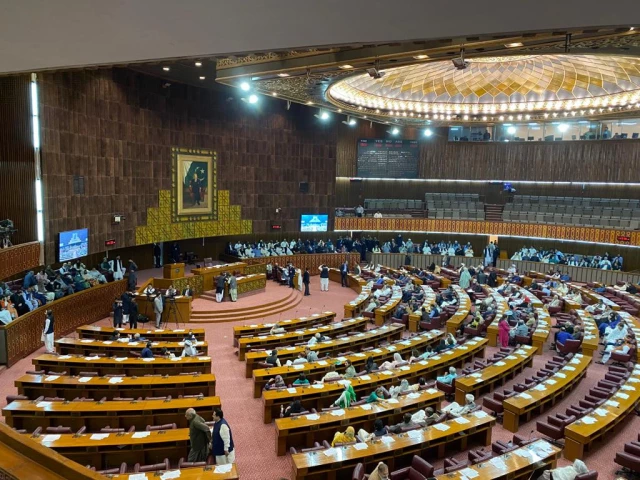
The 16th National Assembly recorded its highest legislative result in recent parliamentary history in its second year, even as political polarization, declining turnout and institutional vulnerabilities continued to cloud its performance, according to PILDAT’s annual performance assessment.
Covering the period from March 1, 2025 to February 28, 2026, the report notes that the Assembly entered its second parliamentary year “against a context of sustained political polarization and institutional tensions”, but demonstrated “increased legislative activity alongside persistent structural and procedural challenges”.
The assembly met for 84 working days during the year, compared to 93 meetings in the first year, a decrease of approximately 9.7%. However, the total working time increased to 231 hours from 212 hours previously, indicating comparatively longer sessions.
Despite this increase, the total working time remained “significantly lower than the historical average of 324.5 hours over the second year observed during previous assemblies”, notes the press release.
Financially, the annual budget of the assembly amounts to Rs16,290 million. The average budget per session increased significantly to reach Rs193.93 million, compared to Rs136.96 million in the first year.
Legislative productivity has increased significantly. A total of 59 bills were passed in the second year, compared to 47 in the first year, an increase of 25.5%.
Compared to the second years of the 12th to 15th National Assemblies, where the average number of bills passed stood at 21.75, the current Assembly recorded the highest legislative output among recent assemblies.
At the same time, the use of executive legislation has declined. Eight orders were issued during the year, compared to 16 in the first year, a reduction of 50%.
Among the most consequential developments was the adoption of the 27th Amendment.
According to the report, the amendment introduced “structural changes in Pakistan’s judicial architecture, including the creation of a Federal Constitutional Court, changes to judicial appointment processes, restructuring of the military command framework and the expansion of constitutional immunities for key officials.”
The amendment generated “intense political and legal debate,” with critics raising concerns about judicial independence, separation of powers, and civil-military balance. Its adoption marked the most significant constitutional development of the Assembly’s second year.
Another controversial measure was the Elections (Amendment) Bill 2026, which restricted public access to parliamentarians’ asset declarations by granting the president discretion to withhold any disclosure on security grounds.
The bill has sparked debate over transparency and accountability, particularly because of the expedited legislative process used for its passage.
Despite increased legislation, structural weaknesses persisted. In the second year, 47.59% of the scheduled agenda items remained unfinished, slightly better than the 49.18% in the first year, meaning that almost half of the scheduled items remained unfinished.
Attendance trends also reflected a decline in engagement. The average attendance of MPs fell to 58.80%, compared to 66.29% in the first year. Quorum was reported 19 times, and eight sessions were adjourned due to lack of quorum.
Structural issues regarding the attendance recording system remain unresolved.
Prime Minister Shehbaz Sharif attended six of the 84 sessions, reflecting an attendance rate of around 7%, continuing a trend of limited executive presence in parliamentary proceedings.
One of the defining institutional challenges during the year was the prolonged absence of an officially recognized opposition leader.
Following the disqualification of Omar Ayub Khan on 5 August 2025, the position remained vacant until 16 January 2026, when Mahmood Khan Achakzai was formally notified. The five-month vacuum weakened the opposition’s coordinated control during a period of significant constitutional and legislative change.


