
Chief Election Commissioner warns of contempt notices, daily hearings as delimitation delays stall local elections
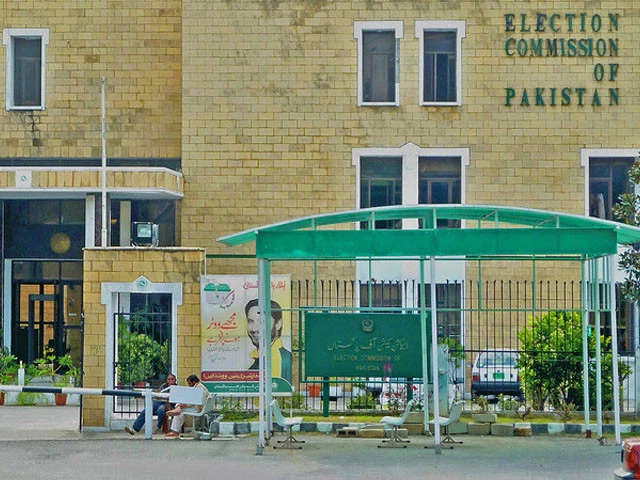
Election Commission of Pakistan building in Islamabad. Photo: Radio Pakistan
ISLAMABAD:
The Election Commission of Pakistan on Thursday summoned Interior Minister Mohsin Naqvi for delay in holding local body elections in Islamabad, while issuing a contempt notice to the interior secretary for not appearing before the commission.
A five-member bench headed by Chief Election Commissioner (CEC) Sikandar Sultan Raja heard the matter. Islamabad Chief Commissioner Ali Randhawa appeared before the committee, but the interior secretary did not attend the hearing.
“Where is the Secretary of the Interior?” the CEC asked during the hearing, ordering that the interior minister be summoned in person if the secretary continued to remain absent.
“If the secretary does not come, then we will summon the interior minister in his personal capacity,” Raja said, adding that the minister will have to appear in the next hearing.
Officials of the Election Commission of Pakistan (ECP) told the bench that a letter was sent to the interior ministry, but no response was received. They also complained that the Home Secretary was not cooperating with the commission.
Noting the absence, the CEC ordered the issuance of a contempt notice to the Minister of the Interior.
The officials informed the bench that a demarcation notification, official map of Islamabad and number of union council members were required before the demarcation process could begin.
Raja noted that the Islamabad Capital Territory administration seemed to be taking the issue lightly.
“These elections are directly under the responsibility of the Islamabad Capital Territory (ICT),” he said, adding that three federal ministers had already appeared before the commission and assured it that the issue would be resolved.
“Do not force us to take strict measures,” warned the CEC, ordering authorities to provide a clear timetable. The Islamabad Chief Commissioner has been asked to present the progress made in this matter in the next hearing.
The case was adjourned until next Tuesday.
Read: Non-party LG polls challenged in LHC
Punjab LG Polls
The commission also heard a separate case regarding delays in local elections in Punjab.
The Punjab chief secretary and local government secretary appeared before the committee during the proceedings.
The ECP special secretary informed the bench that the commission had earlier constituted a committee and held several meetings on the issue.
He said the commission already had the Punjab Local Government Act and delimitation framework, but the provincial government was yet to provide local government election rules and demarcation maps.
“We need the maps to start the demarcation process,” Raja remarked, asking if the exercise could begin immediately.
The Punjab local government secretary told the commission that the deputy commissioners had been instructed to provide the required cards within two to three days.
“Within a week, the deputy commissioners will provide the cards to the district election commissioners,” he said.
ECP officials said the delimitation process would take around two months once the maps are received.
A committee member asked if a new election date would be announced after the end of the two-month exercise.
The CEC gave Punjab a final deadline of one week, ordering that all deputy commissioners provide the cards by March 12.
“If the maps are not provided, the commission will hold a formal hearing,” Raja said.
He added that deputy commissioners of each division would be summoned and the commission would hold daily hearings if the required maps were not submitted.
“If the maps are provided, the process will move forward; if not, we will set another hearing date,” the CEC said.
Context of delays
The ECP has been considering the issue of delay in local elections in Islamabad for several months and has repeatedly sought the cooperation of the federal government and the Islamabad administration in fulfilling the legal and administrative requirements of the polls.
Under the Islamabad Local Government Act, 2015 – amended in 2024 – the capital’s municipal governance framework outlines the structure of local bodies, including union councils, representation quotas and administrative powers of elected representatives. However, officials told the committee that further amendments were needed in Section 15 of the law to facilitate the electoral process.
In an earlier meeting, the ECP directed the Ministry of Interior and Islamabad administration to finalize proposed amendments in consultation with the commission under Section 219(3) of the Election Act, 2017, which empowers the commission to ensure that elections are organized and conducted in accordance with law.
The committee had fixed a hearing on the Islamabad local government elections for November 13 and sent notices to the interior secretary and the chief commissioner of Islamabad to deliberate on the proposed legal changes.
Officials informed the committee that they had already written to the Interior Ministry, urging it to make the necessary changes to ensure smooth implementation of the law.
According to the ECP, the last correspondence received from the Ministry of the Interior on this subject dates from October 23, 2025.
The interior minister was summoned after the state interior secretary failed to appear before the committee and amid concerns that necessary legislative amendments and administrative procedures – including delimitation and issuance of demarcation notifications – had not yet been completed, delaying the electoral process in the federal capital.
Moreover, the issue of delay in local body elections in Punjab has been under scrutiny for months. In December, the provincial government informed the Lahore High Court that the upcoming polls would be held on a partisan basis under Section 68 of the Punjab Local Government Act, 2025, during hearings on a petition filed by Jamaat-e-Islami challenging the law and seeking confirmation that the elections would be held along partisan lines.
Justice Sultan Tanveer Ahmed observed that the proceedings could not move forward without a response from the Election Commission of Pakistan (ECP) and adjourned the hearing.
In January, the ECP took strict note of the provincial government’s failure to fulfill legal and administrative requirements for the elections, despite earlier assurances.
The commission summoned the Punjab chief secretary and local government secretary, noting that provincial authorities were yet to provide delimitation rules and notifications to union councils – essential prerequisites for launching the electoral process.


