
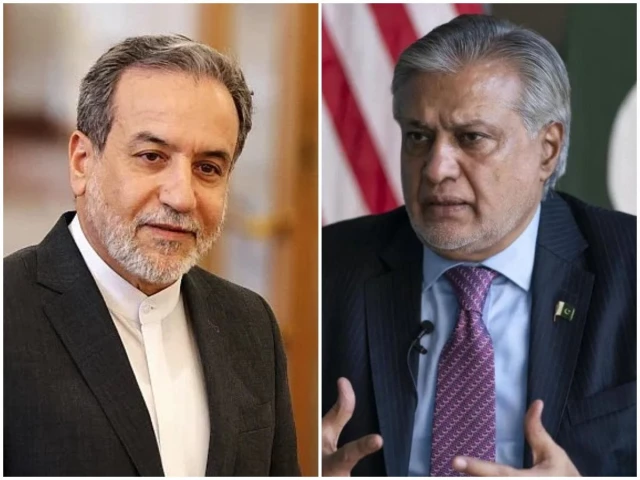
Iranian Foreign Minister Abbas Araghchi (left) and Foreign Minister Ishaq Dar (right). Photo: Files
ISLAMABAD:
Pakistan has stepped up its diplomatic efforts in the face of the rapidly evolving crisis in Iran and the Gulf region, engaging regional capitals while calling for restraint and warning against actions that could further widen the conflict, officials and diplomatic sources said on Friday.
Deputy Prime Minister and Foreign Minister Ishaq Dar spoke with Iranian Foreign Minister Seyyed Abbas Araghchi on Friday evening, expressing concern over the deteriorating regional situation and stressing the importance of maintaining communication as tensions escalate.
According to the Ministry of Foreign Affairs, the two sides agreed to remain in close contact on the development of the situation.
Diplomatic sources said Islamabad also raised concerns with Tehran, urging Iranian leaders to avoid attacks on Gulf countries, warning that such actions could dangerously widen the conflict and destabilize an already unstable region.
It was the second telephone conversation between Dar and Araghchi since tensions between Iran and the United States and Israel erupted last week.
Dar had earlier revealed that he had reminded his Iranian counterpart of the mutual defense agreement between Pakistan and Saudi Arabia. Dar went on to say that due to Pakistan’s shuttle diplomacy, Iran avoided attacking Saudi Arabia.
Pakistan’s diplomatic push comes amid reports of attacks targeting several regional states, including Azerbaijan and Turkey, which have triggered fresh tensions in the Middle East and Caucasus region.
Meanwhile, Prime Minister Shehbaz Sharif held a telephone conversation with Azerbaijani President Ilham Aliyev, during which he strongly condemned drone strikes on the Nakhchivan enclave, which allegedly targeted civilians.
The prime minister assured Azerbaijani leaders that Pakistan stood in “full solidarity and support of the brotherly people of Azerbaijan” during this difficult period. He also briefed President Aliyev on Pakistan’s diplomatic efforts following the crisis in Iran and the Gulf region.
President Aliyev thanked the Pakistani Prime Minister for his call and appreciated Islamabad’s expression of solidarity. Both leaders stressed the need for de-escalation and restoration of peace in the region and agreed to remain in close contact.
In a separate statement, the Foreign Office expressed “serious concern” over the attacks targeting Turkey and Azerbaijan, warning that such actions were a violation of international law and could push the region towards further escalation.
“While reaffirming Pakistan’s strong solidarity with Turkey and Azerbaijan, we call for restraint and the use of dialogue and diplomacy to maintain regional peace and stability,” the statement said.
Iran, however, has rejected allegations that it carried out attacks against Azerbaijan and Turkey. Iranian officials have called the accusations a “false flag operation” orchestrated by Israel to widen the conflict and draw more regional players into the confrontation.
Diplomatic observers say Pakistan’s opening reflects a careful balancing act as Islamabad seeks to maintain ties with multiple regional players while preventing the crisis from escalating into a broader regional war.


