
Applicants affected by the March 9-13 suspension will receive instructions by email to reschedule their appointment.
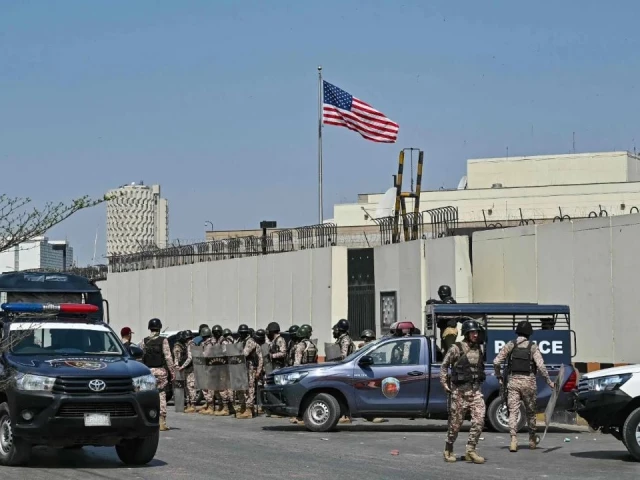
Security officers stand guard in front of the American consulate in Karachi, March 1, 2026. PHOTO: AFP
The U.S. Embassy in Islamabad suspended its visa services from March 9 to 13, but says it will continue to provide routine and emergency services to American citizens as tensions rise in the Middle East.
“All immigrant and non-immigrant visa appointments are canceled from March 9 to 13,” the embassy said in a statement on X, adding that visa applicants affected by the suspension would receive instructions via email on how to reschedule their appointments.
The U.S. Embassy Islamabad will continue to serve U.S. citizens requiring routine and emergency services. All immigrant and non-immigrant visa appointments are canceled March 9-13. Visa applicants will receive email instructions for rescheduling their appointments. All… pic.twitter.com/8ATavoIum5
– US Embassy Islamabad (@usembislamabad) March 8, 2026
“The U.S. Embassy Islamabad will continue to serve U.S. citizens requiring routine and emergency services,” the statement said.
Meanwhile, all consular services at the US consulates general in Karachi and Lahore remain suspended, the embassy said.
This development comes as US-Israeli strikes against Iran and the Islamic Republic’s retaliation continue in the region. Iranian attacks also targeted U.S. military bases, while drones struck targets in Saudi Arabia and Kuwait, officials from both countries said Sunday.
Read: Two Israeli soldiers killed while targeting Iranian commanders in Beirut
The governments of Saudi Arabia, Kuwait and the United Arab Emirates reported Iranian drone attacks on Saturday and early Sunday, causing varying degrees of damage. Iran’s Revolutionary Guard also targeted U.S. forces at a base in Bahrain, according to Iranian state media.
As tensions rise in the region, the United States earlier this week ordered the departure of non-emergency government personnel and eligible family members from its consulates in Lahore and Karachi, the State Department said in an updated travel advisory.
In its latest travel advisory on Pakistan, which remains at Level 3 — meaning travelers should reconsider travel — the State Department said the decision was made due to security risks following heightened regional tensions.


