
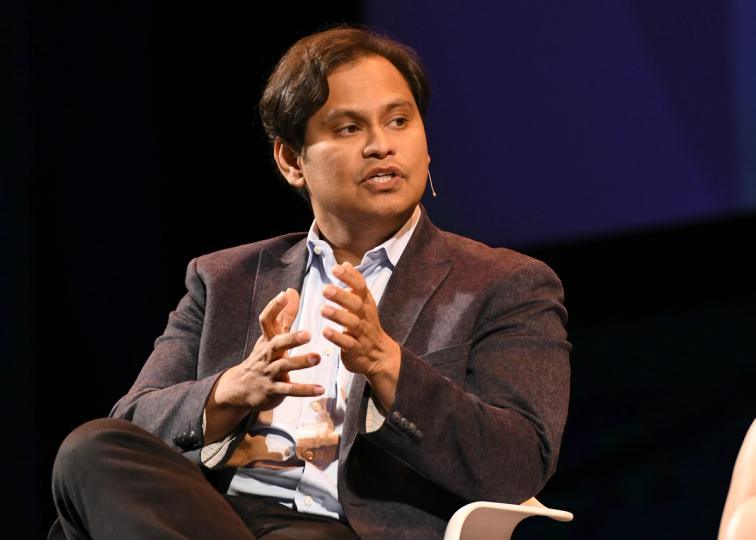
Tech investor Imran Khan says cryptocurrency does not play a significant role in his AI investment strategy, arguing that the asset class operates on a fundamentally different thesis than the AI-driven productivity boom.
Despite the growing narrative that AI and crypto will converge, Khan said he largely views them as separate investment themes.
“Crypto is a different animal,” he said in an interview. “When it comes to AI, you are investing in productivity and economic growth. » This difference means that crypto rarely fits the framework used by his company, which focuses on companies that benefit from structural technological changes.
Khan is the founder and chairman of the investment committee of Proem Asset Management, a technology-focused investment firm with $450 million in assets under management. Before launching Proem, he served as chief strategy officer at Snap (formerly Snapchat), helping lead the company to its public listing, and led global internet investment banking at Credit Suisse, where he worked on major deals including Alibaba’s record IPO.
However, it is not anti-crypto.
Although direct token exposure generally does not fit the firm’s investment thesis, which focuses on fundamental private equity, Proem held positions in Coinbase (COIN), Robinhood (HOOD), as well as bitcoin miner Iren (IREN) and bitcoin spot through iShares Bitcoin Trust (IBIT), according to its latest 13F filing. These positions are not part of the company’s AI strategy, but rather its broader focus on the technology sector, Khan said.
Crypto and AI Intersection
While Khan argues that the two sectors are completely different, some investors argue that an intersection of AI and crypto makes sense because both rely on decentralized computer networks and data infrastructure.
The argument is that blockchains can provide payment channels and coordination systems for AI services running on the Internet without a central owner. In fact, last month, Citrini Research’s report, which exposed the AI bubble fear and caused a brief market collapse, mentioned that autonomous AI agents would disrupt traditional payment systems by bypassing credit card networks in favor of stablecoins.
Others say blockchain-based systems could also help track how AI models use data, verify results, or manage the digital identities of autonomous software agents.
Although the idea of a convergence of the two sectors remains largely experimental, it has fueled a wave of startups attempting to connect AI development with crypto networks. Meanwhile, many Bitcoin miners have already pivoted to the AI boom by repurposing their data centers and power infrastructure to support artificial intelligence.
Even Bitcoin could benefit from the growth of AI, said NYDIG, a financial services and infrastructure company. The company’s analyst argued that if AI wiped out jobs and wages, weakening consumer demand, it could force policymakers to cut rates to stabilize the economy, and adding a wave of liquidity could support bitcoin’s price.
Fear of the AI bubble
Khan’s comments come as the AI investment boom that exploded after the launch of ChatGPT begins to show signs of strain.
Nvidia (NVDA) – the dominant supplier of chips used to train AI models – and custom networking and AI chip maker Broadcom (AVGO) are both down about 5% year to date, reflecting growing questions about the pace of returns on massive investment in AI.
At the same time, the Citrini report that sparked the AI scare describes a hypothetical scenario for 2028 in which rapid adoption of AI would lead to widespread white-collar job losses and a sharp decline in consumer spending.
Although this is a worrying scenario, Khan looks at the bigger picture and argues that similar fears have accompanied almost every technological revolution.
“If you read Karl Marx, he said the same thing about machines 200 years ago,” Khan said. “We are seeing an AI revolution today that could be as big as the industrial revolution, and people are making the same arguments.”
He added that new technologies have historically reshaped labor markets rather than eliminating jobs altogether.
“When there is new technology, you create new types of jobs,” Khan said.


