
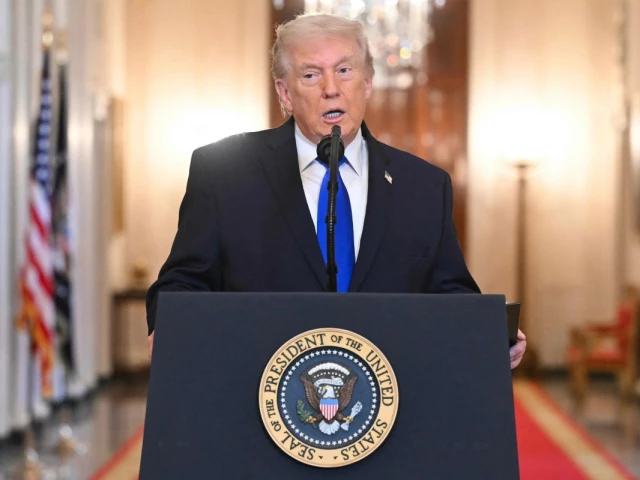
US President Donald Trump. PHOTO: AFP/File
TEHRAN/WASHINGTON:
Iran has displayed a defiant stance with a top leader saying he saw no room for diplomacy in the ongoing conflict sparked by joint US-Israeli strikes, while President Donald Trump insisted the war was all but over.
Iranian officials have said efforts to mediate a ceasefire are irrelevant as long as military clashes persist, while Iranian leaders have insisted the country has no intention of harming ordinary Americans, even as they have warned Washington against targeting civilians.
Trump said in a CBS interview that the U.S.-Israeli war with Iran was “pretty much” over, without elaborating. “I think the war is almost total. They have no Navy, no communications, no Air Force,” Trump told CBS News by telephone.
Kamal Kharazi, an adviser to the supreme leader’s office, previously said there was no immediate diplomatic prospect. “I don’t see any more room for diplomacy,” Kharazi said in an interview with CNN in Tehran, adding that Iran could sustain the war for a long time.
Kharazi’s remarks follow the country’s decision to strengthen its political leadership following the assassination of Supreme Leader Ali Khamenei in the first wave of US-Israeli strikes that began on February 28.
Iran’s Assembly of Experts has chosen Mojtaba Khamenei, the son of the assassinated leader, as the country’s new supreme leader, testifying to the continuity within Iran’s political and religious establishment despite the upheaval caused by the conflict.
Iranian officials said their armed forces were carrying out “managed and progressive offensive operations” in the region. In further strikes on energy installations in the Gulf, the vast Al Ma’ameer oil facility in Bahrain was hit, causing fire and damage.
Bahrain later said the fire at the oil facility had been brought under control, but state energy company Bapco declared force majeure after the strike – the latest Gulf producer to activate the legal clause, after Qatar and Kuwait.
Bahrain said another Iranian drone attack on the island of Sitra injured 32 people overnight. All the injured were Bahraini citizens and there were four “serious cases”, including children, the Health Ministry said in a statement carried by the official news agency.
The Saudi Defense Ministry said the kingdom shot down and destroyed two waves of drones heading towards the Shaybah oil field in the southeast of the country. NATO said it had intercepted a second ballistic missile fired from Iran into Turkish airspace.
Explosions were also heard Monday night and at the end of the day in Doha, and emergency sirens sounded in Manama, AFP journalists noted. Qatar said it had intercepted 17 ballistic missiles and six drones launched from Iran, without causing any casualties.
Kuwaiti authorities announced a missile and drone attack and the Defense Ministry said its army was working to intercept the salvo. The UAE said its air defenses detected 15 ballistic missiles, destroying 12, while three fell at sea, and intercepted 17 of 18 drones.
Two Emirati soldiers have meanwhile been killed when their helicopter crashed due to a “technical malfunction”, the Abu Dhabi Ministry of Defense said. The plane crashed while the crew was carrying out their national service inside the country, the statement added.
The Emirati deaths bring to 23 the number of people killed in the Gulf since the start of the war, including 10 civilians. The latest strikes came after Washington ordered embassy staff to leave Saudi Arabia, following a series of attacks targeting the kingdom.
A U.S. soldier died after being wounded in an attack last week in Saudi Arabia, the military said, bringing the number of U.S. troops killed in the war to seven. Army Sergeant Benjamin Pennington, 26, was injured at Prince Sultan Air Base.
Support for the new leader
Meanwhile, thousands of Khamenei supporters gathered in Tehran’s Enghelab Square to pledge allegiance to the new leader. The political establishment has also rallied around Mojtaba Khamenei, pledging support for her leadership during this time of national crisis.
Security chief Ali Larijani said the appointment of the new supreme leader had plunged the United States and Israel into “despair.” Iran’s Revolutionary Guards also pledged their full obedience to the new leader, saying they were ready to follow his orders.
The choice of Mojtaba Khamenei appeared to dampen hopes for a quick diplomatic resolution, with Iranian officials and advisers indicating the conflict could continue for a prolonged period.
Iranian Foreign Minister Seyed Abbas Araghchi said Tehran does not want to harm American civilians during the conflict with the United States and Israel, emphasizing that the Iranian government distinguishes between American public opinion and political leaders in Washington.
Iranian Foreign Ministry spokesman Esmaeil Baghaei said any discussion of ceasefire talks was irrelevant while military operations were ongoing. “At this particular juncture, talking about anything other than defending our homeland is irrelevant,” Baghaei said, adding that Iran did not start the conflict but was responding to an imposed war.
He also rejected accusations that Iran had launched attacks on neighboring countries, including Turkey, Cyprus and Azerbaijan, insisting that no offensive had been launched from Iranian territory towards these states.
Baghaei suggested that some incidents may have been staged to create divisions between Iran and neighboring countries, warning that such actions could constitute attempts to undermine regional relations.


