
Iran’s new supreme leader injured but “safe and sound”; Three ships hit by projectiles in the Strait of Hormuz
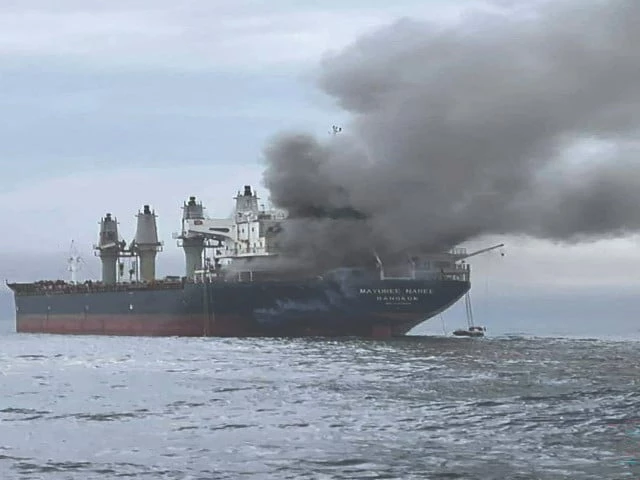
Smoke rises from the Thai bulk carrier “Mayuree Naree” near the Strait of Hormuz after an attack. Photo: AFP
WASHINGTON/TEHRAN:
President Donald Trump signaled again Wednesday that there could be a quick end to the U.S. war against Iran, saying there was little left in the country for U.S. forces to attack, even as Iranian President Masoud Pezeshkian on Wednesday set the conditions for what he called a war “initiated by the Zionist regime and the United States” as the Middle East conflict drags on.
There is “virtually nothing left to target” and the war will end “soon,” Trump said in an interview with Axios. “Whenever I want it to end, it will end.”
Trump has repeatedly given mixed messages about the war’s timeline and goals, but he also said Monday that the end could come “soon.”
In an article on X, he said: “In discussions with the leaders of Russia and Pakistan, I reaffirmed Iran’s commitment to peace in the region. The only way to end this war – started by the Zionist regime and the United States – is to recognize Iran’s legitimate rights, payment of reparations and firm international guarantees against future aggression.
Three ships were hit by unknown projectiles in the Strait of Hormuz, maritime security and risk companies said Wednesday, bringing to at least 14 the number of ships hit in the region since the start of the Iranian conflict.
The Thai-flagged dry bulk carrier Mayuree Naree was hit by “two projectiles of unknown origin” while crossing the strait on Wednesday, causing a fire and damaging the engine room, the ship’s Thai operator, Precious Shipping, said in a statement.
The U.S. Navy has refused near-daily requests from the shipping industry for military escorts through the Strait of Hormuz since the start of the war with Iran, saying the risk of attacks is too high at the moment, sources familiar with the matter told Reuters. Trump said the United States was prepared to provide naval escorts whenever necessary.
Earlier on Wednesday, the Japanese-flagged container ship ONE Majesty suffered minor damage from an unknown projectile 25 nautical miles (46 km) northwest of Ras Al Khaimah, United Arab Emirates, two maritime security companies said.
A third ship, a bulk carrier, was also hit by an unknown projectile about 50 miles northwest of Dubai, maritime security companies said.
The projectile damaged the hull of the Marshall Islands-flagged Star Gwyneth, maritime risk management company Vanguard said, adding that the ship’s crew was safe. Owner Star Bulk Carriers said the ship was hit in the hold area while anchored. There were no injuries to the crew and no listing.
Iran’s new supreme leader injured
Iran’s new supreme leader, Mojtaba Khamenei, is injured but “safe and sound”, the president’s son said Wednesday, offering the first official explanation for why the 56-year-old has not been seen since his appointment over the weekend.
“I learned that Mr. Mojtaba Khamenei was injured. I asked friends who had connections,” Yousef Pezeshkian, who is also a government advisor, wrote in a message on his Telegram channel. “They told me that, thank God, he is safe and sound,” added the president’s son Masoud Pezeshkian.
Mojtaba Khamenei, until now a quiet but powerful figure behind the scenes, was named Iran’s number one leader after her father Ali Khamenei was assassinated in an airstrike at the start of the US-Israeli war against the Islamic republic.
But questions have multiplied about his location and physical condition after his appointment by the religious body of the Assembly of Experts, the new supreme leader having not yet been seen, let alone spoken, in public.
In a report published Wednesday, the New York Times, citing three unnamed Iranian officials, said Khamenei “suffered injuries, including to his legs, but was alert and sheltering in a highly secure location with limited communications.”
Damaged sites
At least 17 U.S. military, diplomatic and air defense sites in the Middle East have been damaged by Iranian drone and missile strikes since the conflict in the region began, according to a New York Times analysis on Wednesday.
The report said Iran responded to U.S.-Israeli attacks by targeting U.S. facilities in the region, striking embassies, killing U.S. troops and damaging military bases and air defense infrastructure.
The New York Times has identified at least 17 damaged U.S. sites, several of which have been struck more than once since the conflict began, based on high-resolution commercial satellite imagery, verified social media videos and statements from U.S. officials and Iranian state media.
At least 150 U.S. troops have been injured in the 10-day war with Iran, two people familiar with the matter told Reuters on Tuesday.
The number of victims has not previously been communicated. Before Reuters published this figure, the Pentagon had disclosed only eight seriously injured U.S. personnel.
In a statement released after Reuters published its report, the Pentagon put the figure at around 140 injuries and said the vast majority of them were minors.
“Since the start of Operation Epic Fury, approximately 140 U.S. service members have been injured in 10 days of sustained attacks,” said Pentagon chief spokesperson Sean Parnell.
He said 108 of the injured soldiers had already returned to duty.
Parnell said the eight seriously injured service members were receiving the highest level of medical care.
(Contributed by News Desk)


