
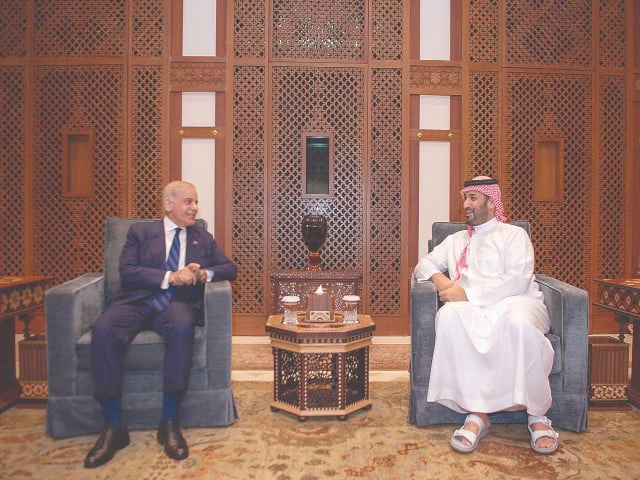
The Prime Minister assures MBS: Pakistan remains firm towards Saudi Arabia; CDF Munir and Dar assist the Prime Minister in discussions; Discussions focus on Iranian strikes
Prime Minister Shehbaz Sharif meets Saudi Crown Prince and Prime Minister Mohammed bin Salman in Jeddah. Photo: APP
ISLAMABAD:
Prime Minister Shehbaz Sharif on Thursday assured Saudi Arabia of Pakistan’s full “solidarity and support” during a meeting with Crown Prince Mohammed bin Salman in Jeddah, as Islamabad stepped up diplomatic efforts to prevent further escalation in the Middle East amid continued Iranian strikes against Gulf states.
The prime minister, who visited Saudi Arabia amid a deteriorating regional situation, held a restricted meeting with the Saudi crown prince, who is also the kingdom’s prime minister, according to a statement issued by the prime minister’s office.
Deputy Prime Minister and Foreign Minister Ishaq Dar and Chief of Army Staff and Chief of Defense Force Field Marshal Syed Asim Munir were also present during the talks.
An official press release issued by the Prime Minister’s Office provided limited information on the nature and scope of the discussions. Sources nevertheless indicated that there were in-depth discussions on the current situation, with particular reference to Iranian strikes against Saudi Arabia.
On the day the prime minister visited Jeddah, Saudi defense officials said they had intercepted more missiles and drones fired by Iran.
“At the start of the meeting, Shehbaz conveyed his respectful greetings and best wishes to Saudi King Salman bin Abdulaziz Al Saud and expressed appreciation for the kingdom’s long-standing support to Pakistan,” according to the statement from the Prime Minister’s Office.
The prime minister also expressed Pakistan’s “full solidarity and support” for Saudi Arabia in what the statement described as a difficult period.
The two leaders had an in-depth exchange of views on recent developments in the region and agreed to work together for regional peace and stability.
“The Prime Minister assured His Royal Highness that Pakistan will always stand firmly with the Kingdom of Saudi Arabia and strive to realize their mutual desire for peace in the region,” the statement said.
The meeting took place during an unscheduled one-day visit by the prime minister to Saudi Arabia that officials said was part of Pakistan’s diplomatic efforts to help defuse tensions between Iran and Gulf states.
The hasty trip came a day after the prime minister held a telephone conversation with Iranian President Masoud Pezeshkian, reflecting Islamabad’s growing concern over the rapidly evolving situation in the region.
Officials said Pakistan was walking a delicate diplomatic tightrope as the conflict entered its third week. Although Islamabad maintains close strategic and security ties with Riyadh, Iran remains Pakistan’s immediate neighbor with whom it shares complex political, economic and security relations.
The diplomatic sources said Islamabad had intensified its contacts with key regional capitals amid concerns that continued Iranian missile and drone strikes on Gulf states could trigger a wider regional conflict.
According to officials close to the discussions, Pakistan urged Tehran to avoid targeting Gulf countries, particularly Saudi Arabia, warning that such actions could significantly escalate tensions.
The Iranian president had earlier expressed his regrets to the Gulf countries and indicated that Tehran would refrain from attacking them unless it was attacked first. However, reports of continued strikes against Saudi Arabia and other neighboring states have increased fears of further escalation.
Foreign Ministry spokesperson Tahir Andrabi earlier said that the prime minister’s visit to Saudi Arabia was part of the ongoing coordination between the two countries on regional peace and security issues.
“The Prime Minister’s visit should be seen in the broader context of Pakistan’s efforts to advocate and facilitate an early cessation of hostilities and violence in the region, with the aim of paving the way for dialogue and diplomacy,” Andrabi said.
During Wednesday’s phone call with the Iranian president, Shehbaz exchanged Ramazan greetings and discussed the developing regional situation.
The Prime Minister also offered condolences on the death of Iran’s Supreme Leader, Ayatollah Ali Khamenei, and congratulated Iranian leaders on Ayatollah Mojtaba Khamenei’s assumption of responsibility.
The Foreign Ministry reiterated that Pakistan condemned the attacks on Iran, but also strongly denounced Iranian strikes against Gulf states, highlighting Islamabad’s attempt to maintain a balanced stance amid the intensifying crisis.
“As you know, Pakistan condemned the unjustified attacks against the Islamic Republic of Iran,” Andrabi said, referring to previous strikes carried out by the United States and Israel.
“At the same time, Pakistan also strongly condemned Iran’s attacks on the brotherly countries of Saudi Arabia, Bahrain, Jordan, Kuwait, Qatar and the United Arab Emirates, and stands in solidarity with all these countries,” he added.
Pakistan has also expressed concern over attacks targeting other states in the region, including Turkey and Azerbaijan, warning that such developments could push the region towards further escalation.
The officials said Islamabad remained in close contact with several regional capitals as part of its diplomatic activities.
Deputy Prime Minister and Minister of Foreign Affairs Ishaq Dar held multiple conversations with his Iranian counterpart while maintaining frequent contacts with the leaders and officials of the Gulf countries, Oman and the United Arab Emirates.
The foreign ministry said Pakistan was trying to play the role of “bridge builder” by encouraging restraint and maintaining open communication channels between regional capitals.
“Our main position on issues concerning sovereignty, international law and the United Nations Charter, as well as on dialogue and diplomacy, is respected in regional capitals,” Andrabi said.
“This allows us to maintain communication channels between the capitals concerned,” he added.


