
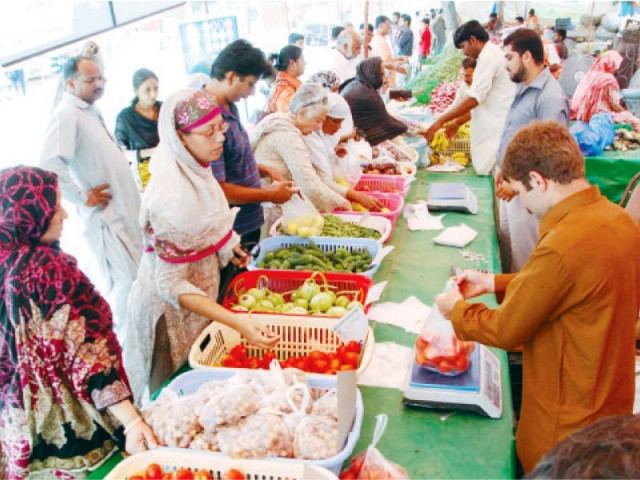
Ramazan Bazaar. PHOTO:EXPRESS
LAHORE:
As Ramazan draws to a close, the government’s campaign to enforce official price lists in Lahore’s markets appears to have brought little tangible relief to consumers, with traders continuing to sell essential goods well above the advertised rates.
Market research suggests that most food items – from vegetables and fruits to poultry and dairy – remain largely unavailable at government-set prices. For many residents, the weekly price lists published by the district administration have increasingly become symbolic rather than enforceable.
Officials said inspection campaigns were underway and sanctions were being imposed to curb excessive prices.
However, consumers say enforcement efforts have largely focused on Sahulat Ramazan bazaars – subsidized markets operating under a separate administrative structure designed to provide products at controlled prices.
Critics say the focus on these bazaars has distracted from the much larger network of neighborhood markets where most residents buy their daily groceries. Instead of ensuring compliance with rules at open markets, the district administration and the Special Assistant on Food Safety and Consumer Protection have repeatedly pointed to visits to Ramazan bazaars as proof of enforcement of the rules.
Analysts say that while problems with subsidized bazaars can often be resolved through administrative coordination, the real challenge lies in monitoring the thousands of outlets operating across the city.
In the markets, violations of official prices remain commonplace. Essential commodities – including milk, curds, pulses and perishables – are rarely sold at the prices set by the authorities.
Deputy commissioners occasionally impose fines during inspections, but traders frequently return to overcharging once the officials leave. Traders in several markets acknowledged that these sanctions had a limited deterrent effect.
Instead, fines are often treated as a routine business expense, with the added cost ultimately passed on to customers through higher prices.
Consumers have called for a robust price control strategy that prioritizes consistent monitoring of all markets, tougher penalties for repeat violators, and enforcement mechanisms that can translate official policies into real relief for households.
The latest weekly price list illustrates the growing gap between official prices and those on the current market.
Prices of live chicken increased by Rs 10 per kilogram in the official list to Rs 339-353, but the product was largely unavailable at these rates in many districts. Chicken meat increased by Rs14 to an official price of Rs511 per kg, while consumers paid between Rs560 and Rs630. Boneless chicken hovered around Rs950 per kg in several regions.
Vegetable markets have seen a similar trend. New sweet-skinned potatoes were officially priced at Rs 18-20 per kg but sold at Rs 30-40.
Tomatoes remained officially priced at Rs 60-65 per kg, although retail prices ranged between Rs 120-160. Onions increased by Rs 8 per kg to Rs 55-60 but continued to sell for between Rs 80 and Rs 120.
Chinese lemons remained quoted at Rs 60-65 per kg but sold between Rs 120 and 250.
Peas remained officially priced at Rs38 to Rs40 per kg, but sold between Rs80 and Rs100. Beetroot retailed between Rs200 and Rs400 per kg. Coriander was available at around Rs50 per packet, while turnips, priced at Rs23-25 per kg, were selling at Rs60-80. Mustard greens, fixed at Rs 28-30 per kg, retailed for around Rs 60.
Fruit markets also present significant disparities. Apples were officially priced at Rs 250 to Rs 420 per kg, but sold at Rs 350 to Rs 700 depending on quality. Category A bananas were priced at Rs 215-240 per dozen but sold at Rs 300-350, while Category B, priced at Rs 125-140 per dozen, retailed at Rs 200-250.
Kandhari pomegranates were priced at Rs 601-630 per kg but sold at Rs 800-1,000. Melons, officially reduced to Rs 100-135, are retailed at Rs 200-250 per kg. Strawberries, priced at Rs 247-260 per kg on the official list, were selling at Rs 300-350, while grapes, officially priced at Rs 420-600 per kg, were retailing at Rs 600-1,000.


