
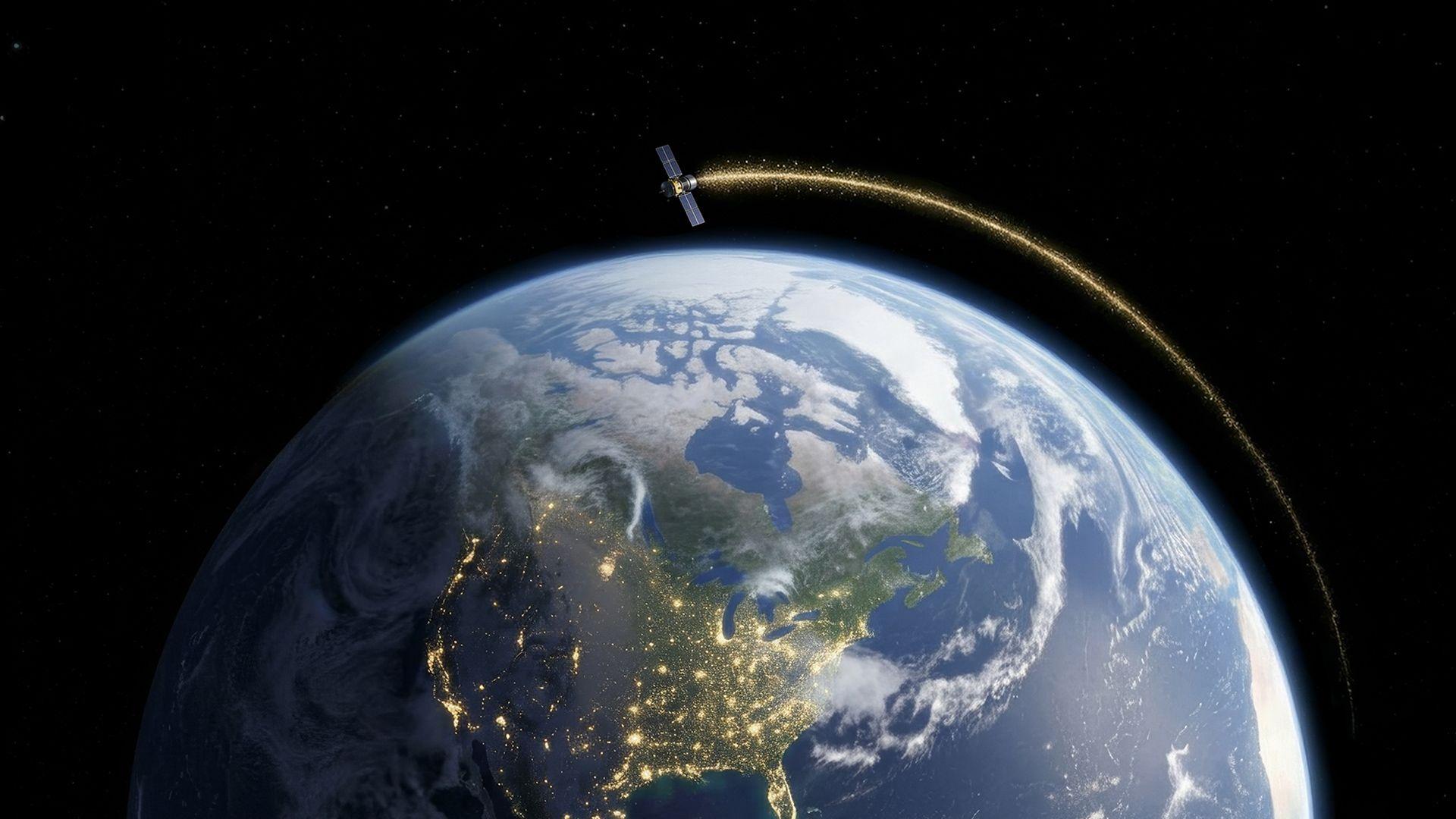
- Nvidia unveils hardware for orbital data centers
- The Space-1 Vera Rubin module will deliver huge increases in power and efficiency, with the RTX PRO 6000 Blackwell Server Edition GPU returning to Erath to process data
- Six space companies have already signed up to work with Nvidia
Nvidia has outlined its plans to help usher in the next generation of “space innovation,” including boosting data centers in space with the latest AI capabilities.
At Nvidia GTC 2026, the company revealed how its hardware helps partners and “space operators” become more efficient and powerful, especially for operations like disaster response, climate and weather forecasting, and more.
This includes the Space-1 Vera Rubin Module, Nvidia’s latest tool for orbital data centers (ODCs) running advanced LLMs and foundation models, which includes a Rubin GPU providing up to 25 times more AI compute than its H100, and a high-bandwidth interconnect to process massive data streams from space instruments in real time.
Article continues below
Looking to the future
Nvidia notes that such power increases will enable spatial inference, with its IGX Thor and Jetson Orin platforms offering energy-efficient, high-performance AI inference, image sensing and accelerated data processing to enable true edge computing on-orbit in a compact module.
It will also help AI applications operate seamlessly, “from ground to space and from space to space,” while supporting increasingly complex missions and enabling ODCs to become widespread.
Elsewhere, Nvidia’s data center platforms on Planet Earth, including the RTX PRO 6000 Blackwell Server Edition GPU, will provide high-throughput, on-demand processing for geospatial intelligence, delivering up to 100x faster performance than traditional CPU-based batch systems when analyzing massive image archives such as weather data.
The platform will also help AI applications operate seamlessly, “from ground to space and from space to space,” while supporting increasingly complex missions and enabling ODCs to become widespread.
All of this is expected to help unlock processes such as on-orbit analysis, autonomous scientific discovery and rapid information generation, pushing space technology even further, as six commercial space companies have already reportedly deployed the Space-1 Vera Rubin module.
“Space computing, the final frontier, is here. As we deploy constellations of satellites and explore deeper into space, intelligence must live where the data is generated,” said Jensen Huang, founder and CEO of Nvidia.
“AI processing in space and ground systems enables real-time sensing, decision-making, and autonomy, transforming orbital data centers into instruments of discovery and spacecraft into self-navigation systems. With our partners, we are extending Nvidia beyond our planet, boldly taking intelligence where it has never gone before.”
Follow TechRadar on Google News And add us as your favorite source to get our news, reviews and expert opinions in your feeds. Make sure to click the Follow button!
And of course you can too follow TechRadar on TikTok for news, reviews, unboxings in video form and receive regular updates from us on WhatsApp Also.


