
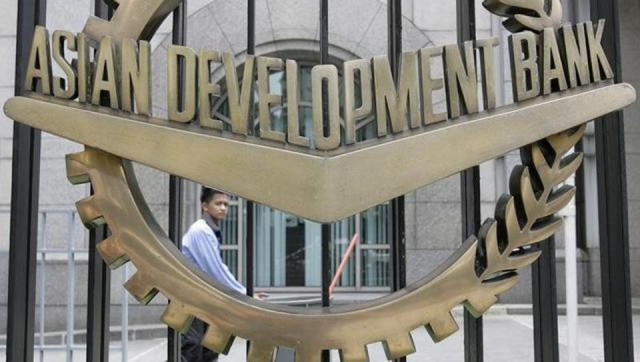
An employee walks past the headquarters of the Asian Development Bank (ADB) in Manila. PHOTO: REUTERS
ISLAMABAD:
The Asian Development Bank has unanimously approved a five-year indicative lending strategy of $10 billion to $12 billion, which includes allocations to finance critical mineral exploration and the dilapidated Pakistan Railways Main Line I project.
The Indian executive director also supported the strategy at the ADB board meeting, although he made some comments on Pakistan’s governance and debt issues.
The ADB on Wednesday launched a new Country Partnership Strategy (CPS) for Pakistan, 2026-2030, setting out a roadmap to support the country’s transition to sustainable and inclusive growth through private sector-led development, according to the lender’s Manila-based field office.
The lender said the five-year strategy will focus on three pathways: enabling private sector development, advancing inclusion and empowerment, and building resilience and sustainability.
The ADB has not formally indicated the amount of the financial package. But multilateral and government officials have said that, based on current annual approvals, the indicative amount is $10 billion to $12 billion over a five-year period.
Pakistan and the ADB would negotiate the individual projects as part of the overall package over a period of five years.
They said the size could further increase if Pakistan’s credit rating improves. All three credit rating agencies recently upgraded Pakistan, but even the new ratings are not enough to secure cheaper long-term loans in debt markets.
Pakistan currently benefits from an average of $2 billion in new loans from the ADB, half of which is concessional financing. Last year, the ADB approved record loans of $2.6 billion for Pakistan.
According to the approved CPS, ADB will extend its financing, policy support and technical assistance to promote the development of critical minerals value chains in Pakistan.
“The new CPS is designed to address Pakistan’s structural challenges and promote robust and sustainable growth, which benefits the entire country, particularly the poor and vulnerable,” said Emma Fan, ADB Country Director for Pakistan.
“It promotes strategic investments and reforms in key sectors to boost economic growth and create jobs. The ADB looks forward to supporting Pakistan’s public and private sectors in achieving this ambitious agenda,” she added.
The ADB will help maximize the value of Pakistan’s critical mineral deposits by supporting transparent governance frameworks, integrated infrastructure and strengthened social and environmental safeguards, the partnership document said.
The lender pointed out that Pakistan is home to significant deposits of copper, barite and chromite, as well as other minerals like gold, salt and marble. Despite their mineral wealth, extractive industries contribute only about 2.4% of Pakistan’s GDP and employ only about 0.2% of the workforce.
Mineral exports are modest. The gap between economic potential and the contribution of the mining sector reflects systemic challenges related to infrastructure, governance and regulatory frameworks.
The AfDB will support the expansion of critical minerals opportunities through modernized geodata systems, co-financing arrangements, and improved regulatory and fiscal frameworks.
According to the PSC, the ADB will also assist in the effective establishment and implementation of sovereign wealth funds to ensure equitable sharing of benefits and enable long-term investments for the sustainable development of Pakistan.
The lender also plans to provide a $500 million loan to support the reform of Pakistan’s pension and insurance systems and the development of capital markets to channel long-term savings into productive investments.
The five-year plan will also make allocations for infrastructure projects. Support for Main Line-I, Pakistan’s main rail artery, will be a key program under the new CPS, the ADB said.
He said the upgrading of tracks, signaling systems and stations would transform Main Line I into a modern and efficient transport route, capable of helping Pakistan fulfill its growing role in regional integration.
Beijing had initially decided to finance the Main Line-I project under the China-Pakistan Economic Corridor initiative. China later decided to withdraw the bilateral financing agreement due to Pakistan’s growing indebtedness.
The ADB said its future financing will also extend to the modernization of ports in addition to the development of national and provincial highways and highways.
The AfDB will deepen its support for trade and logistics by modernizing and integrating supply chains and simplifying and harmonizing cross-border trade procedures.
The AfDB and the World Bank have provided loans in these areas, but progress often falls short of the criteria agreed upon when these loan agreements were signed.
The partnership framework document states that poverty in Pakistan remains high at 45% in the last fiscal year and is 2.5 times more prevalent in rural areas than in urban areas. The richest 10% of households earn 42% of the country’s income, and the poorest 50% earn only 13%.
The five-year program will also strengthen decision-making in disaster risk management, including through improved information management systems. The ADB will help Pakistan improve its climate governance, mobilize climate finance and increase climate investments to advance resilience, adaptation and mitigation.
The lender pointed out that Pakistan’s production and export bases are narrow, its business environment is difficult and its public financial management is unbalanced. Infrastructure deficits are characterized by an inefficient energy sector, insufficient investment in rail and deficiencies in urban services.
More than 200 state-owned enterprises and government-owned public entities are valued at the equivalent of 48% of GDP. The ADB said the heavy public sector footprint, complex regulatory environment, overlapping and conflicting oversight responsibilities, and ineffective accountability mechanisms contribute to persistent governance challenges.
Among the 215 countries and territories assessed, Pakistan scores low, near the bottom quintile, on global governance indicators, the report added.


