
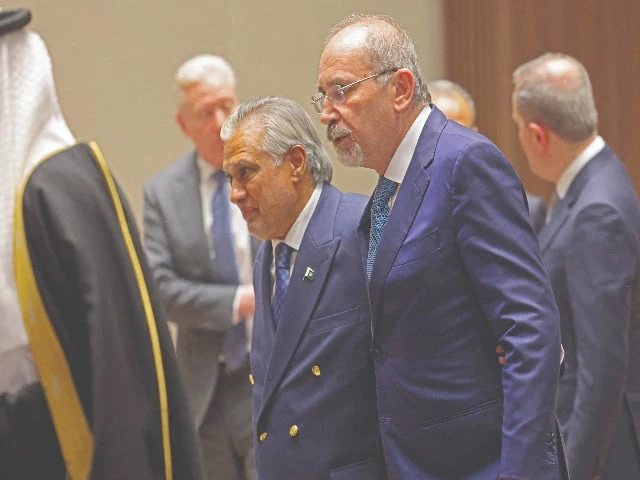
Deputy Prime Minister and Minister of Foreign Affairs Ishaq Dar and Jordanian Foreign Minister Ayman Safadi attend the consultative ministerial meeting in Riyadh. Photo: AFP
ISLAMABAD:
As Deputy Prime Minister and Foreign Minister Ishaq Dar arrived in Riyadh on Wednesday for a crucial ministerial meeting of key Arab and Muslim countries, Pakistan’s main objective was to promote dialogue and de-escalation in an increasingly volatile regional crisis.
However, even before the meeting of foreign ministers from Saudi Arabia, Azerbaijan, Bahrain, Egypt, Jordan, Kuwait, Lebanon, Pakistan, Qatar, Syria, Turkey and the United Arab Emirates could officially begin, the situation took a dramatic turn.
New Israeli strikes targeted Iran’s energy infrastructure, provoking a fierce response from Tehran that spread across the Gulf, hitting critical facilities and raising fears of a wider regional war.
This escalation has left Arab foreign ministers in an intransigent mood. “Pakistan’s work was reduced even before the meeting started,” a senior diplomat told The Express PK Press Club, describing the atmosphere as tense and emotionally charged.
Diplomatic sources said several Arab states were unwilling to respond to calls for restraint or diplomacy with Iran, preferring a strong and unequivocal condemnation of Tehran in the joint statement.
Pakistan, which is trying to position itself as a bridge between Iran and the Gulf countries, found itself facing one of the most delicate diplomatic challenges in recent years.
Sources said Islamabad had engaged in intense behind-the-scenes diplomacy to calm tempers and soften the language of the joint statement. When discussions began on the draft declaration, Gulf countries sought to send a strong message holding Iran solely responsible for the escalation, while Pakistan argued for a more balanced approach.
“We convinced our Arab friends to dilute the statement to some extent,” another diplomat said, adding that Islamabad also sought to make explicit references to Israel and the broader causes of instability in the Middle East.
The final joint statement, issued after the consultative meeting in Riyadh, strongly condemned Iranian missile and drone attacks against several countries, including the Gulf states, calling them unjustifiable under any circumstances.
He called on Tehran to immediately cease hostilities, respect international law and refrain from any actions threatening regional security, including maritime routes.
At the same time, the statement also included a condemnation of Israel’s actions in Lebanon, particularly its “expansionist policy”, reflecting a key demand from Pakistan during the negotiations.
Despite this partial success, officials acknowledged that Pakistan must walk a “tight diplomatic rope” to maintain relations with Iran and its key Gulf allies.
Meanwhile, in an official statement issued by the Ministry of Foreign Affairs, Pakistan stressed the need to address the root causes of the crisis.
The statement emphasized that while Islamabad supports the sovereignty and territorial integrity of all states in the region and condemns attacks on civil and energy infrastructure, lasting peace cannot be achieved without addressing the underlying causes of the conflict.
In this context, Pakistan “condemned in the strongest possible terms Israel’s continued aggression and provocations,” linking broader regional instability to long-standing disputes and policies.
During the meeting, Dar reiterated Pakistan’s call for an immediate cessation of hostilities and stressed that diplomacy is the only viable way forward. He also warned against actions that could jeopardize regional energy security and worsen global economic challenges.
The Foreign Ministry said Pakistan would continue its diplomatic efforts and maintain a “constructive role” in efforts aimed at de-escalation.
However, diplomatic sources warned that with positions hardening and distrust intensifying, the space for mediation was rapidly shrinking, making it increasingly difficult for Pakistan to perform a balancing act in an already unstable region.
Meanwhile, Dar, stressing the importance of preserving the unity of the Muslim Ummah, called for an early end to the ongoing conflict and reiterated Pakistan’s call for dialogue and diplomacy.
Addressing the ministerial meeting of Arab and Islamic countries, he expressed his full support for the territorial integrity, sovereignty and political independence of all brotherly regional states, and stressed the need to end all attacks on their territories.
The Deputy Prime Minister stressed the importance of addressing the root causes of the crisis and, in this regard, condemned in the strongest terms Israel’s continued aggression and provocations against countries in the region.
He also condemned attacks on civilians, as well as energy and critical infrastructure, and called for an end to such actions.
Dar urged all parties to refrain from any actions that could undermine regional energy security and exacerbate global economic challenges.
He briefed the participants on Pakistan’s ongoing diplomatic efforts to resolve the crisis and reiterated Islamabad’s desire to continue to play a constructive role in resolving regional security challenges.
During the visit, Dar conveyed a message of strong solidarity and unwavering support to Saudi Foreign Minister Prince Faisal bin Farhan Al Saud on behalf of the government and people of Pakistan.
He also attended a quadrilateral meeting of foreign ministers of Egypt, Pakistan, Saudi Arabia and Turkey, held on the sidelines of the summit.


