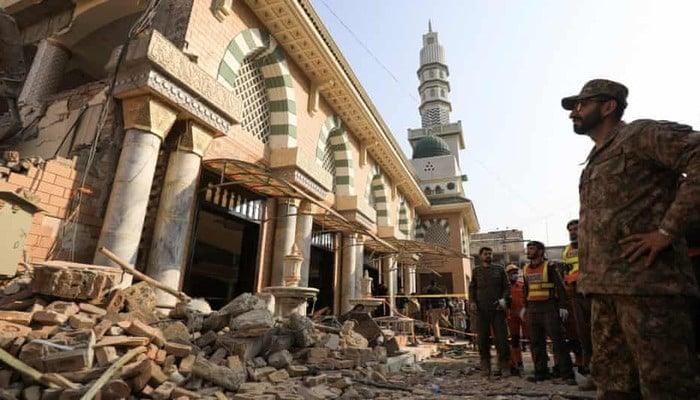
Pakistan is once again facing a sharp rise in militant violence, marking one of the most difficult phases of internal security since the peak of terrorist incidents in 2010.
In the years since the US withdrawal from Afghanistan in 2021, attacks have increased in frequency, coordination and lethality. Yet the more troubling reality is not only the resurgence of activism, but also the state’s continued reliance on a largely kinetic response to what are in fact two very different threats.
Pakistan today faces two distinct theaters of violence, each driven by distinct motivations, actors and end goals. Treating them from a uniform security perspective risks leading to strategic stagnation.
The first theater is centered on Khyber Pakhtunkhwa and the Pashtun belt of Balochistan, where militancy is ideologically motivated in the name of religion. Groups such as the TTP and the Haqqani Network, supported by the Afghan Taliban and transnational actors like ISIS and the remnants of Al Qaeda liaison networks, seek to seize a patch of territory to establish a rigid and exclusionary version of a Sunni theocratic state.
The return to power of the Afghan Taliban has changed the operational environment in their favor. Whether through direct support, tolerance or inability to act, the space available to anti-Pakistan militant groups across the border has expanded. The TTP demonstrated renewed organizational coherence and operational capacity, carrying out increasingly sophisticated attacks with weapons left behind by the United States.
The second theater is in the Baloch-majority districts of Balochistan, where the conflict is not religious but political. Baloch insurgent groups base their struggle on grievances of political marginalization, inequitable distribution of resources, lack of provincial autonomy and human rights concerns. Their goals range from greater autonomy within the federation to outright separatism.
These are fundamentally different conflicts. One is ideological and transnational; the other is political and sub-nationalist. Yet Pakistan’s response to both situations remains strikingly similar: intelligence-led military operations, recently increasingly supplemented by air power, including cross-border strikes against militant sanctuaries.
There is no doubt that such operations brought tactical gains. However, tactical success has not translated into lasting stability. Militant violence temporarily subsides, only to reappear in more adaptive forms. The problem is not the use of force per se; it is an excessive dependence on it.
A critical but often overlooked dimension of this challenge is the weakening of Pakistan’s institutional coordination framework. The mandate to integrate and harmonize national counter-terrorism efforts lies officially with the National Counter-Terrorism Authority (Nacta). Effective coordination requires neutrality and the ability to align federal and provincial actors without institutional bias.
When coordinating agencies also participate in the operational domain, questions of territory, ownership, and institutional primacy inevitably arise, particularly with respect to civilian federal agencies and provincial counterterrorism ministries.
The result is a fragmented response architecture. Information can be shared, but policy coherence remains weak. Provincial counterterrorism services, already operating with limited capacity, lack a coherent national framework to align with, while civilian control appears increasingly marginalized. For now, Pakistan risks continuing to implement reactive measures rather than a unified national strategy.
Added to this institutional weakness is the ambiguity surrounding the political framework itself. The revised National Action Plan (NAP), currently being implemented under the banner of Azm-e-Istehkam, is touted as the central roadmap for the fight against terrorism. However, a closer look reveals that these are largely general, abstract goals rather than an actionable strategy. It does not clearly specify who is responsible for what, nor does it establish time-bound objectives or measurable criteria.
Without clearly assigned responsibilities and deadlines, even the best-intentioned policy goals risk remaining ambitious. Indeed, Pakistan has a declared policy direction in the form of a National Policy for Prevention of Violent Extremism 2024, but it lacks an implementation framework.
What is needed is a truly holistic national policy – one that places economic security at its heart, recognizing that instability, unemployment and regional disparities create fertile ground for both ideological activism and political insurgency. This must be complemented by integrated efforts in internal security, social development and foreign policy, particularly in managing relations with Afghanistan. The fight against terrorism cannot succeed independently of these broader functions of the state.
In the case of religious militancy in Khyber Pakhtunkhwa, Pakistan is engaged in a war of ideas as much as a war of weapons. Groups like the TTP and the Islamic State of Khorasan draw strength from discourses of religious legitimacy, anti-state rhetoric, and the exploitation of governance gaps.
Yet the state’s counter-narrative remains weak and fragmented. It mainly relies on the Pyam e Pakistan fatwa which states that suicide attacks and killing of innocents are against Islam, but does not tell the youth that the concept of nation-state and the evolution of social sectors are in accordance with the injunctions of Islam. The recent use of the labels of Fitna al Khawarij and Fitna al Hind appears to be a step in the right direction, but the neglected area of madrassa reforms still offers spaces for radicalization.
In Balochistan, the limits of a first kinetic approach are even more obvious. Political grievances cannot be resolved by force alone. Although security operations can quell insurgent activity, they do little to address the underlying causes that sustain it. Development initiatives, often presented as solutions, struggle to gain legitimacy when local populations feel excluded from the decision-making process or perceive the benefits as being external.
The absence of meaningful policy dialogue, transparent resource-sharing mechanisms and accountable local governance structures continues to worsen the trust deficit. As history shows time and time again, subnationalist insurgencies rarely end without political accommodation.
Recent signs of a more assertive posture, including cross-border strikes in Afghanistan, reflect growing frustration within Pakistan’s security establishment. However, escalation without a parallel diplomatic and political strategy carries significant risks, regional tensions, civilian fallout and increased radicalization. More importantly, it fails to address the key drivers of activism, ideology, governance deficits and political exclusion.
There is an urgent need to develop a coherent and comprehensive counter-terrorism strategy, which clearly distinguishes between the nature of threats and aligns responses accordingly. In Khyber Pakhtunkhwa, this means combining precise security operations with a robust ideological counter-offensive, better policing and better governance. In Balochistan, this requires a shift from a security-focused approach to a political approach, based on dialogue, inclusion and equity.
At the national level, restoring the authority of Nacta, going beyond the abstract formulations of the revised National Action Plan and translating Azm e Istehkam into a time-bound executable framework are no longer options but urgent necessities. The choice is now difficult: continue to manage violence through episodic force or confront its causes through a coherent national strategy? Without this change, the state risks remaining locked in a cycle in which tactical victories are repeatedly overtaken by strategic failure.
The writer is a former Inspector General of Police (Punjab) and a former acting Home Minister of Punjab.
Disclaimer: The views expressed in this article are those of the author and do not necessarily reflect the editorial policies of PK Press Club.tv.
Originally published in The News