
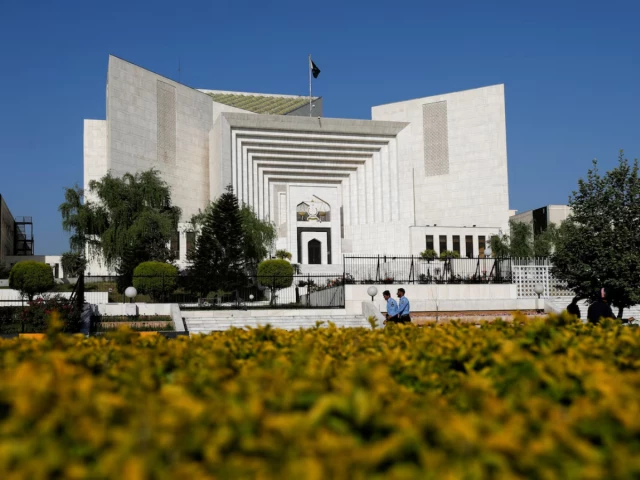
Police officers walk past the Supreme Court of Pakistan building, in Islamabad, Pakistan April 6, 2022. REUTERS
ISLAMABAD:
The Supreme Court has ruled that a charge cannot be made against an alleged colleague without first granting a preliminary hearing in contempt cases.
In a three-page judgment written by Justice Muhammad Ali Mazahar while hearing a contempt case, the court observed that a reading of the relevant section of the Contempt of Court Ordinance, 2003 clearly shows that before taking cognizance of it or fixing a date for framing a charge, the alleged contempt must be given an opportunity to hold a preliminary hearing.
He added that if duly satisfied that a prima facie case is made out, the court may then fix a date for framing of the charge in open court and proceed to decide the case.
A three-judge bench headed by Justice Muhammad Ali Mazahar heard the case.
The case concerns an individual who allegedly violated the order dated 03.09.2024 passed by the Sindh High Court (SHC) in his home jurisdiction.
The applicant, who is the respondent in this criminal appeal, has filed an application for contempt of court under section 204 and sections 3 and 4 of the Contempt of Court Order 2003.
After notice, a counter-affidavit was filed. The Single Judge SHC observed that Section 17(3) of the Ordinance requires a date to be fixed for framing the charge, and therefore fixed December 11, 2024 for framing the charge, after notifying the Advocate General of Sindh for his appearance to assist the court.
Feeling aggrieved, the petitioner challenged the order through an intra-judicial appeal, which was disposed of on November 19, 2024, with the parties directed to appear before the Single Judge for further proceedings.
However, the SC noted that in this case, the single judge, prima facie, without providing for the possibility of a preliminary hearing, directly fixed a date for framing the charge.
“In our view, there are some apparent lacunae in the record and this crucial issue was also overlooked by the learned Division Benches while disposing of the High Court appeal,” the order said.
The court set aside both the orders of the High Court as it was a contempt proceeding.
As to the contempt application, it will remain pending, and if the court wishes to initiate contempt proceedings, after providing an opportunity for a preliminary hearing based on the contempt application and the counter-affidavit filed by the alleged contempt, it may decide whether a prima facie case of contempt is established to proceed in accordance with law.
The appeal is allowed in the above conditions, the order states.


