
- Quantum battery scaling reduces charging time while increasing stored energy
- Collective molecular interactions accelerate energy transfer beyond the typical limits of conventional batteries
- Energy density increases as the number of participating molecules increases
Conventional battery design follows a predictable rule that increasing size results in longer charging times and proportional gains in capacity.
This new quantum battery shatters that assumption – not by a little, but in a way that seems fundamentally inconsistent with classical thermodynamics.
In a study published in Light: science and applicationsResearchers from CSIRO and RMIT University describe this behavior as superextensive, where performance improves faster than the system grows.
Article continues below
When bigger means faster, not slower
“That’s why your cell phone takes about 30 minutes to charge and your electric car takes overnight to charge,” said lead researcher Dr James Quach of CSIRO, Australia’s national science agency.
“Quantum batteries have this really special property: the larger they are, the less time they take to charge. »
This result arises from collective quantum interactions, in which individual components no longer behave independently but act in a coordinated manner that amplifies the efficiency of energy transfer.
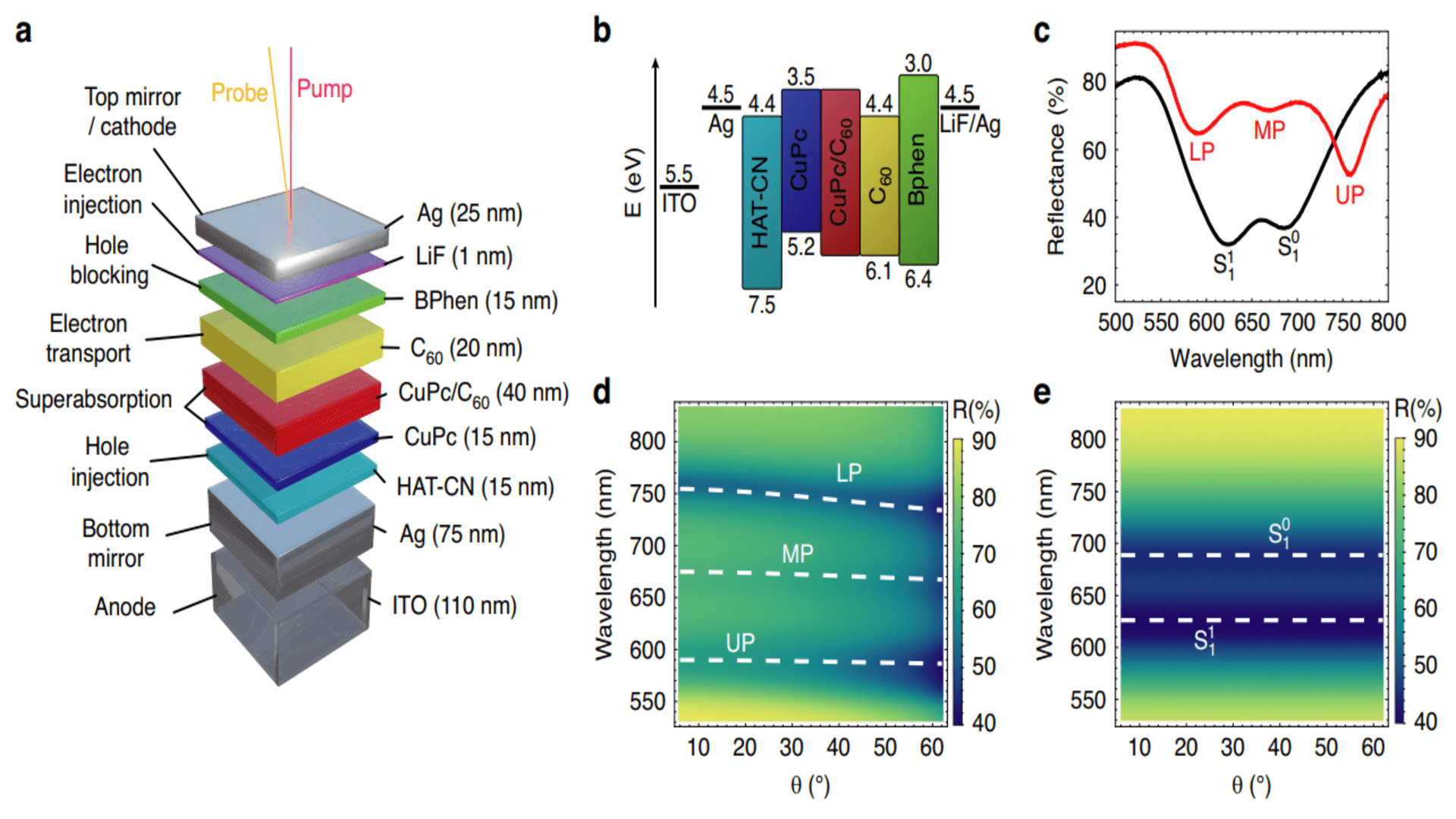
The device relies on a microcavity structure that confines light and strongly couples it with organic molecules such as copper phthalocyanine. When light enters this confined environment, it forms hybrid states called polaritons.
This interaction is not simply additive. As more molecules are introduced, the coupling strength increases collectively rather than linearly.
The result is more efficient energy absorption as the number of participating molecules increases. Scaling the battery doesn’t slow it down, but rather speeds up charging.
Unlike previous prototypes, this design incorporates layers that allow energy to be extracted in the form of electrical production, allowing a complete charge and discharge cycle.
Experimental measurements show that charging occurs on femtosecond timescales – quadrillions of a second.
More importantly, charging time decreases as the number of molecules increases, while stored energy and peak power increase, challenging classical expectations, where energy density generally remains constant regardless of system size.
Instead, energy density increases alongside faster charging, reinforcing the role of collective quantum effects.
After charging, the energy shifts to a metastable state rather than immediately dissipating.
Excited single states transform into triplet states through intersystem crossing, thereby extending the lifetime of the stored energy.
These states persist for nanoseconds – brief, but significantly longer than the initial excitation phase.
The system also enables energy extraction through integrated charge transport layers, converting stored energy into electrical current.
Output power increases more than proportionally with system size, reflecting the same very extensive scaling.
Although the efficiency gains remain limited, the improvement in photon-to-charge conversion suggests that the microcavity design improves performance.
This prototype demonstrates a complete operational cycle within a single quantum device.
However, the stored energy remains extremely low – only a few billion electron volts – which is insufficient for practical applications.
Follow TechRadar on Google News And add us as your favorite source to get our news, reviews and expert opinions in your feeds. Make sure to click the Follow button!
And of course you can too follow TechRadar on TikTok for news, reviews, unboxings in video form and receive regular updates from us on WhatsApp Also.


