
Says the government is not responsible for this increase and has introduced targeted subsidies to support vulnerable groups
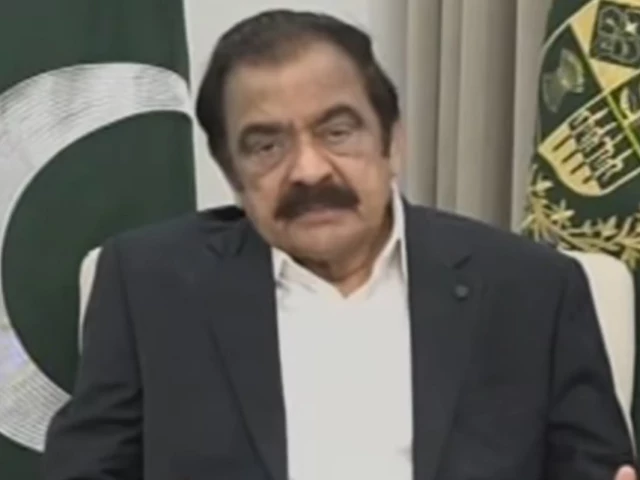
Advisor to the Prime Minister on Political Affairs, Rana Sanaullah. SCREENSHOT
Adviser to the Prime Minister on Political Affairs, Rana Sanaullah, on Friday defended the recent increase in oil prices, saying the government had made sustained efforts to protect the public from its impact and had introduced targeted subsidies to ease the burden on vulnerable groups.
The government on Thursday further increased the price of petrol by Rs 137 per liter to the highest ever level of Rs 458.4 after Prime Minister Shehbaz Sharif decided to impose more taxes on consumers. The government also increased the price of high-speed diesel to Pakistan’s highest level of Rs 520.35 per liter, an increase of Rs 185 per liter or 55 per cent.
Read: Government increases tax on petrol to Rs161 per liter and sets new price at Rs458 per liter
In a video statement, Sanaullah said the world is facing an unprecedented rise in global oil prices, which has affected Pakistan in the same way as other countries. “Faced with this situation, the prices of gasoline and diesel have been increased,” he explained.
He noted that the government had delayed passing on the increase to consumers by three weeks by adopting austerity measures and using financial resources.
“Initially, austerity measures were implemented, after which the Prime Minister established a fund. Around 129 billion rupees were spent from this fund, enabling the government to keep prices stable for three weeks,” he added.
However, he added, such measures could not be maintained indefinitely. He revealed that extensive consultations were held with the chief ministers of all provinces, as well as the leaders of Azad Jammu and Kashmir and Gilgit-Baltistan, alongside political, administrative and military leaders, to find ways to minimize the impact on the public. Following these deliberations, the government decided to put in place targeted subsidies.
Sanaullah said motorcycle users had been identified as one of the most vulnerable groups, while farmers would receive Rs 1,500 per acre to support them during the upcoming harvest season.
He added that freight transport operators would get subsidies ranging from Rs 70,000 to Rs 80,000 per month, depending on capacity, to avoid fare increases. Similarly, passenger bus operators would receive Rs 100,000 per month to keep ticket prices stable.
Defending the price hike, the advisor said the government was not responsible for the increase, instead attributing it to the ongoing war, which had driven up global fuel prices. “Everyone knows who started the war and why,” he noted.
Referring to concerns over fuel shortages, he said Pakistan had managed to avoid any disruption in supplies due to the continued efforts of the Prime Minister, contrasting the situation with other countries.
Read also: Gas price hike sparks protests in NA, JI announces nationwide action
Sanaullah criticized elements calling for protests against the government, saying they were ignoring his efforts and trying to incite the public for political purposes. “The government has been trying to keep prices low and reduce the burden on the poor. It is also working to end the conflict,” he said, adding that protests should instead be directed at those responsible for the war.
He warned that if the conflict continues for another two to four months, the situation could worsen globally, not just in Pakistan. “We must face these challenges together and avoid internal divisions,” he said.
Calling for restraint, he advised citizens to remain vigilant against those who seek to exploit the situation for personal or political gain.
“This is not a crisis that we caused,” he said. “We are among those working to resolve this problem and promote public welfare. As a determined and united nation, we will overcome this challenge as well.”


