
The minister said that electricity produced from fuel oil costs the public between Rs 60 and 80 per unit.
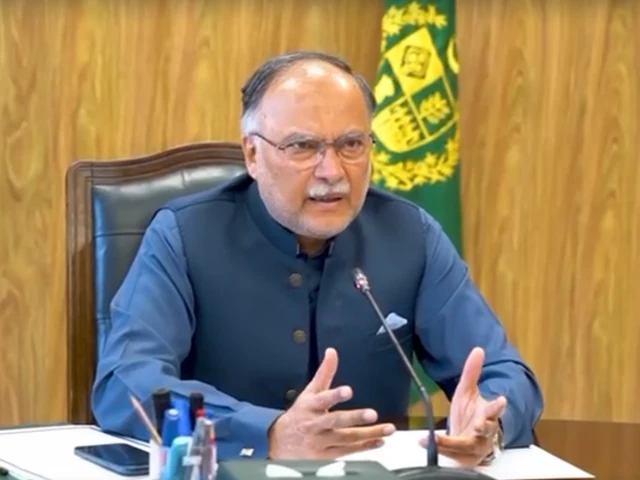
Planning Minister Ahsan Iqbal chairs a consultative meeting in Islamabad on the production of two historical historical web series on Quaid-e-Azam Muhammad Ali Jinnah and Allama Muhammad Iqbal. SCREENSHOT
LAHORE/ISLAMABAD:
Planning Minister Ahsan Iqbal on Saturday called for revising market timings to reduce electricity consumption and curb oil consumption, as the country grapples with higher import costs due to the global oil crisis.
Addressing a press conference in Lahore, the planning minister stressed the importance of reducing energy expenditure to deal with economic tensions caused by the ongoing conflict.
Noting that Pakistan depends on imported fuel for power generation, Iqbal stressed the need to improve the efficiency of petrol and diesel consumption.
He observed that markets in Pakistan generally opened after noon and remained open until 2 a.m., using “electricity generated from imported fuel.”
“If we use electricity at night now, it will be produced from fuel oil, which costs the public Rs 60-80 per unit,” he said, questioning whether such “irresponsible conduct” was appropriate for a country facing a huge crisis.
“Crises are moments of behavioral change,” he said.
Iqbal said provinces have been asked to consult with traders and “seek an action plan within a week so that we can ensure early closure of markets”.
He said the measure would save the government and the public from the “unnecessary burden” of billions of rupees, urging traders to take a considered view on the issue.
The planning minister said markets in “developed or economically prosperous countries” such as Japan, the United States, Malaysia, Indonesia and Turkey did not remain open after 6 p.m. or no later than 8 p.m.
“If you enter the neighborhoods after 9 p.m. or 10 p.m., there is complete calm. People have fallen asleep. Early to bed, early to rise,” he said, stressing that this was also the routine advised by Islamic teachings.
The minister said the government had taken note of unnecessary fare increases introduced by carriers, noting that provinces had been instructed to discuss prices with carriers to avoid profiteering.
“You can play your role in the development and stability of the country by avoiding unnecessary use of a single drop of gasoline or diesel,” he said, suggesting the public to adopt several fuel-saving measures.
“If you go to the office alone, try carpooling with colleagues from your residence or area to your office,” Iqbal said.
He advised people not to use electricity when it is not needed so that “the country’s import bill can be reduced as much as possible.”
NPMC
Iqbal chaired an online meeting of the National Price Monitoring Committee (NPMC) on Saturday, directing provincial governments to take immediate steps to curb inflationary pressures following a recent increase in fuel prices.
The meeting reviewed the impact of rising oil prices on transportation rates and essential commodities.
Officials informed the committee that diesel prices had increased significantly, while transport fares in major urban centers had increased by 25 to 30 percent on average, with some routes reporting increases of up to 50 percent.
Expressing concern, the minister asked provincial authorities to ensure that transport departments issue notices of revised fares within 24 hours and strictly implement them.
He stressed that the benefits of government subsidies should not be negated by arbitrary increases imposed by carriers.
Iqbal directed the chief secretaries to assign clear responsibility to provincial transport secretaries in fare regulation and compliance.
He also called for stronger enforcement on the ground, including random inspections and verification mechanisms to check overcharging.
Highlighting the likelihood of a “second round effect” on food prices due to rising logistics costs, the minister ordered a weekly check of essential commodities.
The NPMC would now meet on a weekly basis, especially over the next month, to closely monitor price movements.
The Pakistan Bureau of Statistics has been directed to share district-wise price rankings every week to identify abnormal trends, thereby enabling provincial administrations to take timely corrective measures.
The minister further directed market committees and district administrations to regulate wholesale and retail prices and monitor profit margins to avoid hoarding and profiteering.
Special emphasis was placed on ensuring uninterrupted supply of perishable and staple commodities including tomatoes, onions, potatoes, wheat, rice and pulses.
Referring to government subsidies, the minister stressed that their expected impact must be reflected in market prices.
“If subsidies are fully passed on as prices rise, their purpose becomes irrelevant,” he observed.
The meeting also raised concerns over the price gap of urea fertilizers between domestic and international markets, warning of potential risks of smuggling.
Iqbal directed the Interior Ministry and provincial authorities to take immediate steps to prevent smuggling and ensure adequate availability for farmers.
With the contribution of the APP


