
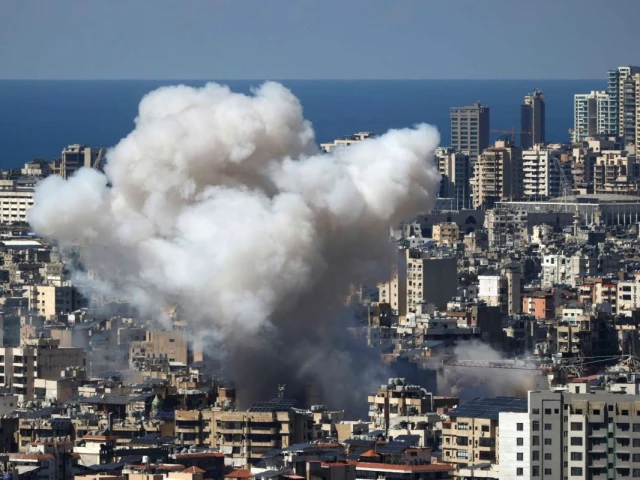
Smoke billows from the site of an Israeli airstrike in the southern suburbs of Beirut, the Lebanese capital, March 9, 2026. Lebanon was drawn into the Middle East war last week when the Iran-backed militant group Hezbollah attacked Israel in response to the assassination of Iranian supreme leader Ayatollah Ali Khamenei in U.S.-Israeli strikes. PHOTO: AFP
ISLAMABAD:
Prime Minister Shehbaz Sharif on Thursday held a telephone conversation with Lebanese Prime Minister Nawaf Salam and strongly condemned the ongoing Israeli aggression against Lebanon.
He also expressed condolences for the loss of thousands of precious lives in these hostilities.
The Prime Minister said Pakistan was engaged in sincere efforts towards regional peace and it was in this spirit that the Iran-US peace talks were being held.
While thanking Prime Minister Shehbaz Sharif for his peace efforts, the Lebanese Prime Minister sought Pakistan’s support to immediately stop attacks targeting Lebanon and its people.
The two leaders agreed to stay in touch.
Talks with Bahrain, Qatar and Austria
Meanwhile, in separate calls, the Prime Minister thanked Bahraini King Hamad bin Isa Al-Khalifa for his support to Pakistan’s mediation efforts and discussed the importance of respecting the ceasefire with Austrian Chancellor Christian Stocker. He also spoke with the Emir of Qatar, Sheikh Tamim bin Hamad Al Thani, expressing hope that “through concerted efforts, peace would soon return to the entire region.”
Earlier, the Foreign Ministry also strongly condemned Israel’s continued attacks on Lebanon, warning that they undermine global efforts towards regional peace.
“Pakistan condemns, in the strongest possible terms, the ongoing Israeli aggression against Lebanon, which is resulting in the loss of innocent lives and widespread destruction of infrastructure,” FO said in a statement.
“Israeli actions undermine international efforts to establish peace and stability in the region and constitute a flagrant violation of international law and fundamental humanitarian principles,” he warned.
Pakistan called on the international community to “take urgent measures to end Israeli aggression against Lebanon.”
He reiterated his “unwavering solidarity with the Lebanese government and people during this difficult period,” adding that he supports Lebanon’s sovereignty and territorial integrity, as well as its peace and stability.
Lebanon declared a day of national mourning on Thursday after Israeli strikes hit the country.
The Lebanese prime minister’s office declared Thursday that it would be a “national day of mourning for the martyrs and wounded of the Israeli attacks which targeted hundreds of innocent and defenseless civilians”, ordering the closure of public administrations and the lowering of flags.
Hours later, Hezbollah said it fired rockets toward Israel in response to what it called a violation of the truce between the United States and Iran.
There were mixed messages over whether the fighting in Lebanon was included in the truce, with Israel insisting it was not.
Benjamin Netanyahu
Israeli Prime Minister Benjamin Netanyahu said Thursday he had ordered his ministers to begin direct negotiations with Lebanon over Hezbollah’s disarmament amid growing fears its ongoing strikes could undermine the fragile truce between the United States and Iran.
A Lebanese government official told AFP shortly after Netanyahu’s announcement that Beirut “wants a ceasefire” declared before beginning any negotiations with Israel, a day after deadly strikes across the country.
At least 300 people were killed and more than 1,000 injured in Wednesday’s bombardment, Lebanon’s Health Ministry said, while Hezbollah said it was engaged in close combat against Israeli forces on the ground Thursday in the southern Lebanese town of Bint Jbeil.
Netanyahu’s order to negotiate directly with the Lebanese government focused on disarming Hezbollah and establishing peace, according to a statement from his office, but he offered no immediate respite from the bombings.
“Lebanon wants a ceasefire before starting negotiations,” said the Lebanese government official, who is familiar with the matter and requested anonymity.
Even as Netanyahu spoke, the Israeli military issued a new evacuation order for Beirut’s southern suburbs, just a day after the wave of strikes.
“In light of Lebanon’s repeated requests to open direct negotiations with Israel, I asked the cabinet yesterday to begin direct negotiations with Lebanon as soon as possible,” Netanyahu said.
“The negotiations will focus on the disarmament of Hezbollah and the establishment of peaceful relations between Israel and Lebanon.”
Separately, US President Trump confirmed to NBC News that he had asked Netanyahu to desist from strikes in Lebanon to help ensure the success of upcoming negotiations.
“I’ve spoken with Bibi (Netanyahu) and he’s going to be discreet. I just think we need to be a little more discreet,” Trump said.
Meanwhile, Hezbollah MP Ali Fayyad said the group rejected direct negotiations with Israel and that the Lebanese government should demand a ceasefire as a precondition before taking further steps.
The Israeli attack on Lebanon, which the UN described as “carnage”, has been condemned worldwide.
Brussels, Moscow and Ankara have demanded that the two-week ceasefire between the United States and Iran be extended to Lebanon.
“We are particularly concerned about the situation in southern Lebanon,” said German Chancellor Friedrich Merz, echoing statements from Paris and London.
“The severity with which Israel is waging war could derail the entire peace process, and this must not happen,” he warned.
For his part, Iranian Parliament Speaker Mohammad Bagher Ghalibaf said Tehran considered Lebanon an “inseparable part of the ceasefire” and President Masoud Pezeshkian said Israeli strikes had made talks with US envoys scheduled for the end of the week in Islamabad “meaningless”.
“We continue to strike Hezbollah with force, precision and determination,” Netanyahu said on social media.
“Our message is clear: whoever acts against Israeli civilians, we will hit them. We will continue to hit Hezbollah wherever necessary.”
The day after the strikes, rescuers were still working in the rubble of an affected building, in the heart of a residential area on the Beirut seafront.
Half the building had collapsed, some rooms cut in two by the deadly strike, a dining room and fountain exposed.
The other half of the building is just a pile of stones and twisted metal, a school report here, a law class from Saint-Joseph University there, a child’s stuffed toy.
According to civil defense, several bodies are still under the rubble.
(With contribution from agencies)


