
Reaffirms Pakistan’s desire to further strengthen its fraternal relations with the republic
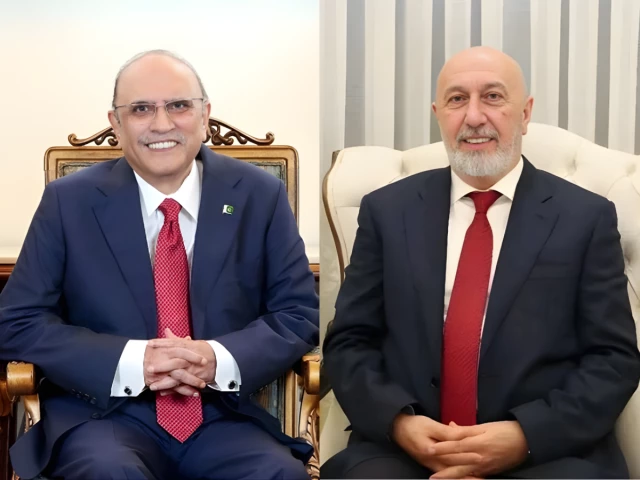
President Asif Ali Zardari (left) and Iraqi President Nizar Amidi (right). PHOTO:
President Asif Ali Zardari on Sunday congratulated Nizar Amidi on his election as President of the Republic of Iraq, conveying his best wishes for success in his new role. Radio Pakistan reported.
In his message, the president said he was convinced that “under the leadership of President Amidi, Iraq will continue its efforts towards stability, progress and national cohesion.”
He reaffirmed Pakistan’s keenness to further strengthen its brotherly relations with Iraq and enhance cooperation in areas of mutual interest. President Zardari also conveyed his best wishes for continued prosperity and well-being to the Iraqi people.
On Saturday, Iraq’s parliament elected the Kurdish politician as the country’s new president, a largely ceremonial role, following parliamentary elections last November.
US President Donald Trump threatened in January to withdraw Washington’s support for Iraq, a major oil producer, if former Prime Minister Nouri al-Maliki was nominated to form a government.
Who is the new president of Iraq?
For nearly two decades, Nizar Mohammed Saeed Amidi worked behind the scenes at Iraq’s presidential palace, helping to overcome constitutional impasse, political crises and the delicate balance between Baghdad and northern Iraq’s Kurdistan region.
On Saturday, the former adviser and former environment minister moved from behind the scenes to the top of the Iraqi state, winning the trust of Parliament to become Iraq’s new president.
Amidi, the candidate of the Patriotic Union of Kurdistan, received 227 votes in the second round of parliamentary voting, beating his rival Muthanna Amin, who received 15 votes.
His rise crowns a political career built less on public rhetoric than on the search for a discreet consensus.
From the presidential palace to the presidency
For years, Amidi served as one of Iraq’s top constitutional advisors, working alongside Presidents Jalal Talabani, Fuad Masum and Barham Salih between 2005 and 2022.
At the Baghdad Peace Palace, he developed a reputation as a behind-the-scenes troubleshooter, adept at drafting presidential decrees, handling constitutional crises and building consensus among Iraq’s rival political forces.
This position also allowed him to acquire rare experience in the management of one of the most sensitive issues in Iraq: relations between the federal government in Baghdad and the Kurdistan region, in northern Iraq.
Born on February 6, 1968 in the town of Amedi, Dohuk province, Amidi studied mechanical engineering at the University of Mosul before beginning a political career that would extend to Baghdad and the Kurdish region.
His life and career took place between Sulaymaniyah and Baghdad, making him what many Iraqi politicians describe as a cross-regional figure.
Fluent in Arabic and Kurdish, and a father of four, Amidi is often seen as a political translator capable of speaking to Iraq’s competing power centers.
Political heir of Talabani
Amidi began his political career as Secretary General of the Patriotic Union of Kurdistan from 1993 to 2003.
He then rose through the party ranks, becoming a member of its politburo and heading its Baghdad office in 2024.
He is widely seen as a political heir to the approach of former President Jalal Talabani, whose emphasis on Iraq’s ethnic and sectarian diversity made him one of the few Kurdish leaders widely accepted across the country’s political spectrum.
This image appears to have helped Amidi at a time when Iraq’s fractured political system is once again seeking compromise.
From Minister of the Environment to Head of State
In 2022, Amidi joined the government of Prime Minister Mohammed Shia al-Sudani as Minister of Environment.
Although the ministry is often considered secondary, he has used his position to elevate environmental issues to the level of national security, particularly water scarcity and climate change.
He has represented Iraq at major international forums and established himself as one of the most prominent voices advocating for Iraq’s water rights.
Amidi assumes the presidency at a time of institutional uncertainty and regional tensions, with the hope that he will use his experience and vast network of relationships to strengthen the presidency’s traditional role as guarantor of national unity.
Parliament elected him after two previous sessions were postponed due to disagreements over the position between Iraq’s two main Kurdish parties, the Patriotic Union of Kurdistan and the Kurdistan Democratic Party.
Under Iraq’s power-sharing system, the presidency is reserved for a Kurdish politician, while the prime minister is a Shiite Arab and the speaker of parliament a Sunni Arab.
Iraq’s constitution requires the president to task the candidate from the largest parliamentary bloc with forming a government within 15 days of the presidential election.


