
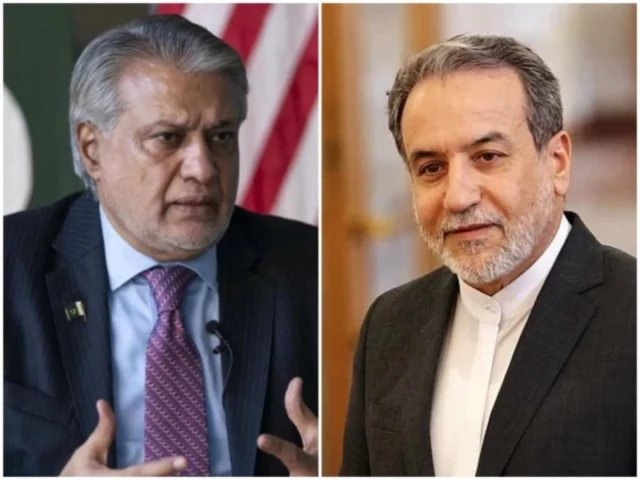
Foreign Minister Ishaq Dar and Iranian Foreign Minister Abbas Araghchi. Photo: Files
Deputy Prime Minister and Foreign Minister Ishaq Dar on Sunday stressed the need for continued dialogue and engagement to resolve ongoing issues during a telephone conversation with his Iranian counterpart Abbas Araghchi.
According to the statement issued by the Ministry of Foreign Affairs (MOFA) on
“The two leaders agreed to remain in close contact and also agreed on a telephone call between the Iranian President and Prime Minister Shehbaz later today,” the statement read.
Deputy Prime Minister/Foreign Minister Senator Mohammad Ishaq Dar @MIshaqDar50 met this afternoon with the Iranian Minister of Foreign Affairs, HE Mr. Abbas Araghchi @araghchi.
The DPM/FM highlighted the need for continued dialogue and engagement as key to resolving current issues like… pic.twitter.com/pbsIsAGjfE
— Ministry of Foreign Affairs – Pakistan (@ForeignOfficePk) April 19, 2026
The development comes as US President Donald Trump announced the upcoming opening of a new round of talks in Islamabad, saying US representatives would visit the capital for the second round of talks with Iran aimed at resolving the Middle East crisis.
“My representatives are going to Islamabad, Pakistan – they will be there tomorrow night for negotiations,” President Trump said in an article on Truth Social.
Separately, Iranian Parliament Speaker Mohammad Bagher Ghalibaf said earlier that negotiations with the United States to end the war had progressed but remained far from a deal, with Tehran saying the crucial Strait of Hormuz would remain closed until Washington lifts its naval blockade on Iranian ports.
In a televised address to the nation on Saturday evening, Ghalibaf said the “third imposed war” began during negotiations thanks to US deception, adding that previous conflicts had also started with the assassination of commanders, Tasnim News reported.
He said proposals relayed through countries including Pakistan had been considered by Iran’s Security Council and Tehran had resisted pressure and warned of escalation. He added that after its military failure, the United States turned to indirect messaging, while Iran remained resolute after the ceasefire.
Read also: Polish DPM hails Pakistan’s role in US-Iran ceasefire in call with Ishaq Dar
Tehran’s reversal of the closure of the Strait of Hormuz has increased the risk that oil and gas shipments passing through the strait will remain disrupted just as Trump is weighing whether to extend the ceasefire.
When American and Iranian negotiators met last weekend in Islamabad, the United States proposed a 20-year suspension of all Iranian nuclear activity, while Iran suggested a three- to five-year halt, according to sources familiar with the matter.
Iranian Deputy Foreign Minister Saeed Khatibzadeh said no date had been set for the next round of negotiations, adding that a framework for the deal must first be agreed.
Trump said Friday that negotiations could take place this weekend and that the two sides were “very close to an agreement.”
There was no sign Saturday of preparations for new talks in the Pakistani capital, where the highest-level negotiations between the United States and Iran since the 1979 Islamic Revolution ended without a deal last weekend.


