
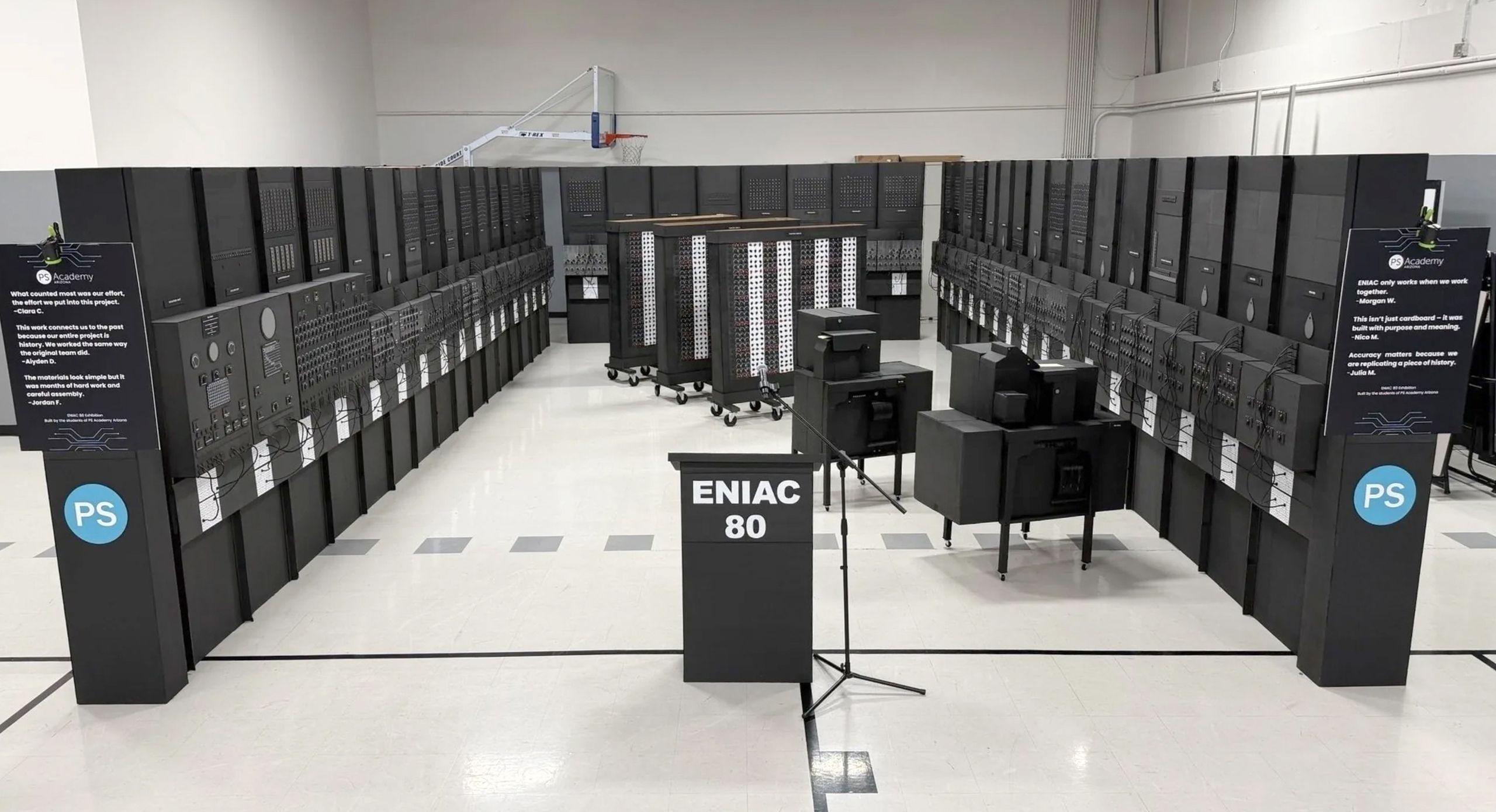
- A full-scale cardboard ENIAC replica recreates the historic computer setup using thousands of handmade parts.
- Teacher sees dyscalculia-based spatial reasoning as key factor in massive classroom construction
- The students build nearly 300 square meters of cardboard structure corresponding to the original dimensions of the computer.
A life-size replica of one of the first programmable digital computers now fills a classroom in Arizona, built almost entirely of cardboard and wood by students working under the guidance of a teacher who credits his own dyscalculia (the mathematical equivalent of dyslexia) with shaping his way of engineering.
The full-scale recreation of the ENIAC (Electronic Numerical Integrator and Computer), widely considered the world’s first programmable general-purpose electronic computer, spans hundreds of square feet and mirrors the layout of the original machine which once weighed approximately 30 short tons.
Students at PS Academy in Arizona spent nearly six months assembling the structure, producing about 22,000 custom parts and assembling them using about 1,600 hot glue sticks, according to I programmer.
Article continues below
Experience, scale and structure of ENIAC
Instead of steel cabinets filled with wiring and electronics, the replica uses cardboard panels layered with LED lighting to simulate the look of the original units.
Technology instructor Tom Burick said the project focused on recreating the physical experience of the machine rather than how it works.
“This project was never about recreating a working ENIAC. It was designed to recreate the experience, scale and structure of ENIAC — so that students and the public could understand what early computers really looked like and what they required of the people who built and operated them,” he said.
Every major unit found in the original system, including the accumulators, function tables, and main programmer, appears in the correct physical position, matching the historical layouts as closely as possible.
Students worked from original patent drawings, military documents and detailed photographs, while communicating with historians and museum staff to verify accuracy.
Burick’s path to teaching follows years spent building robots and running his own robotics company before turning to education after the company closed during the financial crisis of the late 2000s, according to IEEE Spectrum.
He said his own dyscalculia shaped the way he approached engineering challenges, forcing him to develop alternative methods to solve technical problems.
“People tell you what it takes, but they never tell you what it gives,” Burick said. “In my opinion, [it] has always been a superpower.
The completed replica features 18,000 simulated vacuum tubes and multi-function tables arranged in the same U-shaped configuration used by the original machine.
Once construction was complete, the scale of the project left the classroom filled wall to wall with imposing panels that recreate the appearance of early computing environments.
The ENIAC system itself was dismantled decades ago, leaving only scattered sections preserved in museums, which meant that most people would never see the assembled machine in its entirety again.
Rebuilding it on a large scale gave students a way to physically engage with the history of computing rather than through textbooks or diagrams alone.
IEEE Spectrum notes that previous projects led by Burick include an 8-foot-long pilotable Cybertruck replica, and that future plans could involve recreating hardware connected to NASA’s Artemis missions, something I’d like to see.
Follow TechRadar on Google News And add us as your favorite source to get our news, reviews and expert opinions in your feeds.


