
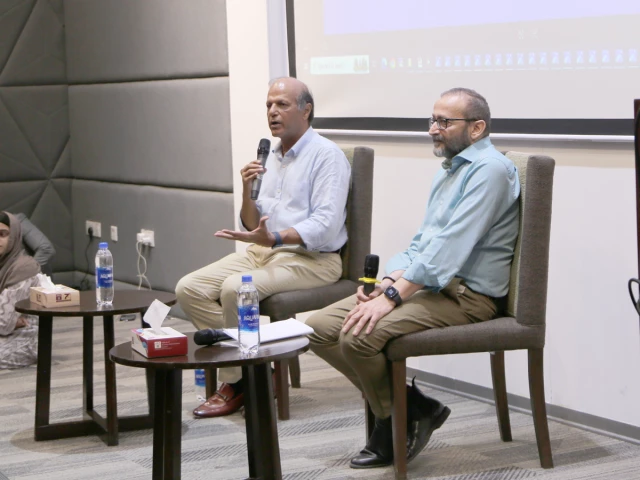
Call to safeguard ethical journalism in evolving threat landscape at event marking World Press Freedom Day
Dawn Editor-in-Chief Zaffar Abbas speaks at the closing session, “Surrender is not an option,” in conversation with IBA-CEJ Director Shahzeb Jillani. Photo: CEJ-IBA
Journalists and media personnel warned on Saturday that threats to journalism were increasingly shifting from physical violence to legal, regulatory and economic pressures.
At an event organized by the Center of Excellence in Journalism, Institute of Business Administration, Karachi (IBA-CEJ) on the occasion of World Press Freedom Day, speakers said that in an era of misinformation and self-censorship, public interest journalism was more vital than ever to promote accountability and ensure an informed society.
Opening the event, IBA-CEJ director Shahzeb Jillani said the gathering took place at a “critical moment for press freedom around the world”, a concern also highlighted by Reporters Without Borders (RSF) in its Press Freedom Index, which described 2026 as the worst year since records began.
Read: Media freedoms in Pakistan face a sharp decline
“We are holding this event at a critical time, when press freedom is at an all-time low globally. Yet we are here to renew our commitment to public interest journalism, to courageously reporting the truth, but also to staying safe while holding power to account,” he said.
In the final session titled “Capitulation is not an option,” Zaffar Abbas, editor-in-chief of Dawn Media Group, spoke about the need to maintain editorial independence despite growing pressures.
“I still believe that giving up is not an option. If you are unable to stand up for what you believe in, then it would be better to quit and go home,” he said.
“Serving society through your writing, broadcasts and images is a powerful way to let people know what’s wrong, so they can make informed decisions. If we continue to do this, we can make a difference,” he added.
He also emphasized that true editorial independence required reducing reliance on government and private advertising.
During a panel discussion on journalist safety titled “Shooting the Messenger: The Price You Pay,” Iqbal Khattak, executive director of Freedom Network, identified regulatory crackdown as a major emerging threat.
Speakers Iqbal Khattak, Adil Jawad and PFUJ President Shahzada Zulfiqar speak during the panel “Shooting the Messenger – The Price We Pay”, moderated by Nadia Naqi. Photo: CEJ-IBA
“Economic strangulation and abuse of cybersecurity laws have become a go-to tactic to silence dissent and punish critics,” he said.
Adil Jawad, his fellow panelist, highlighted the growing vulnerability of digital journalists, noting the growing emphasis on controlling narratives on online platforms.
“There is an increasing focus on controlling speech on social and digital media. More and more digital journalists are being targeted by PECA, often because they lack the training to ensure their safety,” he said.

Female journalists Sidra Dar, Kiran Khan and Yusra Askari speak on the panel “Reporting from the Field? Navigating Daily Trolling, Pressures and Restrictions”, moderated by Shahzeb Ahmed. Photo: CEJ-IBA
The panel also included former Pakistan Federal Union of Journalists President Shahzada Zulfiqar, who spoke about the challenges of journalism in Balochistan, describing the province as an information “black hole”. The session was moderated by Nadia Naqi.
During the opening session, Osama Bin Javaid, senior correspondent of Al Jazeerapaid tribute to journalists working in conflict zones.
“Press freedom around the world is owed to journalists in Gaza on World Press Freedom Day,” he said during his speech titled “Eyewitness to History: Reporting on War and Genocide.”
A separate panel on challenges faced by women journalists, titled “Reporting from the Field? Navigating Daily Trolling, Pressures and Restrictions”, featured reporters Sidra Dar, Kiran Khan and Yusra Askari. The session was moderated by Shahzeb Ahmed.

Panelists speak during the session on journalist safety, titled “Shooting the Messenger: The Price to Pay,” moderated by Nadia Naqi. Photo: CEJ-IBA
Offering advice for dealing with online abuse, the moderator said: “Develop a thick skin so you don’t let trolling get you down, keep going, but also know when to take a break and take a step back. »
Reflecting on the impact of journalism, Kiran said, “Your voice can be so powerful that its pain reaches people and compels them to take meaningful action. »
Speakers throughout the event emphasized that as methods of suppressing journalism become more sophisticated, it has become more urgent than ever to defend ethical, independent, public interest journalism.


