
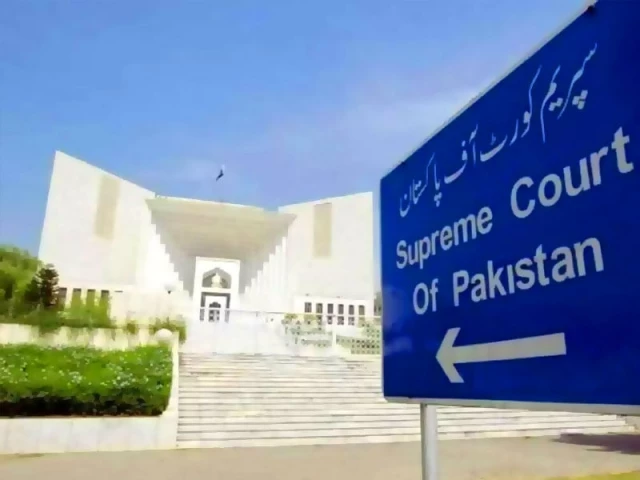
The May 2025 judgment explicitly ordered the government and Parliament to remedy this shortcoming.
ISLAMABAD:
A year after a ruling, the higher judiciary has yet to see implementation of its own directive requiring the federal government to legislate an independent right of appeal for civilians convicted by military courts, leaving a key guarantee of due process in limbo.
In its majority judgment written by Justice Aminuddin Khan on May 7, 2025, the Supreme Court upheld the military trials of over 100 PTI activists involved in the May 9, 2023 attacks on military installations.
However, the same decision recognizes a critical legal gap, finding that while the Pakistan Army Act provides due process in form, it lacks the structural safeguards necessary for a fair appeal forum for civilians.
The judgment explicitly ordered the government and Parliament to remedy this deficiency. He said the legislative framework needed to be supplemented to give civilians convicted under military law an independent right to appeal to the high courts.
“We raise awareness, in unison, of the need for legislative changes, which will also be consistent with the requirements set out in the International Covenant on Civil and Political Rights (ICCPR) to maintain and preserve constitutional and societal norms within the existing legal framework.”
The May 7 order, signed by Justice Aminuddin Khan, Justice Muhammad Ali Mazahar, Justice Syed Hasan Azhar Rizvi, Justice Musarrat Hilali and Justice Shahid Bilal Hassan, said the matter was referred to the government and parliament to consider and make necessary amendments or legislation to the Pakistan Army Act, 1952 and its allied rules within 45 days.
The amendments seek to provide an independent right of appeal to the High Court against convictions passed by a court martial or military courts to persons under sub-clauses (i) and (ii) of clause (d) of paragraph (1) of section 2 of the Pakistan Army Act, 1952 read with sub-clause (4) of section 59 of the same Act.
Two judges – Justice Jamal Khan Mandokhail and Justice Naeem Akhtar Afghan – dissented, finding that military trials of civilians were unconstitutional.
Despite the time-limited directive, the federal government has neither challenged the portion of the judgment requiring appeal rights nor introduced the required legislation. Initially, officials indicated a bill would be proposed, but no progress followed. Subsequently, former Chief Justice Jawad S Khawaja filed a contempt petition against Prime Minister Shehbaz Sharif for non-implementation of the court order.
Parallel legal challenges have also emerged, with some petitioners filing motions for review against the approval of the military trial judgment. Following the 27th Amendment, the case was transferred to the Federal Constitutional Court (FCC), headed by Justice Aminuddin Khan, the author of the original majority decision.
However, since its transfer, the case has not been taken up by the FCC. Meanwhile, those convicted by military courts continue to be deprived of an independent right of appeal.
Legal experts have expressed deep concern over the continued inaction.
Lawyer Faisal Siddiqi said the limited relief of a right of appeal granted by the “26th Amendment judiciary” had effectively been nullified by subsequent developments. To rephrase the great German philosopher Nietzsche, “the judicial system is dead, long live the new judicial system”.
Islamabad-based lawyer Waqas Ahmed pointed out that the SC had allowed military trials of civilians on the condition that an independent right of appeal is ensured, a condition which is still not met. He called this a serious concern for fairness and due process, adding that the FCC, now vested with jurisdiction, must ensure enforcement of the judgment.
Lawyer Asad Rahim Khan argued that even the limited appeal guarantee was insufficient from the start.
“But even with regard to the sops, this one was also upheld. After all, the main consequence of the decision was not to provide an additional avenue of appeal. It was to validate the military courts of civilians outside of a declared state of exception and a constitutional amendment – the first time in our history,” he noted.
He further said that implementing these safeguards, even if limited, had been further complicated by the creation of the FCC, which he described as an aberration within a common law system that weakened binding precedent.
Lawyer Sameer Khosa said the Supreme Court’s Constitutional Court judgment required the federal government to appeal to the convicts, but the government did not even pretend to offer one.
Lawyer Rida Hosain, who assisted one of the petitioners challenging the military trials, says the Supreme Court has recognized that there is no independent right to appeal under the Army Act. Under military law, the right to appeal rests with an appeals court composed of the army chief of staff or one or more officers designated by him. The appeals forum is composed of active military officers who remain subject to the same command structure. A call, within the military structure, is a call to a hierarchy that has an institutional interest in defending its own processes.
“Despite a time-bound directive, the government has failed to take steps to pass legislation. Those convicted by military courts are left without access to an independent appeal forum. The consequences of inaction are serious. Civilians have been deprived of their liberty by military courts without any independent appeal. The failure to legislate destroys the constitutional promise of due process and protection against unjustified deprivation of liberty. It places citizens at the mercy of a system structurally incapable of appealing independently. The government’s inaction reflects its sheer disregard for judicial decisions,” she adds.
Lawyer Rida Hosain further states that a contempt petition has been filed by Jawwad S. Khawaja against Prime Minister Shehbaz Sharif for non-compliance with a time-bound court order. The contempt motion has not been set for hearing. Neither the government nor the judiciary appears interested in enforcing court orders. The duty of a court is not limited to rendering a decision. He must ensure implementation.”


