
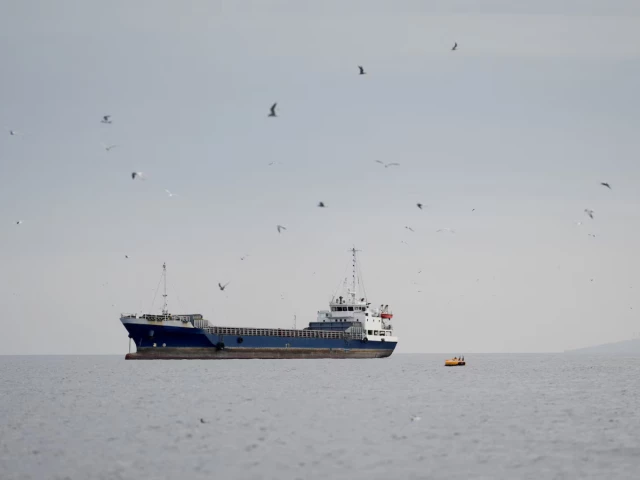
The Iranian ship will also be reloaded in Pakistani territorial waters to be returned to its original owners after repairs.
A ship in the Strait of Hormuz, off the coast of Musandam province in Oman, April 12, 2026. PHOTO: REUTERS
Pakistan on Monday facilitated the transfer of 22 Iranian crew members detained on board the container ship. MV Touska, previously seized by the United States, the Ministry of Foreign Affairs (MOFA) said.
In a released statement, the Foreign Office (FO) said the individuals were flown to Pakistan last night and would be handed over to Iranian authorities today.
“As a confidence-building measure taken by the United States of America, twenty-two crew members detained on board the seized Iranian container ship “MV Touska” have been evacuated to Pakistan,” the statement added.
“The Iranian vessel will also be reloaded in Pakistani territorial waters to be returned to its original owners after necessary repairs,” the statement added.
FO said these returns were coordinated in tandem with support from the Iranian and US sides.
🔊PR No.1️⃣1️⃣4️⃣/2️⃣0️⃣2️⃣6️⃣
Pakistan facilitates transfer of Iranian crew members
🔗⬇️ pic.twitter.com/hhe0eNVh1K— Ministry of Foreign Affairs – Pakistan (@ForeignOfficePk) May 4, 2026
Pakistan welcomes these “confidence-building measures” and will continue to facilitate dialogue and diplomacy while continuing ongoing mediation efforts for regional peace and security, concludes FO.
US President Donald Trump has repeatedly demanded that freedom of navigation be restored through Hormuz since declaring a ceasefire early last month. But Iranian officials responded that the strait would remain under Iranian supervision.
Read: Trump compares US Navy to ‘pirates’ over Hormuz blockade
Some Tehran ships have been seized by the United States after leaving Iranian ports, as well as Iranian container ships and oil tankers sanctioned in Asian waters.
Iran has blocked almost all ships passing through the Strait of Hormuz except its own since the start of the war. Trump imposed a separate blockade of Iranian ports.
The United States and Israel attacked Iran on February 28. Iran responded with its own strikes against Israel and Gulf states that host U.S. bases. US-Israeli strikes on Iran and Israeli attacks in Lebanon have killed thousands of civilians and displaced millions.
The war drove up oil prices and led to the blockade of the Strait of Hormuz, a chokepoint for about 20% of global shipments of oil and liquefied natural gas.
Trump, who has proposed changing timelines and targets for a war that remains unpopular in the United States, has been widely condemned for his comments on the conflict, including when he threatened to destroy all of Iranian civilization last month.
Iran’s military on Monday warned U.S. forces not to enter the Strait of Hormuz after President Donald Trump said the United States would begin helping free ships stuck in the Gulf by the U.S.-Israeli war with Iran.
Trump offered few details of the plan to help ships and their crews that have been “locked in” in the vital waterway and lacking food and other supplies for more than two months since the conflict began.
“We told these countries that we would guide their ships safely out of these restricted waterways, so that they could freely and efficiently go about their business,” Trump said Sunday in a message posted on his Truth Social website.
The unified command of Iran’s armed forces responded by warning U.S. forces to stay out of the strait.
Learn more: Iran warns US Navy to stay away from Hormuz after Trump asks US to help stranded ships
Its forces would “respond harshly” to any threats, he added, asking commercial ships and tankers to refrain from any movement in the absence of coordination with the Iranian military.
“We have repeatedly said that the security of the Strait of Hormuz is in our hands and that the safe passage of ships must be coordinated with the armed forces,” Ali Abdollahi, head of the Unified Forces Command, said in the statement.
“We warn that any foreign armed forces, especially the aggressive US military, will be attacked if they intend to approach and enter the Strait of Hormuz.”
On February 28, the United States and Israel launched a joint offensive against Iran, and Tehran retaliated by striking Israel and other countries in the region harboring American assets.
The war has been suspended since April 8, when Pakistan negotiated a two-week ceasefire. After the ceasefire, Pakistan hosted the highest level US-Iran talks since the 1979 Islamic Revolution, which ended in Islamabad last weekend without a deal, but the ceasefire was respected.


