
Sindh CM says Pakistan ‘does not want war’ but will never compromise on defense
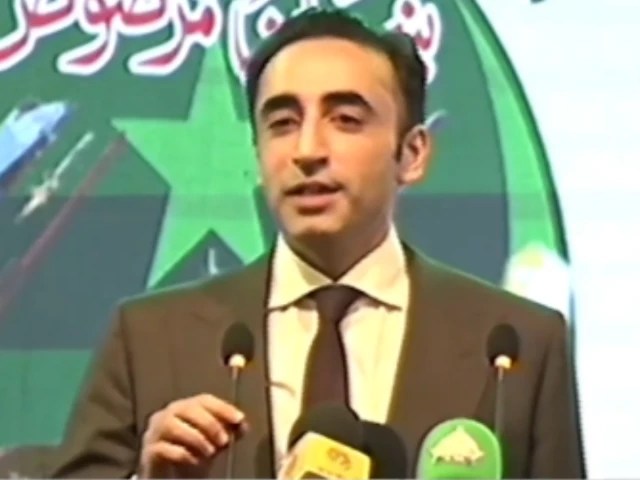
PPP Chairman Bilawal Bhutto Zardari speaking at a ceremony marking the first anniversary of Marka-e-Haq in Karachi. SCREENSHOT
KARACHI:
Pakistan has “endured and overcome” and remains a nation that does not compromise on its sovereignty, PPP Chairman Bilawal Bhutto Zardari said on Monday, adding that Pakistan continues to rise “again and again” in the spirit of those who came before it.
PPP Chairman Bilawal Bhutto Zardari, speaking at a ‘Marka-e-Haq’ ceremony in Karachi, said Pakistan had gone through a period of uncertainty but emerged stronger due to national unity and resilience.
“About a year ago, Pakistan was on the brink of uncertainty,” he said, adding that border tensions had led to fears of conflict.
He said the country faced serious challenges but remained firmly united. “Despite difficult circumstances, Pakistan stood firm,” he said, crediting national unity for overcoming the crisis.
Bilawal said Pakistan’s history has been shaped by struggle and sacrifice. “Since its creation in 1947, Pakistan has been refined through hardship and strengthened through sacrifice,” he said. “This victory is not only the fruit of weapons, but also of determination and courage,” he added.
Bilawal said that from the northern mountains to the shores of the Arabian Sea, the nation stood in one line, adding that this unity was also visible “from the fields of Punjab to the deserts of Sindh and Balochistan”.
“The armed forces defended the country with courage, discipline and dignity,” he said, adding that the diplomats effectively presented Pakistan’s position in the international arena.
He said Pakistan would not surrender under pressure. “We will never lay down our arms,” he said.
He accused some elements abroad of trying to distort history. “Some elements outside the borders are trying to distort history,” he said.
Bilawal added that Pakistan had always preferred peace. “We never wanted war; we always preferred peace,” he said.
He concluded that the moment demanded responsibility and reflection. “This is a time for reflection, not arrogance,” he said.
Addressing a ceremony celebrating the first anniversary of Marka-e-Haq In Karachi, Sindh Chief Minister Murad Ali Shah said Pakistan responded within hours to Indian actions. “A few hours later, India was no longer able to compete,” he said.
He claimed that Pakistani forces had shot down Indian jets, including Rafale, adding: “Jets can be good, but it depends on who is flying them.”
Shah said India had engaged in propaganda claiming attacks on Karachi port, which he termed false, adding that the Pakistan Navy remained on full alert during the situation. He said Pakistan’s nuclear program was started under Zulfikar Ali Bhutto in 1972 and later progressed under Benazir Bhutto through the missile program.
“We are a peaceful country; we have said we do not want war,” he said, adding that Pakistan would never compromise on its defense.
Read: Prime Minister declares “Youm-e-Marka-e-Haq” on May 10 to mark the victory of the operation
Addressing the same function, Sharjeel Inam Memon said the day marked national pride and unity. “Today is an important and joyful day for Pakistan,” he said, adding that the armed forces gave a strong response to the enemy. “The day of ‘Marka-e-Haq“, the Pakistan Army gave a strong response to the enemy and inflicted a humiliating defeat on India,” he said.
He added that the occasion was “nothing short of a festival” and credited former Prime Minister Zulfikar Ali Bhutto with laying the foundation for Pakistan’s nuclear capability. “The Quaid-e-Awam had said that we will eat grass, but we will make Pakistan a nuclear power,” he said.
Memon also highlighted the role of Pakistan Peoples Party Chairman Bilawal Bhutto Zardari in raising international awareness on the Kashmir issue. “Bilawal Bhutto Zardari said the butcher of Gujarat is the butcher of Kashmir,” he said, adding that Bilawal raised the Kashmir issue during his visit to India and faced political threats from India’s ruling party.
He criticized Indian media coverage of the situation, saying: “Indian TV channels were claiming that Lahore and Karachi had been destroyed, when in reality the Pakistani Shaheens had defeated India. »
Pahalgam attack
On April 22, 2025, the escalation between Pakistan and India began when an attack in Pahalgam killed 26 people. India immediately blamed Pakistan for the incident. However, Pakistan has categorically rejected Indian responsibility.
In response, India undertook a series of hostile actions the next day, April 23, 2025, including suspending the 65-year-old Indus Water Treaty (IWT), canceling visas for Pakistani citizens, closing the Wagah-Attari border post, ordering the Pakistan High Commission in New Delhi to close, and reducing diplomatic staff at each other’s embassies.
Tensions further escalated in the early hours of May 7, 2025, when missile strikes hit six towns in Punjab and Azad Jammu and Kashmir (AJK), destroying a mosque and killing dozens of civilians, including women, children and elderly people.
Learn more: French intelligence official confirms Pakistan’s shooting down of Rafale
In a swift military response, Pakistani armed forces shot down Indian fighter jets, including three Rafales. The confrontation escalated again in the wee hours of May 10, 2025, when India targeted several Pakistani airbases with missile strikes. In retaliation, Pakistan launched Operation Bunyanum Marsoos, damaging Indian military installations including missile storage sites, airbases and other strategic targets.
On May 10, 2025, U.S. President Donald Trump announced that a ceasefire had been reached after intense diplomatic efforts overnight. Minutes later, the deal was separately confirmed by Pakistani Foreign Minister Ishaq Dar and Indian Foreign Minister.


