
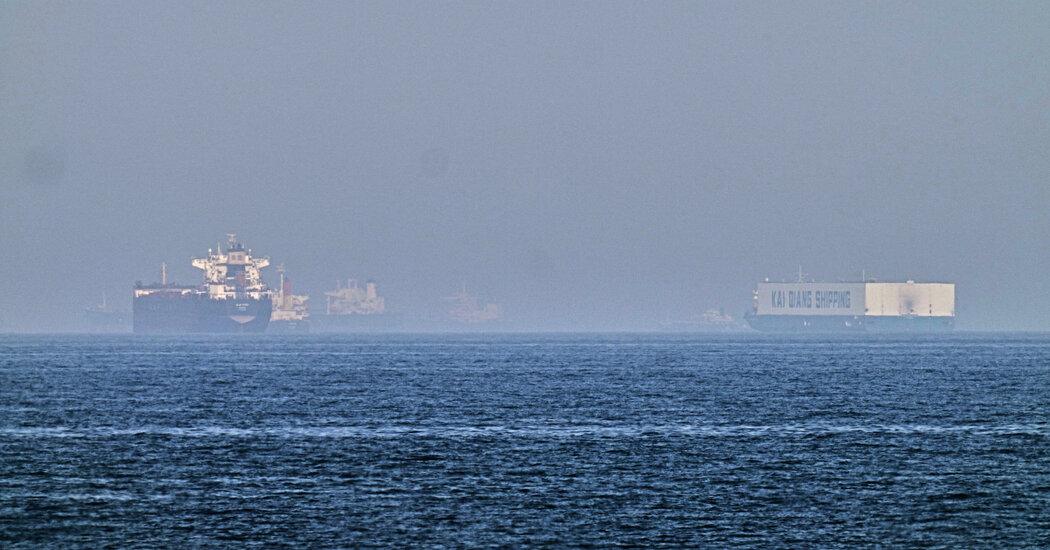
More than two months after the start of the war in Iran, some 1,600 ships remain stuck in dangerous conditions in the Strait of Hormuz, with around 20,000 sailors on board.
On Monday, a U.S.-flagged ship operated by a subsidiary of Maersk, one of the world’s largest shipping companies, became one of the few vessels crossing.
Maersk, a Danish company, said in a statement that the ship, the Alliance Fairfax, had transited the waterway under the protection of the U.S. military.
“Maersk expresses its gratitude to the US military for its professionalism and effective coordination that made this operation possible,” the company said. The transit was uneventful and all crew members were safe, the statement said.
President Trump announced Sunday that the United States would guide stranded ships out of the Strait of Hormuz, a vital trade route for oil and gas, adding that any interference would be dealt with “vigorously.”
U.S. forces on Monday shot down cruise missiles and drones and destroyed six Iranian speedboats that threatened ships the U.S. Navy was guiding through the strait, according to U.S. Central Command. The global oil price jumped more than 5 percent and stock markets fell.
On Tuesday, the situation in the strait appeared to be at a standstill. Oil prices fell but were above their level before Monday’s chaos.
No ships had transited the strait as of Tuesday, according to the latest data from Kpler, a global maritime data company. Before the war, around 130 ships passed through the strait every day. According to S&P Global Market Intelligence, 137 ships transited the strait from April 13 – the date the United States began its blockade – through May 1. Others may have escaped undetected by turning off their transponders.
Jack Kennedy, head of country risk for the Middle East and North Africa at S&P Global Market Intelligence, said the U.S. military was likely in the coming days to increase the number of its ships intended to help ships transit the strait.
But despite this, most ships do not feel safe enough to leave. “Iran still retains the ability to deter most transits through the Strait through its asymmetric military capabilities,” Mr. Kennedy said.
Maersk said the U.S. military recently contacted the company and offered the ship the opportunity to leave the Persian Gulf under its protection.
The Alliance Fairfax, a ship used to transport vehicles, was “accompanied by US military assets” when it left the Persian Gulf, according to Maersk. A security plan for the trip was developed in coordination with the U.S. military, the company said.
It is unclear what route the Maersk ship took through the strait and how the U.S. Navy helped the ship pass. A Maersk spokesperson did not respond to questions about details of the ship’s passage.
Separately, US Central Command said on Monday that two U.S.-flagged commercial vessels had used the waterway. The circumstances of the second vessel were not immediately known.
While the United States has pledged to help oil tankers navigate the Strait of Hormuz, some companies have said conditions are still too dangerous for them to attempt to cross the waterway, especially as Iran reiterated its warning that ships should not attempt to pass without approval from its navy.


