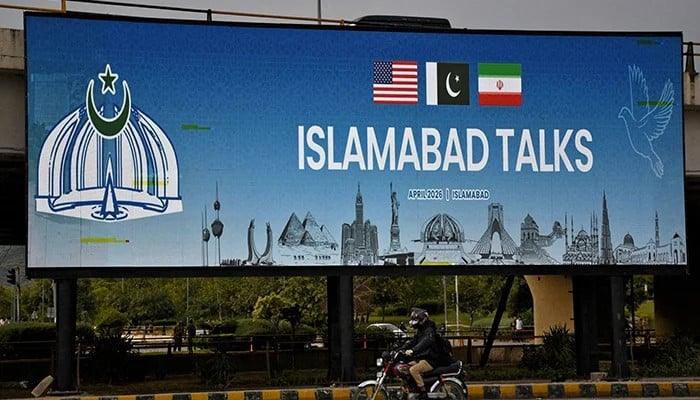
As the world waited with bated breath and Islamabad was besieged and security was tightened, Pakistan played a crucial role as mediator. The prime minister and the army chief were shuttling between capitals, trying to reach consensus and bring the parties to the negotiating table.
Even though Islamabad’s first round of talks in April 2026 ended without a breakthrough and the second round of talks could not take place because Iran and the United States failed to agree on anything in common – with the US canceling planned envoy visits and Iran showing reluctance – Islamabad nevertheless emerged as a powerful diplomatic player.
Is Pakistan becoming a strong middle power, or is it becoming a harsh state? Being a tough state with increased military prowess is perhaps now a necessity of the times and circumstances. The world is becoming more and more hostile and militarized. And the price to pay for a lack of hard power could prove too high, in the form of a violation of territorial integrity and sovereignty.
During last year’s conflict with India in May 2025, Pakistan was able to defend itself through the sheer might of its air force, aided by Chinese technology. The Pakistan Air Force deployed Chinese-supplied Chengdu J-10C fighters, armed with PL-15 long-range air-to-air missiles, achieving notable successes including shooting down Indian aircraft, including advanced Rafale aircraft.
If he didn’t have this ability, he might have suffered a heavy blow from his opponent. This episode is a stark reminder: in times of crisis, deterrence supported by modern technology can preserve sovereignty when diplomacy alone fails.
This growing military prowess is even more evident in Pakistan’s expanding defense deals and arms exports, which reflect its growing influence as an arms supplier. In recent months, Pakistan has struck major deals, including a $4 billion deal with the Libyan National Army for JF-17 Thunder fighter jets and Super Mushshak trainers.
Negotiations have progressed with countries including Bangladesh, Saudi Arabia, Sudan and Indonesia for the sale of dozens of JF-17 Block III aircraft, drones and other systems – deals potentially worth billions more.
Building on previous exports to Azerbaijan, Myanmar and Nigeria, these efforts show how the proven reputation of Pakistani weapons, developed in partnership with China, is opening new markets in Africa, the Middle East and Asia.
Such defense diplomacy and export efforts not only help offset the high costs of maintaining a strong military, but also enhance Pakistan’s strategic leverage and leverage in the Global South.
The current trajectory of the world, marked by the rise of authoritarianism and the right of the strongest, is one where those who wield power and strength dominate the weak and vulnerable. International law is easily ignored or violated with impunity. There is no respect for rules or principles. After all, the rules-based order has always been selectively applied in the interests of Western powers.
This too is now broken. Presidents are kidnapped in their countries, leaders are assassinated by drone and missile strikes in their own homes, embargoes and sanctions are imposed, and entire populations starve. And then we have fascist regimes committing genocide before the eyes of the whole world and with no one to hold them accountable.
So what happens in a world like this? For countries like Pakistan, options are limited. Either you adapt and strengthen your defenses, or you are ready to receive the force. This is indeed a deplorable situation.
The blind and ruthless quest for military power has few winners and many losers. For a country like Pakistan, it is difficult to economically justify maintaining an arms race, but at the same time it seems to be the only realistic pragmatic solution. And it is deeply regrettable that the two South Asian neighbors remain locked in a zero-sum game of relentless pursuit.
But seeking hard power and building a truly hard state are not the same thing. The hard state model that Pakistan is pursuing is incomplete.
A hard state is characterized by a resilient economy, strong institutions, the rule of law and effective governance. This is what makes a hard state effective and internally strong. We have the example of China and Singapore – two tough states with strong, effective systems and institutions and robust economies.
It is the model that meets the expectations of its citizens, even if it is based on authoritarianism. Hard states are hardly democratic and so I find it difficult to be a staunch defender of them. Given the lack of democracy and freedom of expression, they nevertheless ensure the well-being of citizens through good governance and the rule of law.
Unfortunately, Pakistan is far from exhibiting these characteristics of a hard state. The economy is under stress and the rule of law and governance are weak. And what is worrying is a democratic decline and a decline in civil liberties.
Unless Pakistan consolidates itself internally with strong institutions, a healthy economy and a system that meets the needs of the people, it will be a tough state on the surface – strong externally with military prowess and diplomatic influence, but weak internally.
The author is an independent analyst based in Islamabad.
Disclaimer: The views expressed in this article are those of the author and do not necessarily reflect the editorial policies of PK Press Club.tv.
Originally published in The News