
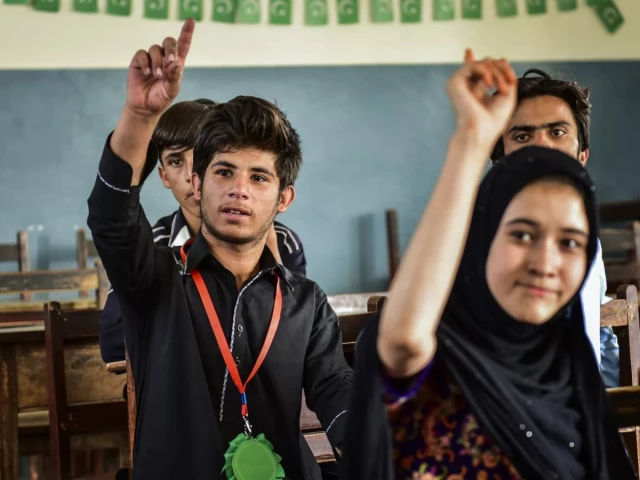
Report calls on provincial and federal governments to invest in human capital and reform governance
A new study paints a detailed and sobering portrait of Balochistan’s youth, revealing a generation caught between rising aspirations and growing structural inequalities, increasingly shaped by social media and shifting geopolitical currents.
The study, published in the Review of the Contemporary Journal of Social Sciences and titled “The Voice of Balochistan Youth: Identity, Development and Geopolitical Perspectives”, was led by Dr. Siraj Bashir Baloch of the Department of Social Work, University of Balochistan, Nomeen Kassi of the Department of International Relations, BUITEMS, and Dr. Farah Naseer of the Department of Sociology, Sardar Bahadur Khan Women’s University, and was conducted through surveys and personal communications with youth across the province.
“The youth of Balochistan is not a problem to be managed, they are a wasted resource,” said Dr Baloch.
“What we have discovered is a generation that is aware, motivated and capable, but is being systematically deprived of the conditions it needs to thrive. This is not a crisis of youth. It is a crisis of governance.”
Facebook remains the dominant source of news and information among those surveyed, accounting for 62% of media consumption, far ahead of religious institutions and websites with 15% and newspapers with just 9%.
X followed in popularity for political discourse, while Instagram carved out a niche among younger and female respondents. The image was of a digitally connected, globally aware and increasingly frustrated generation.
Learn more: Rs16.79 billion RISE program aims to transform future of youth in Balochistan
At the heart of this frustration lies a persistent gap between expectations and reality. A majority of respondents expressed deep dissatisfaction with job opportunities, quality of education and access to health care, grievances that researchers described as symptoms of institutional weaknesses and unequal distribution of resources across the province.
Kassi, whose work focuses on international relations, highlighted the geopolitical dimension of these national failures. “When young people in Balochistan look outward, to China, to the United States, their perceptions are not formed in isolation,” she said.
“They are filtered by lived experiences of exclusion. A young person who has never benefited from development will view any foreign actor with suspicion, and rightly so.”
The China-Pakistan Economic Corridor (CPEC) emerged in the study as a deeply controversial topic. Young people’s perceptions of China were mixed: while many saw the country as a key development partner, others remained skeptical about the real benefits local communities received.
One interviewee captured this tension directly, noting that China was seen as a development partner, but the benefits did not flow equally to local communities. The study recommended mandatory employment quotas of at least 80% for Baloch youth in CPEC-related projects, as well as much greater transparency in contracts and community consultation.
Perceptions of the United States were equally divided; some saw Washington as a gateway to education and opportunity, while others associated its regional policies with inconsistency and interference. India, by contrast, attracts almost uniformly negative sentiment, shaped by long-standing security tensions and domestic narratives that present the neighboring country as a strategic threat rather than a potential partner.
Read also: Balochistan student wins global prize for turning banana waste into fiber
Dr. Naseer, a sociologist whose research focuses on women and marginalized communities, called attention to what she called the study’s most underappreciated finding. “We continue to talk about the youth of Balochistan as if they are an undifferentiated mass,” she said.
“But the data shows that the women surveyed have distinct platform preferences, distinct aspirations, and distinct experiences of exclusion. Any policy that doesn’t take gender into account will fail for half the population before it even begins.”
Researchers warned that the rapid spread of misinformation on WhatsApp and YouTube was actively distorting how young people understood complex geopolitical and developmental realities. The study urgently calls for digital literacy programs to help the province’s youth evaluate online content more critically, a recommendation Dr. Naseer sees as inseparable from broader educational reform.
Despite the weight of these findings, the study steadfastly resisted a pessimistic conclusion. According to the authors, Balochistan’s youth are not inherently prone to radicalization or instability. Their aspirations were extremely constructive, focused on education, employment and meaningful civic participation. A majority of those interviewed favor dialogue rather than force to resolve conflicts, which demonstrates a community truly ready for peace, if given a real opportunity.
Read this: Sports events and gatherings organized in Balochistan to bring young people into the mainstream
“This is the conclusion that should define every political conversation regarding this province,” Dr. Baloch said. “These young people are not asking for revolution. They are demanding a job, a diploma and a government that listens to them. The question is whether anyone in Islamabad or Beijing is paying attention.”
The report calls on provincial and national governments to invest in human capital, reform governance, establish formal youth councils and adopt district-specific development plans tailored to local realities.
He also spoke directly to China, urging investment in social infrastructure, schools, clinics, water supply, as well as large-scale physical projects, and creating scholarship and exchange programs dedicated to Baloch youth.
“CPEC can still be a story of shared prosperity,” Kassi concluded. “But right now, for too many young people in Balochistan, it reads like a story written by others, about a future that will somehow never happen to them.”


