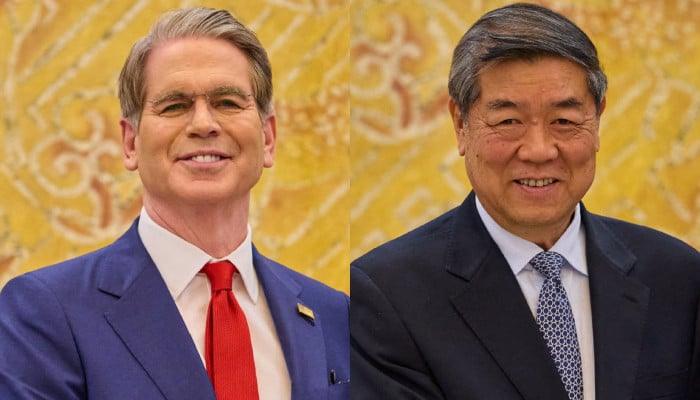
- Bessent and He Lifeng talk at the airport.
- Each met with the South Korean president separately.
- The talks will set the stage for the Trump-Xi summit in Beijing.
INCHEON, South Korea: U.S. Treasury Secretary Scott Bessent and Chinese Vice Premier He Lifeng began negotiations in South Korea on Wednesday to lay the groundwork ahead of this week’s summit of leaders of the world’s two largest economies in Beijing.
Bessent and He began the talks at Incheon airport after each meeting with South Korean President Lee Jae Myung at the presidential Blue House, Reuters witnesses said.
The discussions are expected to cover a range of issues in preparation for talks in Beijing between US President Donald Trump and Chinese President Xi Jinping, which are expected to take place from Thursday to Friday.
Talks between Bessent and He would likely be exploratory with limited immediate results, said Kim Tae-hwang, a professor of international business at Myongji University in Seoul.
“Both sides are essentially waiting in line before the summit, probing each other, rather than seeking progress,” he said.
China’s top trade negotiator, Vice Minister of Commerce Li Chenggang, and Vice Minister of Finance Liao Min were among the officials accompanying him.
At the Beijing summit, leaders are expected to agree to create forums to facilitate mutual trade and investment, while China is expected to announce purchases related to Boeing planes, U.S. agriculture and energy, U.S. officials said.
Beijing also wants the United States to ease restrictions on exports of advanced semiconductors and has raised concerns about a bill aimed at keeping critical chipmaking equipment from China.
They plan to extend the truce on restrictions on Chinese rare earth exports at the summit, but Chinese customs data shows Beijing continues to limit shipments of materials vital to defense and manufacturing.
Summit discussions could also include the war in Iran, as China, which has ties to Iran, is a major buyer of its oil.
Trump said Tuesday, however, that he did not believe he needed China’s help to end the conflict, even as hopes for a lasting peace deal dwindled and Tehran tightened its grip on the Strait of Hormuz.
However, neither side has a strong incentive to make early concessions, academic Kim said, adding that the United States is unlikely to ease restrictions on key technologies such as semiconductors.
China, meanwhile, supported by relatively resilient growth and trade performance, is under less pressure to offer meaningful compromises, he said.