
The U.S. Securities and Exchange Commission’s long-awaited rule allowing the tokenization of securities — a change that could have profound effects on financial markets — faced the controversial perception that it would allow synthetic tokens, but one commissioner took the unusual step of issuing statements on the unpublished rule to potentially counter those views.
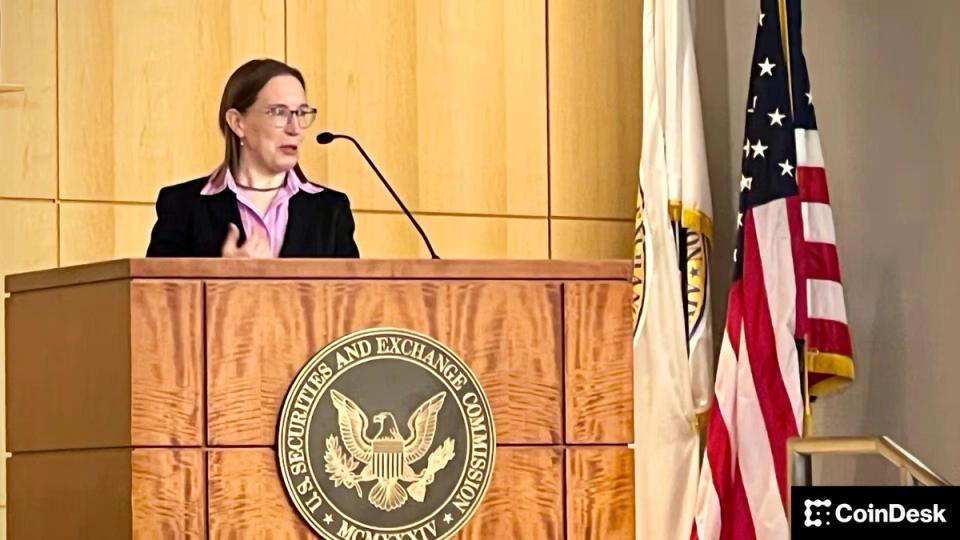
SEC Commissioner Hester Peirce, who had been pushing for safe harbors for tokenization long before the new chairman took office under President Donald Trump, issued two statements on social media site X on Thursday and Friday to clarify what she expects from the soon-to-emerge rule. His posts suggest that the proposed rule will not pave the way for synthetic tokenized securities – third-party tokenization that references a security but does not carry the equity, voting rights and other rights associated with the security.
Peirce, the commissioner behind the SEC’s Crypto Task Force, wrote that she expects the upcoming rule to be “limited in scope and would facilitate trading only in digital representations of the same underlying equity security that an investor could purchase on the secondary market today, not synthetics.”
Peirce posted again to explain what she meant by synthetics, directing people to read the SEC’s January statement on tokenized securities, “which distinguishes tokenized versions of issuer-sponsored stocks and stocks that SEC-registered companies hold for their clients from synthetic instruments that provide exposure to stocks.”
The flames were fanned by a Bloomberg News report this week, which predicted that the agency was considering including a pathway for synthetic tokens tradable on decentralized crypto platforms. Peirce said she appreciated the strong public interest in the rule “but not the hyperbole” about it.
Peirce did not respond to a request for comment on his posts.
The resulting rule will represent the most significant step the SEC has taken to date in forging a new regulatory approach to crypto trading in the United States. Chairman Paul Atkins has said for months that his agency was close to releasing wide-ranging proposals aimed at providing regulatory relief in the crypto space.
He outlined some efforts in a March speech at the DC Blockchain Summit, saying the agency was considering safe harbors from certain regulatory requirements for various crypto activities, including granting startups something like four years of registration exemptions “to provide developers with a regulatory runway during which they could work toward maturity”; a “fundraising exemption” for certain crypto assets in which “entrepreneurs could raise up to a set amount (say $75 million) in a 12-month period”; and a “safe harbor for investment contracts” to prevent certain crypto assets from being defined as a regulated security, with the safe harbor triggering when the issuer completes all servicing efforts.
Atkins said at the time that Commissioner Peirce’s “fingerprints are all over” the SEC rules.
As the SEC — alongside its sister agency, the Commodity Futures Trading Commission — drafted crypto rules, Atkins and CFTC Chairman Mike Selig said they were doing so knowing that Congress was supporting them with the Digital Asset Market Clarity Act to enshrine some of the same ideas into permanent law.
“Only Congress can ensure that regulation in this area is sustainable through comprehensive market structure legislation,” Atkins said in March.


