
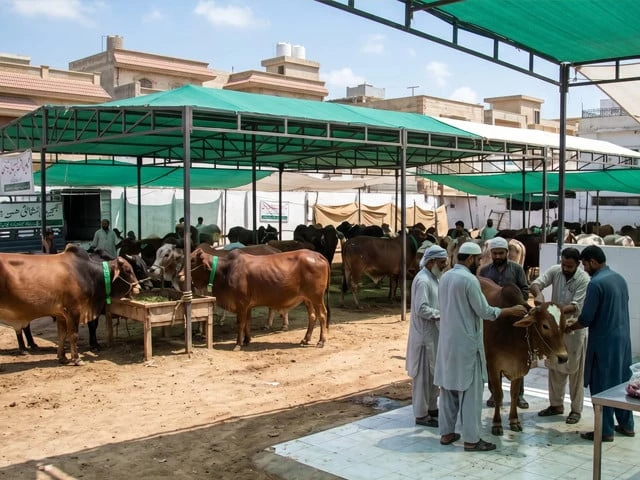
Soaring costs of animals, transport and butchery push middle-class families towards shared sacrifice
KARACHI:
Skyrocketing prices, rising fuel costs and increasing transportation costs have made individual qurbani (ritual animal sacrifice) increasingly difficult for the people of this Eidul Azha, leading to a sharp increase in the trend of ijtimai qurbani (collective sacrifice) in the metropolis.
According to traders, social organizations and mosque administrations, prices of sacrificial animals have increased by more than 50 percent compared to last year, forcing middle-class families to opt for collective sacrifice arrangements through mosques, madrassas, social organizations and neighborhood groups.
Officials associated with social organizations told The Express PK Press Club that the deteriorating economic situation and rising cost of living had affected people’s purchasing power.
“Individual qurbani has become extremely difficult not only for the poor but also for the middle class,” said Imran-ul-Haq, director of the qurbani department of a social organization. “People with relatively stable financial conditions now prefer collective sacrifices rather than purchasing animals individually.”
He estimated that the trend of collective qurbani had increased by 30 to 40 percent this year. According to him, most collective sacrifices are performed on the first day of Eidul Azha, while a smaller number are performed on the second and third days.
Animal traders said sacrificial animals were brought to Karachi from various districts of Punjab and Sindh, including Sahiwal, Rahim Yar Khan, Tando Adam and Mirpurkhas.
Trader Kashif Qureshi said prices varied depending on breed, weight and appearance. “Low weight cows are available for Rs 120,000 to Rs 180,000, medium sized animals for Rs 220,000 to Rs 350,000, while heavy and attractive animals are sold for up to Rs 1 million or more,” he added.
Prices of goats, he added, start from Rs 50,000, while sheep cost between Rs 60,000 and Rs 70,000 or more. “People are looking for animals at an affordable price according to their financial capabilities, but the cost of feed, transportation and labor has increased significantly,” he explained.
Mosque committees and madrassas in the metropolis have introduced various collective qurbani packages ranging from Rs 25,000 to Rs 35,000 per share.
Muhammad Asif Iqbal, secretary of a local mosque, said most citizens booked shares priced between 25,000 and 30,000 rupees. He explained that major mosques and madrassas collectively sacrificed hundreds of animals every year, while charities also distributed meat to deserving families.
He said the skins collected during Qurbani were sold in accordance with government regulations and the profits were used for social and religious purposes.
Meanwhile, charitable organizations, including Chhipa, have also launched collective and individual sacrifice programs. Chhipa spokesperson Chaudhry Shahid Hussain said bookings for collective qurbani were continuing with most citizens opting for packages worth Rs 28,000-30,000.
The growing demand for sacrificial animals has also boosted economic activity in Karachi. Temporary animal feed stalls, transport services and herding camps have sprung up in different localities, providing seasonal employment opportunities to hundreds of people.
Carriers said transportation costs had increased by almost 60 percent due to rising fuel prices. “The minimum rate for transporting animals is now around Rs 4,000 and can exceed Rs 10,000 depending on the distance,” said transporter Imran Ahmed.
Professional butchers have also increased slaughter rates by 30 to 40 percent this year. According to butcher Kamran Qureshi, slaughtering a large animal on the first day of Eid could cost between Rs 25,000 and Rs 35,000, while goat slaughter charges range between Rs 10,000 and Rs 15,000.
He said the shortage of experienced butchers had created opportunities for seasonal workers, many of whom offer lower rates but lack professional expertise.
The authorities have authorized 21 cattle markets across the city in addition to the Northern Bypass cattle market. However, illegal roadside animal markets have also popped up in several areas, causing traffic jams.
The Karachi Commissioner’s Office said action has been initiated against unauthorized livestock markets operating on roadsides and public spaces.
Officials at the Northern Bypass Livestock Market said more than 60 percent of animal sales had already been made, and families continued to visit the markets in large numbers, day and night.
Despite financial woes, Karachiites are continuing preparations for Eidul Azha, with neighborhoods across the metropolis witnessing increased activity as families tend and guard their sacrificial animals late into the night.


