
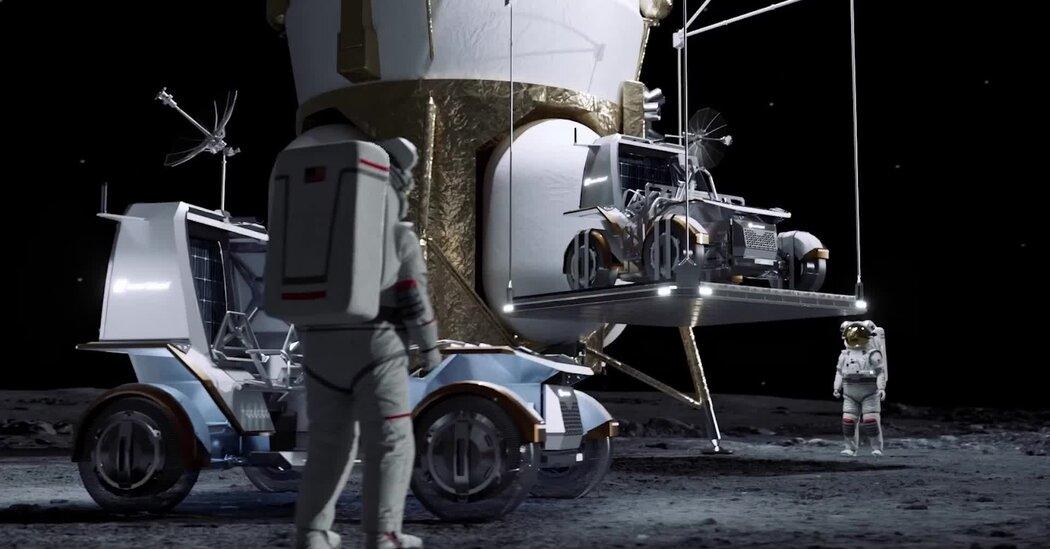
NASA on Tuesday awarded contracts to two companies to develop 21st-century versions of the moon buggies driven by astronauts during the Apollo missions of the early 1970s.
Lunar Outpost of Golden, Colorado, and Venturi Astrolab of Hawthorne, California, will each receive about $220 million to build the vehicles.
Carlos García-Galán, who leads NASA’s program to build a lunar base over the next decade, said the space agency wants to have a rover ready on the Moon when the next astronauts arrive. It could be as early as 2028, when the mission known as Artemis IV is expected to land.
“It’s absolutely a goal,” Mr. García-Galán said at a news conference Tuesday that provided an update on NASA’s plans to build an outpost on the Moon.
The two new rovers – what NASA calls lunar terrain vehicles, or LTVs – will be far more capable than their Apollo predecessors. Each will weigh about a ton, have the ability to go up and down 20-degree slopes, and can carry two astronauts. In the absence of astronauts, rovers will be able to move on their own, or drivers on Earth will be able to take the wheel remotely.
Both vehicles have more modest designs than NASA initially sought four years ago. At that time, NASA asked companies to submit proposals for what was essentially a car rental service on the surface of the Moon for 10 years. LTV requirements then included a robotic arm and a top speed of 9.3 miles per hour. But in 2024, when NASA announced the finalists, which included Lunar Outpost and Astrolab, the space agency said only one winner would be selected and that it did not expect the vehicle to be ready until 2030.
When Jared Isaacman became NASA administrator this year, he decided to reduce the requirements and speed up the schedule. The required top speed is lower, at 6.2 miles per hour; the robotic arm fell; and instead of a 10-year contract, NASA is now asking that it only last one year.
This will allow astronauts to take trips to the Moon sooner. “I have no doubt they will come back and give us feedback that will inform” the design of improved vehicles in the future, Mr. Isaacman said.
For Lunar Outpost and Astrolab, the accelerated schedule has led to a mad rush to come up with new designs to fit into NASA’s new specifications, released in late March. Proposals were due May 1.
“We were able to put together a really credible response because we had done a lot of work in the previous phase,” Jaret Matthews, chief executive of Astrolab, said in an interview.
The two companies must now compete again to build the rovers in 18 months. But Justin Cyrus, chief executive of Lunar Outpost, pointed out that the lunar vehicle used by the Apollo astronauts was developed in just 17 months.
“So we have a month more than Apollo,” Mr. Cyrus said. “It’s going to be tight, but it’s going to be a lot of fun.”
NASA also announced that Blue Origin, the rocket company created by Jeff Bezos, had been awarded a contract worth up to $468 million to bring rovers to the Moon.
On Tuesday, NASA also awarded $75 million to Firefly Aerospace of Cedar Park, Texas, to transport four robotic drones, under development at NASA’s Jet Propulsion Laboratory in Southern California, to provide lunar surface reconnaissance in the South Pole region, where Artemis astronauts will land.
These drones will be able to move quickly from one place to another.
“This will help us create a digital terrain map of different landing sites on the Moon and survey lunar base sites,” García-Galán said. “So all of those things are going to be key to continuing to understand where we’re going.”


